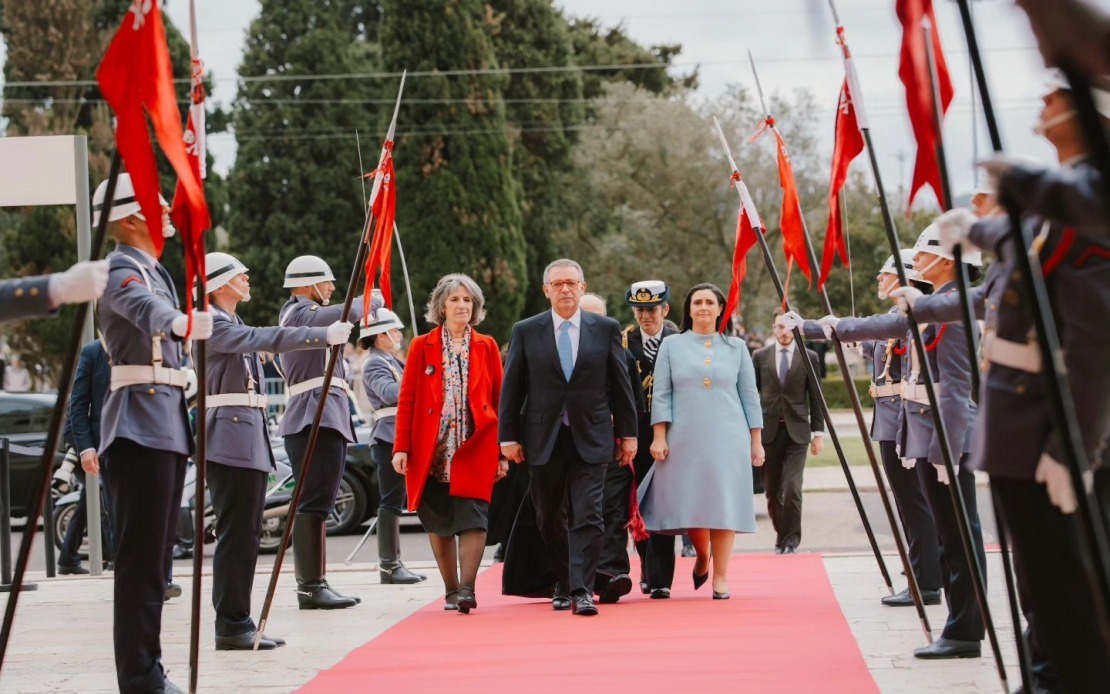
Portugal has joined a growing list of European democracies restricting face coverings in public spaces following President Antonio Jose Seguro's signature on the measure this week. The legislation, which originated from proposals by the right-wing Chega party, now stands as law after the presidential approval on Tuesday. Seguro's decision came after parliamentary amendments to the original proposal persuaded him that the measure warranted his endorsement, according to a statement released by Belem Palace, the seat of the Portuguese presidency in Lisbon.
The Portuguese leader framed his support for the ban around several interconnected principles that he argued form the foundation of Portuguese society. Seguro emphasised that an uncovered face represents a fundamental aspect of social cohesion and trust between citizens, positioning the restriction as essential to maintaining the mutual recognition and direct interpersonal connections that characterise daily Portuguese life. His rationale extended beyond simple security concerns to encompass broader questions about social integration and the values underpinning European democratic systems.
A particularly significant dimension of Seguro's justification centred on gender equality and human dignity. The presidential statement explicitly addressed what it characterised as an inherent asymmetry in requiring only women to conceal their faces entirely. Portuguese officials argued this practice contradicts the principles of equal dignity and parity between men and women that ostensibly define contemporary European democracies. This framing attempted to position the ban as a progressive measure protecting women's equality rather than as a restriction on religious or cultural expression.
Seguro also referenced jurisprudence from the European Court of Human Rights in defending his position, suggesting that international legal precedent supported restrictions on face coverings. The presidential statement further invoked the concept of a shared "common experience" within a free society, arguing that citizens should navigate public life according to established communal standards while retaining freedom to express individual identity and beliefs in other contexts. This attempted to reconcile the restriction with broader principles of personal liberty and pluralism.
However, Amnesty International Portugal has mounted a vigorous challenge to the new law, characterising it as fundamentally discriminatory and claiming it undermines the rights of Muslim women who voluntarily choose facial coverings as an expression of their religious faith and personal conviction. The human rights organisation's criticism highlights the tension between state-imposed uniformity in public appearance and individual autonomy regarding religious and cultural practice, a debate that remains unresolved across Europe.
Portugal's action aligns it with an established pattern in European governance. France, Belgium, Austria, Denmark, and the Netherlands have all implemented full or partial restrictions on face coverings in public settings. This convergence reflects broader political currents across the continent regarding immigration, integration, and the boundaries of religious expression within secular European states. Each country has reached these conclusions through distinct political and legal processes, yet the cumulative effect represents a significant continent-wide trend.
For Southeast Asian observers, particularly those in Malaysia with its significant Muslim majority and constitutional protections for religious practice, Portugal's approach presents a stark contrast to local constitutional frameworks. Malaysia's Federal Constitution explicitly guarantees freedom of religion to all citizens, and the practice of veiling and face coverings remains deeply embedded within Islamic tradition and personal choice. The Portuguese law underscores how differently European and Asian democracies have approached questions of religious expression and state authority over public appearance.
The political economy of the ban also warrants examination. Portugal's right-wing Chega party originated the proposal, reflecting how immigration and integration concerns have mobilised conservative political movements across Europe. That the proposal gained sufficient parliamentary support to reach the presidential desk demonstrates how these issues have transcended fringe politics to become mainstream legislative concerns in Portugal, even if Seguro's amendments suggest some negotiation and moderating influence occurred during the legislative process.
The philosophical foundations underlying Portugal's decision reveal assumptions about the nature of democratic citizenship and public space that differ markedly from multicultural frameworks prevalent in Southeast Asia. By linking facial visibility to social trust and the possibility of direct human recognition, Portuguese policymakers have established a conception of public civic participation that privileges visual identification and facial expression as prerequisites for genuine social integration. This represents a particular cultural and philosophical standpoint rather than a universal principle.
The coming months will reveal how Portuguese courts and civil society navigate the implementation of this restriction. Enforcement mechanisms, the definition of prohibited coverings, and potential exemptions for medical, occupational, or festive contexts remain to be clarified. How Muslim women and other affected communities respond—whether through legal challenges, civil disobedience, or adaptation—will shape the law's practical consequences and its standing within Portuguese society.
For Malaysia and other Southeast Asian nations, the Portuguese case demonstrates how differently democracies can balance competing principles of security, integration, equality, and religious freedom. While European nations increasingly move toward restrictions grounded in secular integration frameworks, Malaysia's constitutional architecture and plural society continue to afford protected space for religious expression and personal conviction regarding appearance, reflecting distinct historical trajectories and social compacts that have evolved in the Asian context.

