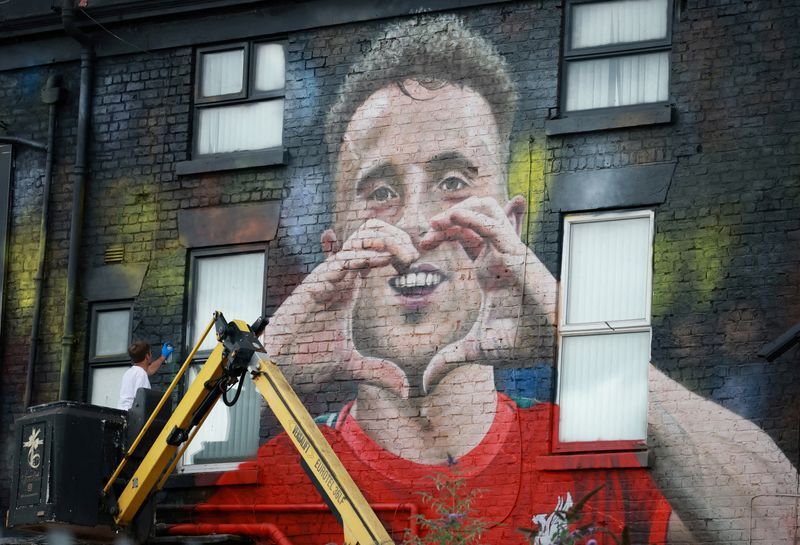
Portugal's World Cup journey has become inseparable from remembrance this summer as the national team prepares to take on Croatia in a knockout fixture on Thursday—a date that marks precisely one year since the tragic death of Diogo Jota, one of their most accomplished and beloved players. The Liverpool forward and his brother André Silva perished in a car accident in northwestern Spain when their Lamborghini left the road and caught fire, an event that devastated both the Portuguese football community and supporters worldwide. Though the match will technically occur on July 2 in Canada, the clock's advance into July 3 Portugal time will transform the occasion into something far deeper than a routine tournament encounter.
The weight of this coincidence has not escaped anyone connected with the Portuguese squad. Manager Roberto Martinez, who has spoken of Jota as "our light," took the symbolic step of naming him as an honorary member of the World Cup delegation, a gesture that extends the player's presence beyond memory into the fabric of the team's campaign. The decision reflects both the esteem in which Jota was held and the psychological importance of acknowledging his influence as Portugal pursues continental glory. Such tributes represent a modern acknowledgment that some losses transcend the boundaries of professional sport, becoming part of a team's collective identity and shared purpose.
Various members of the squad have incorporated Jota into their personal campaign narratives. Midfielder Rúben Neves, identified as one of Jota's closest friends within the dressing room, has assumed the number 21 jersey as a direct tribute. Portugal's Prime Minister Luís Montenegro further elevated the commemorative aspect by presenting wristbands bearing Jota's name to the entire playing group. These tangible symbols serve a dual purpose: they keep Jota's memory visibly present during matches and training sessions, while simultaneously demonstrating to supporters that the team carries their shared grief into every moment of competition.
The emotional resonance of this anniversary extends beyond Portugal's borders. Scotland's captain Andy Robertson, Jota's teammate at Liverpool and a close personal friend, received a poignant letter from Jota's widow, Rute Cardoso, when the World Cup tournament began. In her message, Cardoso expressed gratitude for Robertson's refusal to let the memory fade, framing his participation in the finals as a continuation of their friendship. "When you step on to the pitch, Diogo will be with you in your thoughts, in your steps, in your heart," she wrote, transforming individual grief into a broader narrative of solidarity across national boundaries. Such correspondence highlights how modern football transcends competitive rivalries, creating genuine human connections that persist beyond professional circumstances.
For the Portuguese contingent, the impending match carries layers of meaning that extend into the realm of national identity and aspiration. Defender Vitinha articulated this sentiment in midweek comments, describing the convergence of personal, familial, and national motivation as fuel for Thursday's encounter. The players understand that victory would constitute not merely a progression through the tournament structure but a meaningful tribute to a teammate whose absence has left a void in both the squad's composition and its emotional landscape. This psychological dimension—transforming grief into determination—represents one of sport's more profound capacities to channel loss into collective action.
Jota's playing record underscores what Portugal lost through his untimely passing. During his international career spanning 49 appearances, he accumulated 14 goals, establishing himself as a dependable source of attacking threat at a critical juncture in the nation's football development. Had circumstances permitted, he would almost certainly have featured prominently in North America this summer, having previously missed the 2018 World Cup due to injury. His absence represents not merely the loss of a talented footballer but the removal of an experienced voice from a generation tasked with maintaining Portugal's standing among European football's elite.
The broader significance of this moment resonates particularly within Portuguese-Canadian communities in cities such as Toronto, where Portugal's opening match took place and where Thursday's encounter will unfold. Miguel De Silva, owner of a Portuguese-Canadian establishment in the city's Little Portugal neighbourhood, captured the sentiment prevalent among diaspora supporters: the match has transcended its status as a sporting fixture to become an occasion for remembrance and collective expression. For many in the community, supporting their national team on such an emotionally charged date represents a way of honouring not only Jota's memory but also the bonds between homeland and diaspora that football consistently reinforces.
Roberto Martinez's management has consciously validated the emotional dimensions of this campaign, refusing to compartmentalise grief and competitive obligation. This approach recognises that players are not merely tactical instruments but human beings navigating complex emotional terrain while performing at elite levels. By integrating Jota's memory into the team's official identity rather than treating it as an external distraction, Martinez has created a framework within which remembrance enhances rather than diminishes competitive focus. Portugal's players have responded to this framework by channelling their grief into motivation, viewing each match as an opportunity to honour their fallen teammate.
The timing of the Croatia fixture adds a final layer of poignancy to proceedings. As play commences in Toronto, Portugal will watch the clock advance across time zones until the moment when midnight strikes back home, formally acknowledging that another year has passed since the accident that claimed Jota and his brother. This temporal synchronicity transforms a routine quarter-final contest into something approaching a national moment of reflection—a space in which football becomes a vehicle for processing collective loss while simultaneously validating the idea that meaningful achievement can emerge from grief channelled toward purpose.
For the Portuguese squad, Thursday represents an opportunity to transcend the conventional boundaries of sports achievement. Victory would carry significance extending far beyond the immediate tournament implications, functioning instead as a form of tribute to a teammate whose absence continues to reverberate through the national football consciousness. The convergence of competitive aspiration and commemorative purpose has created conditions in which the match itself becomes a meaningful act—one in which progress through the tournament structure constitutes simultaneous progress through the grieving process. In this sense, Portugal's World Cup journey has become as much about honouring the past as constructing the future.

