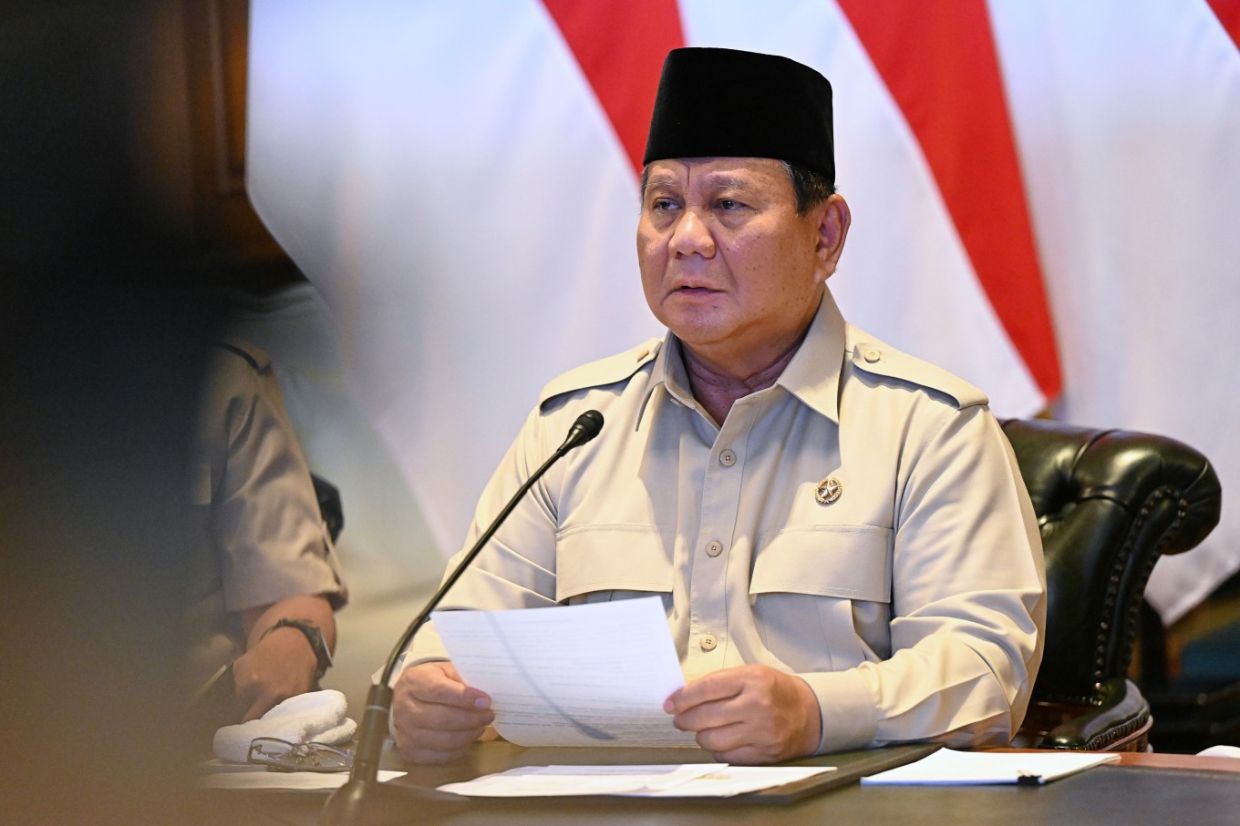
President Prabowo Subianto's political fortunes have undergone a seismic shift in recent months. What began as one of the most durable popularity plateaus enjoyed by any contemporary world leader has crumbled dramatically, with the latest data from Saiful Mujani Research and Consulting showing his approval rating has collapsed from a robust 81.2 percent in November 2025 to just 51.1 percent by July 2026. The nine-month decline, corroborated by independent polling firms, marks the definitive end of an unprecedented extended honeymoon that had outlasted the opening phases of most modern presidencies worldwide.
The Indonesian president's initial surge in popularity was not simply a residual glow from his October 2024 election victory. Rather, it was actively sustained and amplified by signature government initiatives, particularly the free nutritious meal programme that began in January 2025. This targeted social spending, combined with a sustained public relations presence and the natural goodwill that follows a decisive electoral mandate, allowed Prabowo to maintain support levels in the 70s and 80s throughout 2025—a threshold that even his predecessor Joko Widodo struggled to reach until deep into his second presidential term. When SMRC recorded Widodo's peak approval at 81.7 percent in May 2023, it represented the culmination of nearly a decade in high office, making Prabowo's comparable numbers in his first year genuinely extraordinary by international standards.
The contrast with Widodo's own opening phase illuminates just how unusual Prabowo's trajectory has been. Widodo's approval fell sharply from 62 percent at his 2014 inauguration to a mere 41 percent within months, largely due to the political backlash from a contentious fuel price hike. Prabowo managed to sidestep any comparable early shock, suggesting that his administration learned important lessons about the political costs of sudden economic shocks to household budgets. Even when measured against recent American presidents, Prabowo's initial ratings appeared almost charmed. Donald Trump's second term began in January 2025 with a historically low 47 percent approval, while both Barack Obama and Joe Biden experienced steep early declines from their respective opening numbers. Neither approached Prabowo's extended plateau, making the Indonesian president's sustained goodwill seem almost anomalous in the contemporary democratic landscape.
Yet the July 2026 data from SMRC, derived from a survey of 749 respondents conducted between July 5 and 19, reveals the reassertion of political gravity. Dissatisfaction surged from approximately 16 percent to 46.9 percent over the same nine-month period, a swing so dramatic that it signals a fundamental recalibration of public sentiment rather than normal fluctuation. Deni Irvani, SMRC's executive director, identified three specific domains where public perception has deteriorated substantially: economic management, political affairs, and law enforcement. Positive assessments of the economy fell to just 15.7 percent in July, while confidence in political institutions collapsed from 35.8 percent to 13.5 percent. Law enforcement perception managed a slightly higher 26.4 percent, but remains a source of public concern.
The underlying drivers of this dramatic reversal centre on the widening gap between campaign rhetoric and policy delivery. Prabowo had pledged both to curb endemic corruption and to accelerate GDP growth from its recent 5 percent trajectory to an ambitious 8 percent target. These commitments are now being tested against an unforgiving economic backdrop: a persistently weak rupiah, a sluggish stock market, public anxieties regarding government spending discipline, and mounting concerns about the autonomy of Bank Indonesia. For ordinary Indonesian households, these abstract economic indicators translate into concrete daily realities—rising food costs, stagnant wages, and erosion of purchasing power—that no amount of presidential rhetoric can obscure.
Critically, the collapse in Prabowo's ratings has not resulted from any single catastrophic policy error comparable to Widodo's early fuel price misstep. Instead, it represents a more gradual accumulation of disappointment as the easy wins of early presidency give way to the grinding difficulties of actual governance. The free nutritious meal programme, which had helped sustain goodwill through early 2025, has faced implementation challenges that have begun to alienate even sympathetic segments of the population. Red and White Cooperatives, another flagship initiative, has similarly struggled with execution, converting what should have been popular initiatives into sources of public frustration.
Prabowo has not remained passive during his popularity decline. He maintains a highly visible public profile, with frequent televised speeches, a communications apparatus designed to maintain constant visibility, and a willingness to directly challenge critics and journalists. This strategy of permanent campaigning proved effective when underlying economic conditions remained sufficiently positive that rhetorical polish could compensate for implementation shortfalls. The July data, however, suggests this approach has reached its inherent ceiling. Citizens ultimately judge their leaders not through screen appearances but through daily lived experience—whether they can afford food, what the exchange rate means for their purchasing power, whether job opportunities are expanding, and whether promised programmes actually reach them. No amount of presidential rebuttal can overcome these material realities.
The credibility question surrounding these polling findings deserves explicit examination. Saiful Mujani, the founder of SMRC, has become an outspoken government critic, a fact that administration supporters have not hesitated to highlight. It is a fair methodological concern worth raising, and Gerindra Party officials have already done so. However, criticism of a pollster's personal politics provides no evidence of flawed methodology, and SMRC maintains a longstanding track record of credible surveys conducted across multiple administrations, including years when its findings favoured the Jokowi government.
More persuasively, SMRC's findings cannot be dismissed as outliers. Indikator Politik Indonesia independently conducted a survey of 4,250 respondents between July 14 and 24, finding satisfaction at 49.5 percent—a figure that closely tracks SMRC's result and reveals a similar dramatic downward trajectory from 68 percent in April 2026 and 81 percent in December 2025. When two independently managed polling organisations converge on nearly identical numbers across multiple measurement points, the hypothesis of systematic bias becomes impossible to sustain. The convergence itself constitutes powerful corroboration that public sentiment has genuinely shifted.
The magnitude of Prabowo's decline warrants contextualisation within historical patterns. A 30-point approval drop across nine months certainly qualifies as severe, yet it is neither unprecedented nor automatically catastrophic for long-term presidential survival. Democratic history demonstrates that leaders have recovered from steeper falls through economic recovery, successful policy implementation, or political repositioning. What matters now is whether the government can actually deliver on the economy, corruption, and administrative competence fronts that have become primary sources of public concern.
Internal administration responses suggest recognition of the urgency. According to an official familiar with discussions at the Presidential Palace, Prabowo recently convened the National Economic Council to examine policy options for restoring economic momentum, an area where public satisfaction has fallen most dramatically. The government anticipates that climate-related disruptions potentially triggered by El Niño forecasts could further compress household purchasing power and drive food price inflation, necessitating defensive measures such as maintaining fuel prices unchanged to preserve consumer spending capacity. Prabowo and his economic advisers are also reportedly considering expanded social assistance programmes, suggesting a strategy of doubling down on the spending-based approach that sustained his earlier popularity.
Simultaneously, Prabowo's closest advisers have been consulting with the polling organisations and political strategists who orchestrated his successful 2024 presidential campaign. These discussions have reportedly yielded recommendations that the President improve his public communication strategies and conduct a comprehensive operational review of government programmes encountering implementation difficulties. The free nutritious meal initiative and the Red and White Cooperatives programme have both been specifically identified as requiring substantial remediation. One pollster involved in these consultations suggested that approval recovery remains achievable if the President's inner circle successfully executes these recommended improvements in administrative function and public messaging.
Ultimately, Prabowo's political trajectory from this point depends far less on television appearances and rhetorical sophistication than on whether tangible improvements materialise in the economic conditions, institutional performance, and service delivery that shape ordinary Indonesians' daily existence. The extended honeymoon has definitively ended, replaced by the harder demands of democratic accountability. Whether this moment becomes a turning point toward renewed popularity or a prelude to further erosion will be determined not in broadcast studios but in markets, factories, and households across the archipelago.

