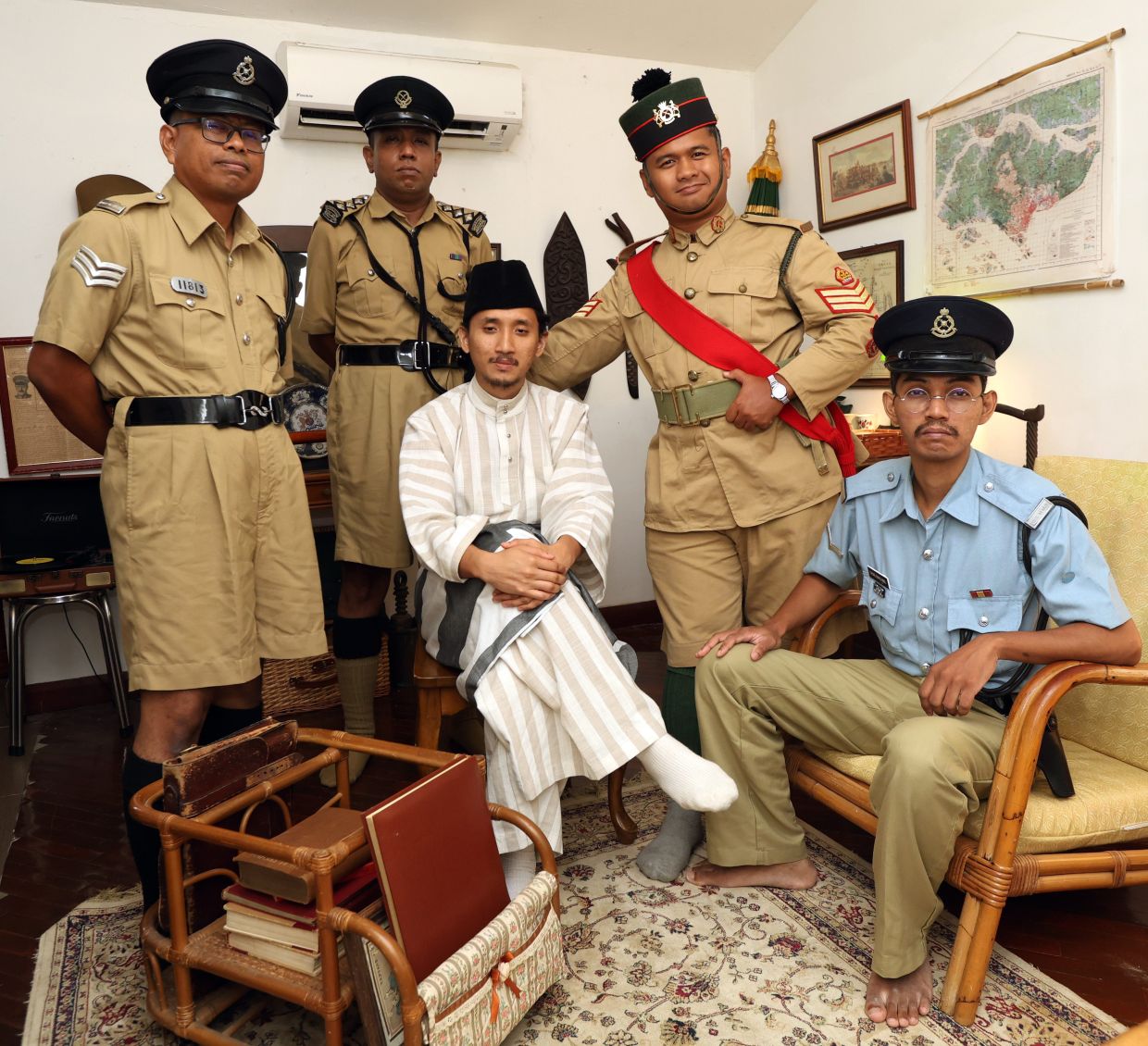
History books and classroom lectures often fail to capture the lived reality of the past, leaving many Malaysians—particularly younger generations—disconnected from their own national heritage. Persatuan Reka Ulang Sejarah (PRUS), a Malaysian historical re-enactment society, addresses this gap by bringing military history into tangible, experiential focus through carefully researched costume, demonstration and public engagement. Rather than remaining confined to academic texts, the group's members embody historical periods, enabling audiences to witness and understand how their forebears dressed, moved and conducted themselves during crucial moments in Malaysian history.
The roots of PRUS trace back to the early 2010s, when a dispersed community of vintage military uniform collectors began gathering at heritage events, including exhibitions organised by the Port Dickson Army Museum at the then-active Royal Malaysian Air Force Base in Sungai Besi, Kuala Lumpur. What began informally as "We Are Re-enactors" eventually crystallised into a more purposeful initiative, with members formally registering PRUS as a society in 2023. This transition from hobbyist collective to institutional body reflects a growing recognition among the founders that their knowledge could serve a broader educational mission. The shift granted them legitimacy to partner with schools, museums and cultural institutions, transforming their passion for historical accuracy into a structured programme of public instruction.
Chairman Abdul Hakim Abdul Rani identifies a specific catalyst for the group's formalisation: widespread confusion about historical military uniforms, particularly from eras when photography was monochromatic and different military branches appeared to wear identical or nearly identical colours. He observed that this ambiguity extended beyond collectors into broader public consciousness, creating an opportunity to establish reliable, authoritative knowledge. By pooling expertise and securing official recognition, PRUS members could present themselves as credible educators capable of dispelling myths and clarifying the material reality of Malaysia's defence heritage. This educational mandate distinguishes PRUS from mere costume enthusiasts; their work carries an implicit responsibility to historical fidelity and public understanding.
The group's approach demands meticulous attention to period-specific detail that extends far beyond donning the correct uniform. Each historical era possessed distinct protocols governing deportment, verbal communication, marching cadence and body language—subtle yet fundamental markers of military culture that living re-enactors must internalise to convey authenticity. Abdul Hakim, who serves as a professional tour guide, emphasises that this commitment to accuracy derives not from theatrical performance but from educational principle. The group does not treat history as entertainment but as a subject requiring scholarly preparation and respectful presentation. This philosophy shapes every aspect of their public work, from the positioning of hands to the formality of address, ensuring that audiences encounter not a caricature of history but a reasonably faithful reconstruction grounded in documentary evidence.
The depth of PRUS's engagement with historical methodology became evident during a two-day jamboree held in July, where members conducted intensive training in military drills, map navigation, route-finding and tactical manoeuvres drawn from original pre-Independence manuals. Abdul Hakim, leveraging his prior service with Askar Wataniah (the Territorial Army), directed these sessions to illuminate how soldiers of that period actually functioned operationally. Significantly, the group substituted wooden sticks for authentic weapons to comply with contemporary regulations, demonstrating that their commitment to historical verisimilitude does not override legal and safety considerations. This jamboree format illustrates PRUS's philosophy: re-enactment serves understanding, not nostalgia, and the group calibrates its activities to respect both historical authenticity and modern legal frameworks.
Beyond grassroots public engagement, PRUS has extended its expertise into commercial filmmaking, advising productions on period uniforms and appearing as costumed extras. Vice chairman Mohd Fadzreeq Mokti underscores that this collaboration represents more than supplementary casting; PRUS members function as historical consultants ensuring visual fidelity to specific periods. When dressed in uniform, they embody living archives—their appearances, movements and bearing all conveying information about how military personnel actually looked and conducted themselves during designated historical moments. This film industry involvement amplifies PRUS's reach beyond educational institutions into popular media, where millions may absorb impressions of Malaysian military history, making the group's insistence on accuracy particularly consequential.
The group maintains heightened activity during August and September, when Malaysia Day and National Month celebrations intensify public engagement with historical themes. At these moments, PRUS members mobilise their collections for exhibitions and public demonstrations, capitalising on heightened popular interest to introduce younger Malaysians to tangible artefacts and living presentation of national history. Abdul Hakim has observed that many students remain unfamiliar with pivotal historical figures and events—a gap he views with genuine concern. He regards schools as foundational venues for implanting historical consciousness early in young people's lives, before secondary narratives and competing media claims capture their attention.
Mohd Fadzreeq, who teaches in a secondary school, has witnessed the pedagogical impact of PRUS activities firsthand. When he appears at his own institution wearing period uniform—an arrangement approved by his headmaster—students respond with palpable enthusiasm, repeatedly inquiring when he will don the costume again. He attributes this engagement to the interactive, tangible nature of historical re-enactment; textbooks and passive classroom instruction cannot rival the immediacy of encountering history embodied before one's eyes. Young learners, he observes, learn most effectively through sensory engagement and hands-on experience, yet many lack opportunity to visit museums or access physical artefacts. PRUS effectively democratises access to historical experience by bringing authentically costumed educators directly into schools and public spaces.
The concept of PRUS members functioning as "walking museums" encapsulates their broader social role. When members appear in public wearing historically accurate uniforms, they inevitably attract enquiries from curious onlookers—the elderly recalling lived experience, parents seeking to educate children, and young people encountering this dimension of their heritage for the first time. Rather than perform passively, PRUS members engage these spontaneous conversations, drawing upon extensive reading of historical documents, military manuals and archival sources to respond knowledgeably. This informal pedagogical function occurs across multiple settings: museum exhibitions, National Month commemorations, school visits and incidental public encounters. Each interaction represents an opportunity to correct misconceptions, deepen appreciation for military contributions to independence and nation-building, and model the kind of rigorous historical engagement that extends beyond curricular requirements.
The significance of PRUS's work extends beyond preserving specific military uniforms or recreating historical drills. In an era when educational resources remain unevenly distributed across Malaysia's regions and socioeconomic strata, and when global popular culture threatens to eclipse local historical consciousness, grassroots initiatives like PRUS serve vital cultural functions. By making history tangible, participatory and emotionally engaging, the group counteracts the alienation that many young Malaysians experience toward academic history. They demonstrate that understanding one's national past need not remain confined to classroom formality but can become an active, embodied practice undertaken by engaged community members. PRUS members effectively argue, through their consistent commitment to accuracy and public education, that historical knowledge matters—that it deserves serious study, careful transmission and ongoing civic attention.
Looking forward, PRUS's model suggests possibilities for expanding historical consciousness across Southeast Asia. As nations throughout the region grapple with competing historical narratives and generational disconnection from shared heritage, re-enactment societies grounded in scholarly rigour and educational mission could proliferate. Malaysia's experience with PRUS indicates that grassroots historical engagement, when pursued systematically and with genuine commitment to accuracy, can bridge gaps between institutional heritage preservation and popular understanding. The group's trajectory from informal collector networks to registered educational society reflects broader recognition that citizens themselves possess considerable capacity to sustain and transmit historical awareness, provided they receive adequate institutional support and public platforms.

