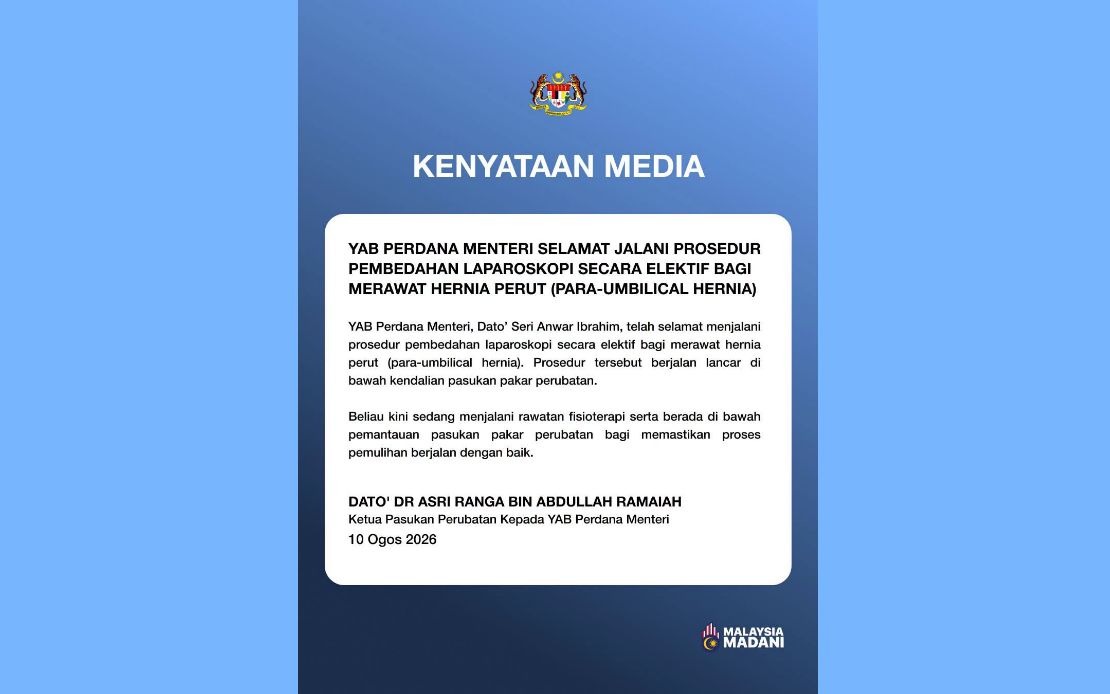
Prime Minister Datuk Seri Anwar Ibrahim has completed a scheduled laparoscopic surgical intervention to address a para-umbilical hernia, marking a significant moment in the nation's political calendar as the country's top leader receives necessary medical treatment. The minimally invasive procedure, conducted on August 10, proceeded without complications, according to statements from his medical team and office.
The head of the Prime Minister's Medical Team, Datuk Dr Asri Ranga Abdullah Ramaiah, confirmed that the operation executed smoothly with support from a multidisciplinary team of medical specialists. The laparoscopic technique—a modern surgical approach that requires only small incisions and reduces recovery time compared to traditional open surgery—was selected as the appropriate intervention for treating the para-umbilical hernia, a condition involving a protrusion through the abdominal wall near the navel.
Following the surgical procedure, Anwar commenced a structured physiotherapy regimen as part of his postoperative rehabilitation pathway. Medical specialists continue to maintain vigilant oversight of his recovery trajectory, with particular attention to monitoring his progress during the critical early phase following the operation. This close supervision aims to identify and address any potential complications promptly whilst ensuring his physical rehabilitation advances optimally.
Tunku Nashrul Abaidah, the Prime Minister's senior press secretary, indicated that Anwar underwent comprehensive diagnostic examinations and specialised procedures as prescribed by his attending medical specialists during the hospitalisation period. The initial recovery phase was expected to span approximately two days of inpatient observation, during which medical personnel would monitor vital signs and postoperative response to the intervention.
For Malaysia's political apparatus and wider population, questions surrounding the Prime Minister's health necessarily intersect with matters of governance and institutional stability. Any extended absence or complication affecting senior leadership carries implications for policy implementation, parliamentary proceedings, and the functioning of executive departments. However, the early projections from the medical establishment suggest a straightforward recovery trajectory without anticipated complications that might necessitate prolonged incapacity.
The decision to proceed with elective surgery at this juncture reflects confidence in both the medical team's capability and the anticipated speed of recovery. Laparoscopic hernia repair, now the standard approach in contemporary surgical practice, typically permits patients to return to desk-based duties within two to three weeks, with full physical recovery occurring over several months. The Prime Minister's office appeared to operate on the assumption that his core governmental functions would resume within this reasonable timeframe.
The public communication surrounding the surgery exemplified a measured approach to transparency. Rather than concealing the medical intervention, authorities disclosed the procedure and its nature directly, whilst simultaneously requesting public prayer and good wishes for the Prime Minister's recovery. This balanced disclosure strategy acknowledges both the legitimate public interest in leadership continuity and the privacy considerations ordinarily attending personal medical matters.
From a Southeast Asian perspective, the event underscores how contemporary democratic systems manage the intersection of personal health privacy and public accountability. Unlike some regional precedents where leaders' serious illnesses have generated speculation and constitutional uncertainty, Malaysia's institutional arrangements appear sufficiently robust to accommodate planned medical treatment without triggering governance crises. The clear designation of responsibility to medical specialists and the straightforward communication reflect institutional maturity.
Anwar's recovery will likely proceed without major impediment given the minimally invasive nature of laparoscopic intervention and the routine character of hernia repair procedures in modern surgery. Medical specialists worldwide perform tens of thousands of such operations annually with consistently high success rates and rapid rehabilitation outcomes. The Prime Minister's access to premier medical facilities and expertise further supports positive prognostic expectations.
The broader implications for Malaysia's political trajectory remain constrained during what appears to be a brief and recoverable medical interlude. Anwar's coalition government continues functioning through its existing institutional structures during his recuperation period. Ministers and senior officials maintain their portfolios and responsibilities, preserving governmental continuity whilst the Prime Minister focuses on rehabilitation.
Looking forward, the successful completion of this elective surgical procedure should permit Anwar to resume his full schedule of domestic policy engagement and international diplomatic commitments within a matter of weeks. The proactive management of the hernia—addressing it through planned rather than emergency intervention—reflects prudent preventative healthcare practice and positions him for sustained active service in his leadership role during the remainder of his tenure.

