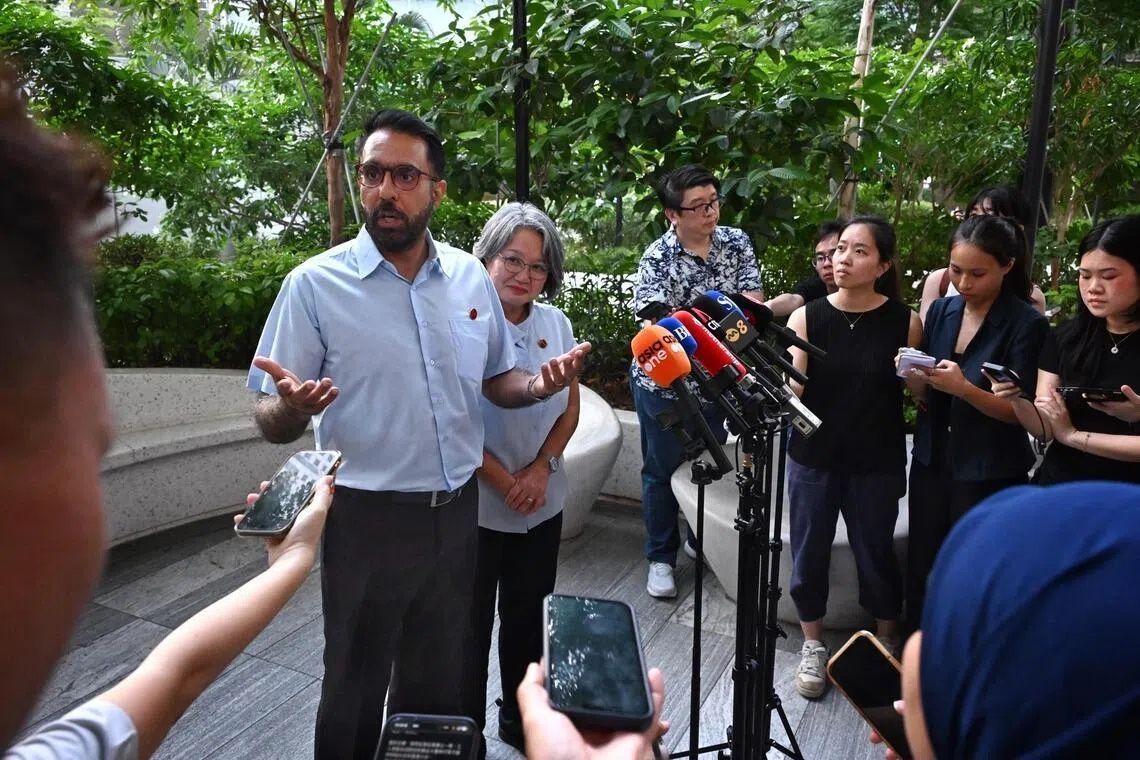
Pritam Singh's grip on the leadership of Singapore's largest opposition party has been firmly cemented following his unopposed re-election at internal polls held on June 28, after a faction of dissatisfied party members failed to force him out at a preceding gathering that same day. The outcome represents a significant turning point for Singh after several turbulent years marked by persistent controversy surrounding former Sengkang GRC MP Raeesah Khan's 2021 parliamentary misstatements and the subsequent legal repercussions that have shadowed his tenure as party chief.
The two sequential meetings—first a special cadres conference at noon followed by the party's biennial elections at 3pm—placed Singh's future directly in the hands of the Workers' Party's inner circle of roughly 100 members. A secret ballot on whether he should resign revealed overwhelming backing, with Singh commanding approximately 80 per cent of the vote according to party sources, far exceeding the supermajority threshold required for his continuation in office. Party chair Sylvia Lim was also returned unopposed to her position, which she has maintained continuously since 2003, underscoring broader stability within the organization's leadership structure.
The path to this victory had been far from certain. A December 2025 letter bearing the signatures of 25 disgruntled cadres had triggered the special conference, with dissenters frustrated over multiple dimensions of Singh's stewardship. His recent criminal conviction for misleading a parliamentary committee regarding his management of Khan's false statements, combined with unresolved questions about his overall judgment and leadership during that episode, galvanized the opposition faction. These cadres had actively sought a credible challenger to Singh, hoping to capitalize on uncertainty around whether former party chief Low Thia Khiang would continue backing his successor.
Low Thia Khiang himself quelled these rumours decisively on the morning of June 28, publicly reaffirming his support for Singh at the very moment the meetings commenced. This intervention proved crucial in neutralizing momentum behind the insurgent movement and signaled to the broader cadre base that continuity and unity remained the preferred path. The timing and substance of Low's statement effectively preempted any last-minute organizational shifts that dissenters might have attempted, demonstrating the residual influence of the party's former leader within Workers' Party circles.
The special conference itself proceeded with procedural propriety and substantive engagement, according to Gerald Giam, the Aljunied GRC MP who chaired the proceedings. Rather than devolving into acrimony, the meeting featured what Giam characterized as a "robust and civil discussion" encompassing a single round of voting. Cadres had structured opportunity to voice grievances and articulate their reservations, while Singh responded with a formal statement and engaged directly with the questions posed. Giam emphasized that the process embodied genuine accountability, permitting the party's membership to render judgment on Singh's conduct and fitness for continued leadership rather than accepting his position as predetermined.
Speaking after his re-election, Singh struck a reconciliatory tone while emphasizing the imperative for organizational cohesion. He framed the party's foundational commitment to rational and responsible governance, suggesting that maintaining party unity served as an essential precondition for effective opposition representation. Rather than dismissing the concerns raised by the 25 signatories, Singh acknowledged that their grievances had been addressed through the disciplinary and accountability mechanisms already completed, including a formal letter of reprimand delivered by the party's central executive committee in response to findings from an internal disciplinary panel comprising senior MPs Jamus Lim and He Ting Ru alongside former Hougang MP Png Eng Huat.
That disciplinary panel had concluded that Singh's actions regarding Khan's parliamentary falsehoods contravened two articles of the Workers' Party Constitution, marking the first formal organizational sanction against him for his role in the episode. Singh's conviction by the High Court in December 2025 for misleading a parliamentary committee—affirming his conviction at first instance—represented the culmination of a protracted legal process that overshadowed his leadership. Additionally, Parliament had declared him unsuitable for the position of Leader of the Opposition in January 2026, and Prime Minister Lawrence Wong subsequently removed him from that role, though the Workers' Party declined to nominate a replacement, maintaining that the post should be held by the chief of the largest opposition faction.
The composition of the newly elected central executive committee reflected both continuity and selective renewal. Twelve members were elected to this top decision-making body, with most retaining their prior positions. Four individuals outside the parliamentary caucus joined or remained on the committee: former chief Low Thia Khiang, previous Aljunied GRC MP Faisal Manap, long-serving committee member Tan Kong Soon, and notably Harpreet Singh, a senior counsel who ran as part of the party's Punggol GRC team during the May 2025 general election. Singh's inclusion represented the sole entirely new addition to the committee, suggesting the party leadership's attempt to inject fresh perspectives while maintaining established institutional continuity.
Harpreet Singh's election carried particular symbolic weight given his subsequent public comments emphasizing that the cadre's decision reflected careful deliberation rather than uncritical loyalty. In a LinkedIn post following the elections, he articulated a sophisticated defense of the membership's re-endorsement of Pritam Singh, arguing that voters had assessed his track record comprehensively. Singh highlighted Pritam's "tireless service," his capacity to remain "calm under sustained political pressure," and his "steady, measured leadership" in advancing the party toward "significant milestones in Singapore's parliamentary history." Crucially, Harpreet Singh framed the vote not as a dismissal of the court's judgment—which he acknowledged "stands and must be respected"—but rather as a judgment that character assessment must encompass the totality of a person's history and conduct.
The resolution of this internal crisis carries implications extending beyond organizational dynamics within the Workers' Party itself. For Singapore's broader political landscape, Singh's decisive re-election provides operational stability to the nation's primary opposition force at a moment when parliamentary dynamics have shifted following the May 2025 general election. The contrast between organizational turbulence and ultimate consolidation may signal to external observers that the party possesses sufficient institutional maturity to address internal discord through democratic mechanisms without fragmenting into competing factions. The procedural emphasis placed on accountability discussions and transparent voting processes also subtly reinforced the Workers' Party's self-presentation as an organization committed to responsible democratic governance, distinguishing its internal culture from potential criticism regarding the handling of Khan's deceptions.
Looking toward neighboring Malaysia and the broader Southeast Asian context, the episode underscores recurring challenges facing opposition parties navigating between organizational discipline and internal democracy. The Workers' Party's management of dissent—permitting the 25 cadres to formally petition for leadership reconsideration while ultimately supporting Singh's continuation—demonstrates one model for balancing these tensions. For opposition-minded observers across the region contending with their own leadership crises and internal cohesion questions, the Singapore case illustrates both the vulnerabilities and resilience inherent in maintaining opposition parties through institutional rather than purely personality-driven frameworks.
The party's capacity to co-opt an additional seven members to its central executive committee over the coming month will provide opportunity for further organizational refinement. The June elections themselves concluded a chapter marked by existential questions about Singh's suitability for leadership; the subsequent months will determine whether the decisive re-election translates into renewed momentum for a Workers' Party seeking to rebuild credibility and advance its agenda following the turbulence of recent years. For Malaysian observers monitoring Singapore's opposition dynamics, this organizational restoration demonstrates both the fragility and recuperative capacity of systems dependent on institutional rather than personality-centered leadership structures.

