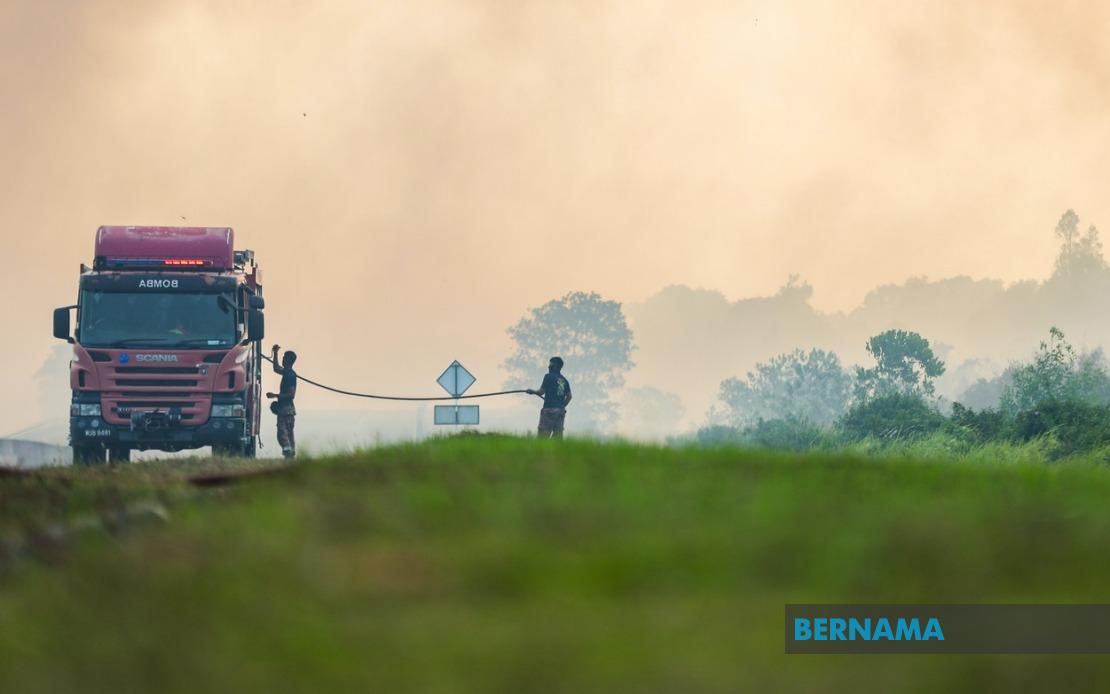
A major peatland fire near Kota Tinggi in Johor has seen significant progress, with firefighting teams extinguishing more than 29 hectares of the affected area by Monday afternoon. The blaze, which erupted along Jalan Bypass Punggai-Sebana Cove in Pengerang, has consumed approximately 51.4 hectares of sensitive peatland, prompting a coordinated emergency response across multiple government and private sector agencies.
The Sungai Rengit Fire and Rescue Station coordinated the operation, with Fire Superintendent II Baharuddin Idris overseeing efforts across two distinct operational sectors. According to his statement, the firefighting campaign began when the fire first broke out on Monday, with teams immediately deploying to contain the blaze before it could spread further into the surrounding wetland ecosystem. The intensity and nature of peatland fires—which burn beneath the soil surface and can reignite unpredictably—necessitated round-the-clock operations to ensure complete suppression.
The scale of the response reflects the serious nature of such incidents in Malaysia's sensitive ecosystems. Peatland fires pose particular environmental challenges because the organic matter beneath the surface can smoulder for extended periods, making traditional firefighting techniques less effective. The operation required 36 dedicated firefighters to work in tandem with nine personnel from the Malaysian Civil Defence Force, fourteen from Ranhill SAJ, two environmental specialists from the Department of Environment, and three officials from the Pengerang Municipal Council. This inter-agency coordination demonstrates the structured approach authorities adopt when managing disasters affecting critical environmental zones.
By Monday afternoon, the operational picture showed mixed results across the two sectors. Sector B had been brought under substantial control, with most of the affected area successfully extinguished. However, Sector A remained more challenging, with approximately 21 hectares still requiring active firefighting and firebreak construction to prevent reignition. These firebreaks—cleared strips of land designed to halt fire spread—are essential when dealing with peatland incidents, as they create physical barriers that limit lateral advancement of underground flames.
Recognizing the limitations of ground-based operations alone, authorities escalated the response by deploying aerial support. An aircraft approved by the Air Operations Control Centre took to the sky at 2:30 pm on Monday, significantly expanding the firefighting arsenal. Aerial operations can deliver large quantities of water or fire retardant over vast areas simultaneously, a capability particularly valuable when ground teams are struggling with terrain or visibility constraints. This decision to introduce aviation assets underscores how serious the situation had become and the determination to bring the fire under complete control.
The deployment of such resources carries significant financial and logistical implications. Aviation support for firefighting operations represents a substantial commitment of public resources, typically reserved for incidents threatening major population centers or critical infrastructure. The approval process through the Air Operations Control Centre involves senior decision-makers evaluating whether the severity of the fire justifies the considerable expense and operational complexity involved in coordinating aerial firefighting.
For Malaysian readers and observers across Southeast Asia, peatland fires carry particular significance beyond immediate property or economic concerns. Peatlands represent crucial carbon sinks and biodiversity repositories, supporting unique ecological communities found nowhere else on Earth. When peatlands burn, they release enormous quantities of stored carbon dioxide and methane into the atmosphere, contributing substantially to greenhouse gas emissions. A single peatland fire can produce air quality impacts across international borders, as evidenced by historical incidents that have blanketed neighbouring countries in transboundary haze.
The Jalan Bypass Punggai-Sebana Cove fire occurs within a region already designated for intensive development, including industrial zones. The proximity of the fire to Pengerang's commercial infrastructure raises questions about land management practices and fire prevention protocols in areas bordering environmentally sensitive zones. The involvement of the Pengerang Municipal Council in response efforts suggests this incident occurred within or immediately adjacent to developed areas, complicating both firefighting tactics and recovery planning.
The 24-hour operational tempo mentioned in official statements reflects established protocols for managing fires in sensitive ecosystems. Continuous operations prevent the fire from regaining momentum during shift changes and ensure that hotspots are immediately detected and suppressed before they can develop into major flare-ups. This relentless approach, while resource-intensive, has proven effective in preventing rapid escalation of peatland incidents.
As of Monday afternoon, authorities had managed to contain more than 57 percent of the affected area, a significant achievement considering the inherent difficulties of peatland firefighting. The continuation of monitoring and suppression activities promised by officials suggests expectations that complete extinguishment would require several additional days of effort. The commitment to sustained operations reflects understanding that declaring victory prematurely on peatland fires frequently results in reignition and renewed spread.
The incident underscores broader challenges facing Malaysian environmental management. As development expands into previously undisturbed areas, the interface between human activity and sensitive ecosystems becomes increasingly complex. Fire prevention measures, including proper drainage management in peatland areas and maintenance of adequate firebreaks around developed zones, become critical components of disaster risk reduction strategy.

