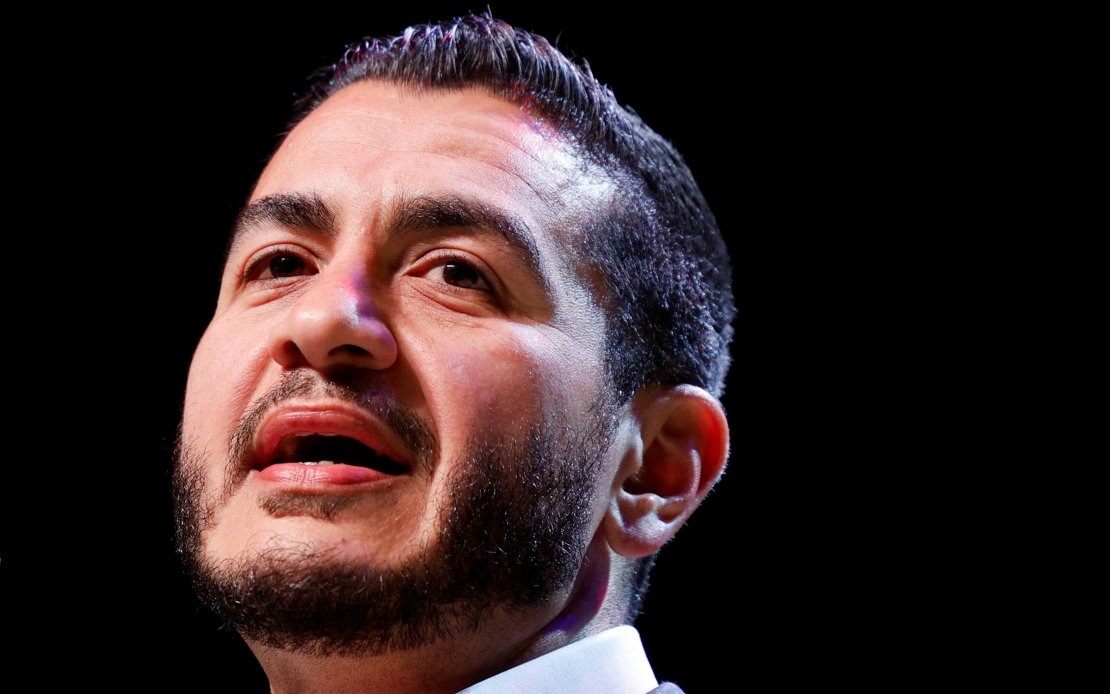
Abdul El-Sayed maintained a slender lead in Michigan's Democratic Senate primary as voting concluded Wednesday, according to results from Anadolu Ajansi, with 91 per cent of ballots counted. The race between El-Sayed and US Representative Haley Stevens remained uncalled by the Associated Press at the time of reporting, though El-Sayed's advantage appeared decisive. The outcome carries significant implications for Michigan's November Senate contest, where the Democratic nominee will confront Republican Mike Rogers in a race to succeed retiring Democratic Senator Gary Peters. Rogers advanced unopposed through his party's primary, allowing him to focus resources on the general election campaign.
The Michigan Democratic Senate primary revealed a sharp ideological split within the party's establishment. Stevens drew endorsements from prominent centrist Democrats, notably Gary Peters himself and other establishment figures aligned with the party's moderate wing. In stark contrast, El-Sayed galvanised progressive voters through backing from Senator Bernie Sanders and Representatives Alexandria Ocasio-Cortez and Rashida Tlaib, positioning himself as the candidate of the party's left flank. This internal divide reflected broader Democratic tensions over national and international policy, with the contest becoming a referendum on party direction heading into the general election season.
The Israeli-Palestinian conflict emerged as an unexpectedly defining issue in Michigan's Democratic primary, reshaping campaign messaging and voter mobilisation across the state. United States support for Israel and its military operations in Gaza became central to voters' decision-making, elevating foreign policy to prominence in a domestic race typically focused on bread-and-butter economic concerns. This shift underscores how international conflicts can penetrate local American politics, particularly in states with significant Arab-American and Muslim populations like Michigan. The prominence of Gaza throughout the primary campaign signals that Democratic candidates will struggle to avoid taking positions on Middle Eastern affairs during the general election phase.
Beyond the marquee Senate contest, Michigan's congressional races produced straightforward Republican victories. Jack Bergman secured the Republican nomination in the 1st Congressional District with commanding support, capturing 74.3 per cent of primary votes against two challengers with 94 per cent of precincts reporting. In the 4th District, Bill Huizenga decisively defeated Philip Tanis to earn renomination, collecting 85 per cent of votes with 83 per cent of ballots counted. Huizenga will advance to face Democrat Sean McCann, who emerged from a contested Democratic primary after defeating Diop Harris II decisively with 67.2 per cent of the vote. These races illustrated the partisan stability of Michigan's congressional delegation despite national electoral uncertainty.
Kansas Republican Senator Roger Marshall easily survived his primary challenge, prevailing over Pond Naramore with 79.9 per cent of the vote as nearly all precincts reported. Marshall faces Adam Hamilton in November, who secured the Democratic nomination after prevailing in a multi-candidate field. The gubernatorial contest in Kansas highlighted the endorsement power of national figures, with Republican candidate Ty Masterson winning a crowded Republican primary through backing from former President Donald Trump. Democrat Cindy Holscher defeated two opponents for the Democratic nomination and will challenge Masterson to succeed Governor Laura Kelly, who cannot seek reelection due to term limits. These races demonstrate how Trump's endorsement continues to reshape Republican primary outcomes across different states.
Missouri's primary elections marked the first congressional races held under a newly redrawn electoral map adopted by the state's Republican-controlled legislature with Trump's explicit support. The redistricting effort aimed to strengthen Republican electoral prospects and consolidate House control. In the 1st Congressional District, Democratic Representative Wesley Bell defeated four opponents, including prominent former Representative Cori Bush, to secure renomination. Bell will advance to face Republican Paul Berry III in a contest that will test whether Democratic incumbents can survive in a map engineered to benefit Republicans. The renomination battle between Bell and Bush illustrated tensions within the Democratic coalition and highlighted competing visions for the party's future direction.
Virginia's statewide Senate primary produced a clear Republican nominee as Bert Mizusawa won the Republican nomination to challenge incumbent Democratic Senator Mark Warner, who advanced unopposed through the Democratic primary. In Virginia's competitive 1st Congressional District, Democrat Shannon Taylor emerged from the primary field with 53.1 per cent of the vote and will confront Republican Representative Rob Wittman, who ran unopposed while pursuing his 10th consecutive full term. In the 2nd District, former Representative Elaine Luria secured the Democratic nomination with 80.4 per cent support, setting up a rematch against Republican Representative Jen Kiggans. These contests position Virginia as a critical battleground where control of Congress may hinge, given the state's historical status as a political bellwether.
Virginia's 7th District primary produced an especially significant Republican nominee in Doug Ollivant, who captured 56.6 per cent of votes in a contested field. Ollivant will challenge first-term Democratic Representative Eugene Vindman, a military officer who gained national prominence following impeachment proceedings against Trump. The Vindman contest encapsulates broader ideological and generational conflicts reshaping American politics, pitting an establishment-aligned Republican against a Democrat whose military background and national security credentials complicate traditional party alignments. This race will likely attract disproportionate national attention and funding given its symbolic importance to broader partisan battles.
Washington's nonpartisan primary system produced different dynamics than traditional Democratic-Republican matchups in other states. In the 1st Congressional District, Democratic Representative Suzan DelBene and Republican Mary Silva advanced to November's general election, bypassing the typical two-candidate general election format. Democratic Representative Marie Gluesenkamp Perez will face Republican John Braun, who secured Trump endorsement prior to the primary. In the 6th District, Democrat Emily Randall advanced to challenge Republican Teresa Fox. Washington's primary results highlighted how regional and institutional variations in electoral mechanics create divergent outcomes even within the same election cycle.
The five-state primary election day revealed persistent patterns in American electoral politics during the 2024 cycle, including the enduring influence of Trump's personal endorsements on Republican races, the salience of foreign policy questions within Democratic contests, and the continuation of geographic polarisation that has defined recent election cycles. These primaries narrowed the field for November's midterm elections while simultaneously illuminating the deep fissures within both major parties over fundamental questions of foreign policy, economic management, and party direction. The races across Michigan, Kansas, Missouri, Virginia, and Washington collectively preview the ideological battlegrounds that will define the general election campaign season.

