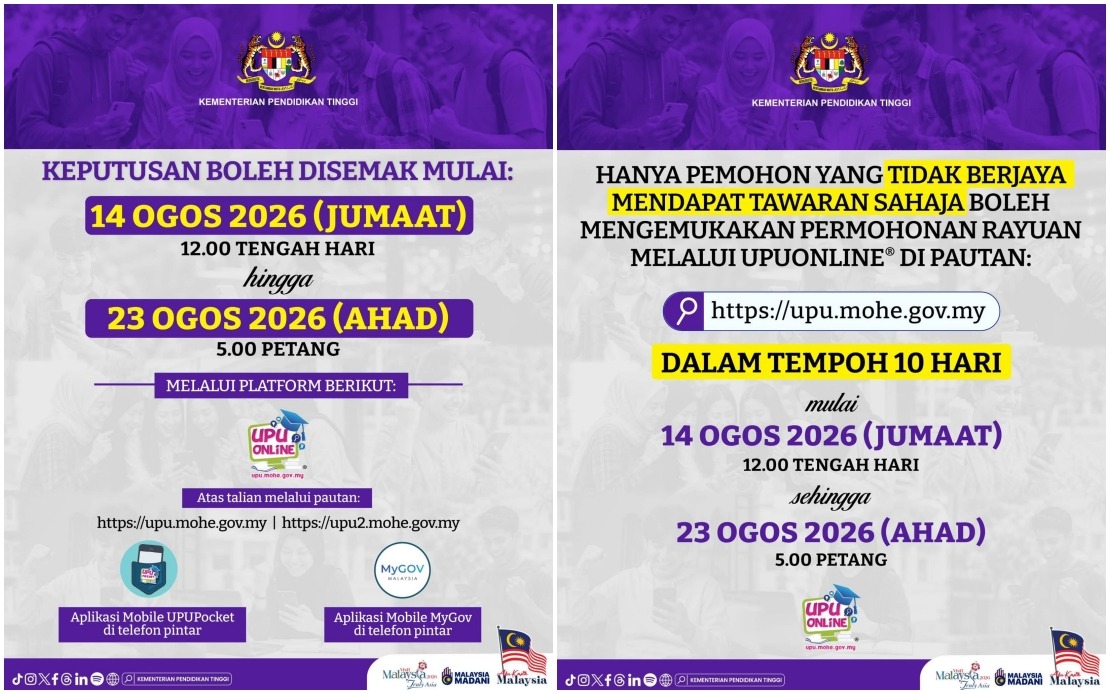
The Ministry of Higher Education will announce on August 14 the outcomes of applications submitted through UPUOnline® by STPM and equivalent qualification holders seeking admission to public universities for the 2026/2027 academic year. This significant date marks the beginning of a crucial two-week window during which prospective students must take action on their offers, making it a pivotal moment for the approximately 100,000 students who annually apply through this centralised system.
Applicants will gain access to their results starting at noon on August 14, with the portal remaining open for queries until 5 pm on August 23. The Ministry has ensured accessibility across multiple platforms to accommodate different user preferences and technical capacities. Beyond the traditional web portals at https://upu.mohe.gov.my and https://upu2.mohe.gov.my, students can also retrieve their results through the dedicated mobile applications UPUPocket and Mobile MyGov, reflecting the government's push towards digital-first service delivery in an increasingly mobile-centric society.
Once results are published, the momentum for decision-making accelerates rapidly. From August 15 onwards, applicants who receive offers must formally confirm their acceptance or rejection through the websites of their respective universities within the specified nine-day window. This confirmation process is not merely a formality; it directly influences whether institutions can accurately gauge enrollment numbers and allocate resources appropriately across programmes. The staggered approach—results on August 14, confirmations from August 15—allows universities a brief window to prepare their administrative systems for the influx of acceptances and rejections.
Successful candidates will subsequently receive official offer letters directly from their chosen universities, beginning August 15. These formal documents represent the final contractual commitment between the institution and the student, outlining programme details, commencement dates, and initial registration requirements. The timing ensures that accepted students have sufficient notice to arrange accommodation, secure any necessary financing, and prepare for the transition to university life.
For the substantial cohort of applicants who do not receive initial offers, the system provides a secondary pathway through an appeal mechanism. Unsuccessful candidates have precisely ten days—from August 14 to August 23—to submit appeal applications via the same UPUOnline® platform, with appeals directed specifically to the intake office at https://upu.mohe.gov.my. This appeals process represents an important safety valve in Malaysia's university admissions system, providing recourse without requiring students to wait an additional year for the next intake cycle.
Crucially, the Ministry emphasises that places offered for the 2026/2027 academic session are final and immutable. Once students accept their initial offers, they are prohibited from subsequently requesting transfers to different programmes or universities. This strict policy aims to ensure stability in enrollment planning and prevent the cascading disruptions that arise when students repeatedly change their preferences after confirmations have been made. However, the appeals process—albeit limited to filling genuine vacancies—offers some flexibility for those genuinely unsuited to their assigned placements.
The availability of appeal selections depends entirely on vacant positions that remain after all newly admitted students have completed their registration. This means that appeals are far from guaranteed acceptance; institutions can only accommodate appeals if genuine space exists after accommodating those who accepted initial offers. Students submitting appeals should therefore view this option as a second chance rather than an assured pathway, particularly for popular and competitive programmes.
For Malaysian educators, parents, and prospective students, this announcement underscores the importance of preparing realistic university preference lists during the application phase. The finality of accepted offers means that decisions made weeks earlier, when students completed their initial UPUOnline applications, cannot be easily reversed. This reality highlights the value of thorough research into programme content, career prospects, and institutional fit before submitting applications.
The August timeline also has downstream implications for university operations across Malaysia. Public institutions must now prepare orientation programmes, arrange accommodation allocations, and finalise teaching schedules based on confirmed enrollment figures. For international applicants and those from East Malaysia, the two-week confirmation window provides adequate time to make travel arrangements and notify employers or other institutions of their final decision.
The reliance on multiple digital platforms reflects Malaysia's broader commitment to accessible public services. By offering web portals alongside mobile applications, the Ministry acknowledges that not all applicants have equal access to desktop computers, while most possess smartphones. This inclusive approach has proven effective in previous years, expanding participation among students in rural areas and lower-income households who might otherwise face barriers to timely information access.
Students should note that the confirmation process is active, not passive. Simply receiving an offer does not guarantee admission; candidates must affirmatively accept within the prescribed period. Those who delay or overlook the August 15–23 confirmation window risk forfeiting their offers entirely, as the system does not automatically presume acceptance. This requirement demands vigilance and attention to detail from applicants.
For those pursuing appeals, success depends on multiple factors beyond academic performance: the popularity of chosen programmes, overall intake numbers, and the extent to which other students have rejected offers. Consequently, applicants should approach appeals strategically, perhaps requesting programmes or universities where vacancies are more likely to materialise, rather than concentrating appeals on highly competitive options.
The public university system's reliance on this centralised UPUOnline® mechanism has streamlined admissions considerably since its inception, reducing regional inequities and standardising the process nationwide. August 14 thus represents not simply an administrative deadline but a transformative moment for tens of thousands of young Malaysians embarking on tertiary education.

