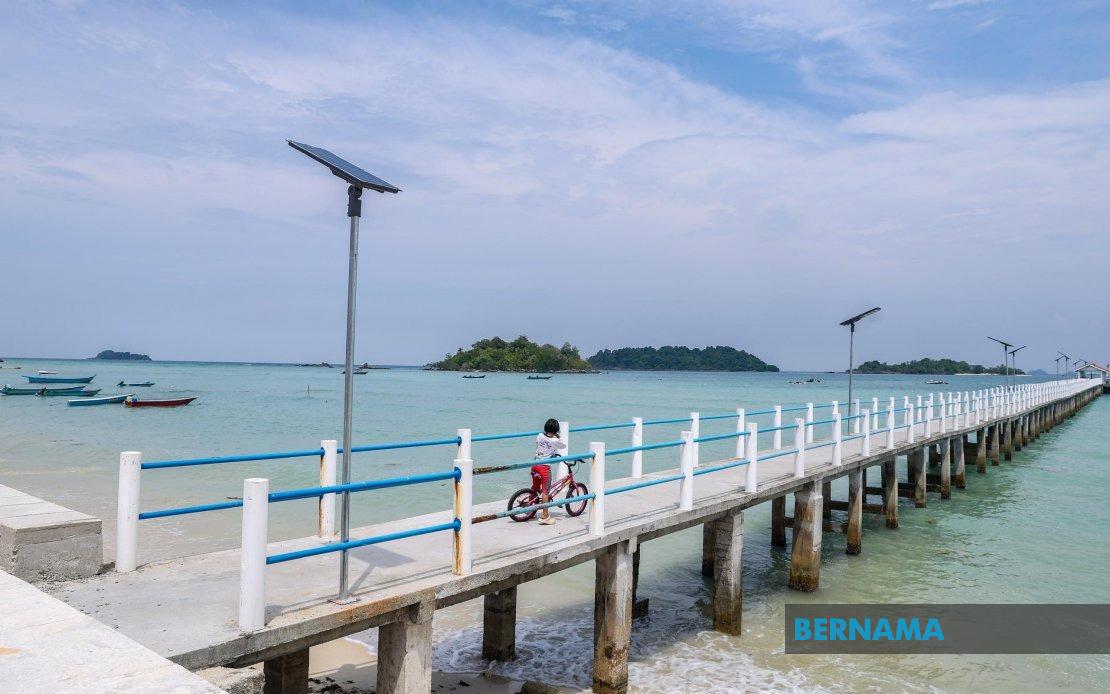
The 150 residents scattered across two villages on Pulau Tinggi are looking to Saturday's Johor state election as a turning point for their struggling island community, where infrastructure decay and economic hardship have long been relegated to the periphery of political attention. As 2.7 million eligible voters prepare to elect 56 lawmakers to represent them in the next legislative term, the islanders are pinning their hopes on whichever candidate secures the Tenggaroh state seat, urging swift action on issues that have festered for years without meaningful resolution.
The deteriorating Kampung Pasir Panjang jetty stands as the most visible symbol of neglect on Pulau Tinggi. Since around 2017, the facility has slipped into disrepair, creating genuine safety concerns for both the fishing community who depend on it for their livelihoods and the tourists who occasionally visit the island. Despite its deteriorating condition, residents continue to use the jetty out of necessity, though local leaders have repeatedly cautioned them to exercise extreme caution. Village chief Rossana Hussin, who assumed her position in 2024, emphasizes that this infrastructure is not merely a convenience but a lifeline for an island population heavily dependent on maritime activities and tourism revenue.
What makes the jetty situation particularly frustrating for residents is that the groundwork for improvement has already been initiated. Rossana submitted formal applications to the Mersing District Office in March seeking approval for the jetty upgrade project, and these submissions received encouraging preliminary feedback from government officials. The bureaucratic machinery appears to have begun turning, yet the actual commencement of work remains unclear, leaving residents in a state of cautious optimism tempered by years of unfulfilled promises. The incoming state representative will inherit what amounts to a shovel-ready project that simply requires political will and expedited approval to transform from paperwork into concrete results.
Beyond infrastructure, the island's fishermen—who constitute the majority of Pulau Tinggi's population—face acute housing challenges that underscore broader economic inequality in rural maritime communities. Many residents fall within the B40 category, Malaysia's bottom 40 percent income bracket, and several require urgent housing repair assistance or face incomplete home renovations that compromise their living conditions. The applications for housing support have similarly been submitted to local authorities, yet without the push from an elected representative actively championing their cause, these requests risk languishing in administrative limbo. For families living in substandard conditions while earning precarious incomes from fishing, adequate housing represents not a luxury but a fundamental necessity for dignity and wellbeing.
Rossana's advocacy reflects the reality facing many village leaders in peripheral communities who must navigate both the immediate needs of their residents and the political currents that determine resource allocation. She has explicitly called on the elected Tenggaroh representative and relevant government agencies to coordinate efforts in addressing these intertwined issues. This appeal transcends partisan politics; it is simply a request that the incoming lawmaker take seriously the basic infrastructure and social welfare needs of constituents who have largely been overlooked by previous administrations.
Demographic decline adds another layer of urgency to Pulau Tinggi's predicament. The island's population has shrunk over recent decades as younger residents have migrated to urban centers or relocated to Federal Land Development Authority (Felda) schemes in search of more stable employment and better economic prospects. This exodus threatens to transform Pulau Tinggi from a functioning community into a ghost island, with only elderly residents remaining. At 85 years old, Mariam Mamat represents the aging cohort increasingly dominant on the island, and her concerns about future viability are not sentimental nostalgia but pragmatic recognition that communities require youth and economic dynamism to survive.
Mariam's call for tourism sector revitalization speaks to an alternative economic pathway that, if pursued seriously, could stem migration and create employment opportunities for younger islanders. Pulau Tinggi possesses genuine appeal for ecotourism and cultural tourism, with its fishing heritage and island setting offering authentic experiences that could attract visitors seeking alternatives to crowded beach resorts. However, realizing this potential requires not merely wishful thinking but concrete investment in tourism infrastructure, marketing, skills training for residents, and coordination between multiple government agencies. Such initiatives typically require a state representative with sufficient political capital to mobilize resources and champion the island's development within state-level planning.
The timing of these appeals is significant. With the Johor election occurring on Saturday, residents have a rare opportunity to make their voices heard and to evaluate candidates based on their specific commitments to addressing island development. In Malaysia's electoral system, voters in marginal constituencies often wield disproportionate influence, and while Pulau Tinggi represents a tiny fraction of the Tenggaroh electorate, the collective voice of island residents can contribute to a candidate's understanding of what constituents prioritize. The election provides a natural moment for accountability and for residents to communicate their non-negotiable demands for basic services.
The broader context matters here as well. Rural and island communities across Southeast Asia frequently experience what development scholars call the "peripherality trap"—geographic and economic remoteness that renders them invisible to policymakers focused on urban centers where electoral rewards and economic benefits appear more substantial. Malaysia's Johor state, though relatively developed compared to some neighboring countries, still contains pockets of genuine disadvantage where basic infrastructure remains inadequate. Pulau Tinggi exemplifies how even within a relatively prosperous state, maritime communities can be left behind without intentional political commitment to inclusive development.
The applications already submitted to the Mersing District Office represent a crucial tactical advantage for residents. They need not convince the incoming representative to initiate new projects from scratch; rather, they need someone willing to prioritize and accelerate approval processes for initiatives that have already passed preliminary assessment stages. This transforms the political ask from abstract promise-making into concrete follow-through on existing commitments. Whether the successful Tenggaroh candidate treats this as a priority will largely determine whether Pulau Tinggi's residents finally see the jetty repaired, housing improved, and economic opportunities expanded, or whether these longstanding issues persist into another political cycle.
As Johor voters head to the polls, the residents of Pulau Tinggi represent countless Malaysians in peripheral communities whose primary concern is not grand visions of progress but practical resolution of degraded infrastructure and economic support. Their appeals are modest in scope yet urgent in nature, and they deserve representation from officials willing to translate electoral promises into tangible improvements in daily living conditions.

