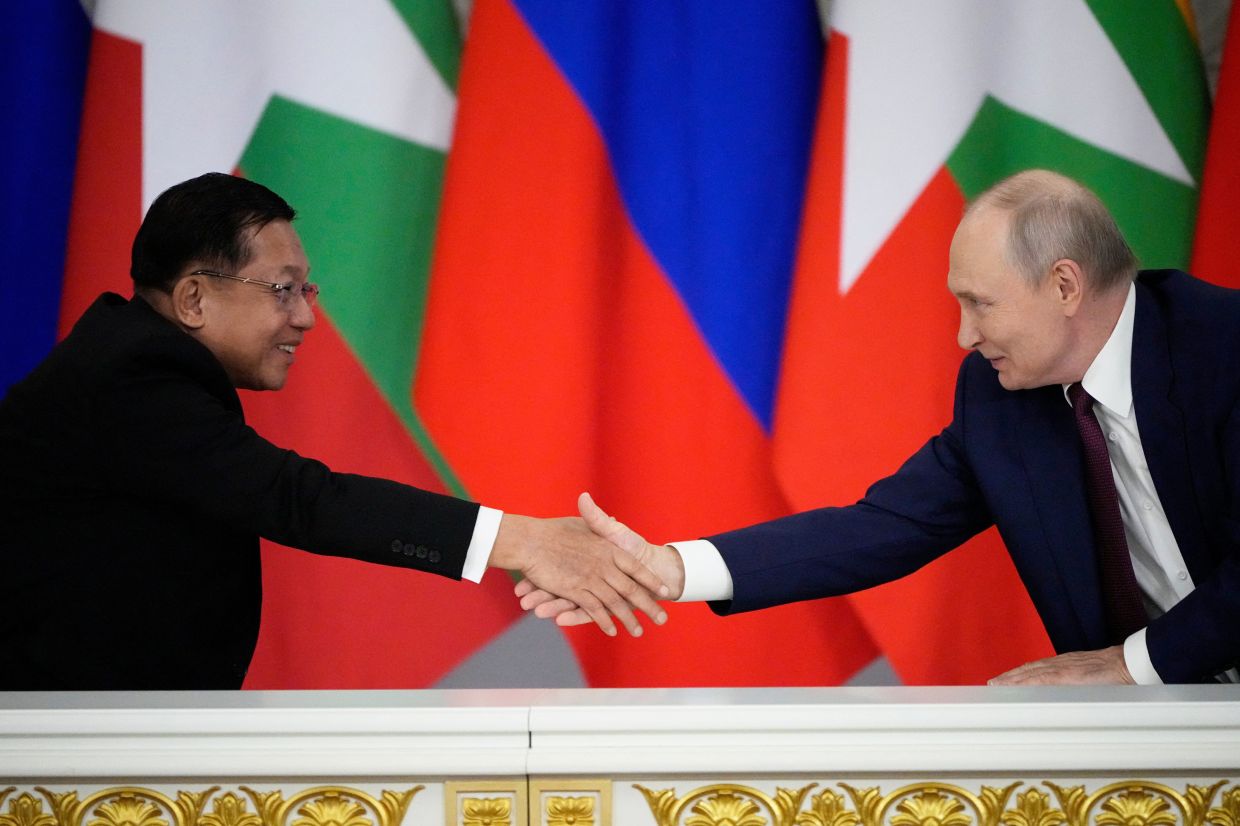
Russian President Vladimir Putin has characterised relations with Myanmar as growing "especially trusting" during high-level talks with President Min Aung Hlaing at the Kremlin, underscoring Moscow's commitment to maintaining close ties with one of Asia's most isolated regimes. The meeting on Tuesday marked the Myanmar leader's first official visit to Russia since assuming the presidency in April, though it represents at least the fourth encounter between the two leaders since Russia's invasion of Ukraine in February 2022.
The Moscow discussions revealed ambitious joint economic initiatives that position Russia as a significant economic stakeholder in Myanmar's future development. Putin outlined plans to construct a power plant and oil refinery in southern Myanmar, with Russian involvement in geological exploration and hydrocarbon extraction operations. Beyond these infrastructure projects, Moscow is exploring opportunities in liquefied natural gas exports, suggesting a comprehensive energy partnership framework extending beyond traditional hydrocarbon sectors. The breadth of economic discussions, supported by the presence of senior officials from financial, energy, and defence ministries, signals that the relationship transcends symbolic gestures and encompasses substantive commercial arrangements.
Military and defence cooperation forms the bedrock of the Russia-Myanmar relationship, a reality reflected in Putin's acknowledgment of "close military and military-technical cooperation" between the nations. According to a United Nations report from May 2023, Russia has supplied over US$400 million in advanced weaponry to Myanmar's armed forces since the 2021 coup, establishing Moscow as a critical military partner for the junta. This weapons pipeline provides Myanmar's leadership with sophisticated equipment that Western embargoes have rendered unavailable, effectively insulating the military from international isolation efforts.
Nuclear technology cooperation represents another frontier in bilateral engagement, with Myanmar working alongside Russia's Rosatom State Corporation to develop a small nuclear power plant. This initial venture aims to expand nuclear applications across healthcare, agricultural production, and industrial sectors—projects that would position Russia as a technological partner in Myanmar's modernisation agenda. Such cooperation deepens mutual dependence and creates long-term institutional linkages resistant to geopolitical shifts.
Russia's willingness to maintain robust engagement with Myanmar stands in marked contrast to Western democracies' policy of isolation following the February 2021 military coup that ousted civilian leader Aung San Suu Kyi. As sweeping international sanctions targeted Russian interests following the Ukraine invasion, Myanmar emerged as one of the few nations refusing to distance itself from Moscow, creating mutual strategic interests. This alignment has particular significance for Southeast Asia, where most Association of Southeast Asian Nations members have adopted hedging strategies rather than outright condemnation of Russia's actions.
Min Aung Hlaing's Moscow visit forms part of a broader diplomatic offensive aimed at legitimising his government internationally following elections in November 2023 that attracted widespread international criticism. The Myanmar president has undertaken recent travels to China, India, Laos, and Thailand in pursuit of regional acceptance, while simultaneously attempting to improve relations with the United States and ASEAN. These overtures reflect the junta's recognition that complete international isolation remains untenable, even with Russian support, necessitating a delicate balancing act between Moscow and more mainstream diplomatic engagement.
The composition of Myanmar's delegation underscored the visit's strategic importance, with a high-level contingent including multiple cabinet ministers and the Myanmar Space Agency director arriving in Moscow on Monday. Beyond his Kremlin meeting with Putin, Min Aung Hlaing convened with Prime Minister Mikhail Mishustin and Vyacheslav Volodin, speaker of Russia's lower house, before attending the Myanmar-Russia Business Forum. This multi-layered engagement structure suggests coordinated planning to showcase the relationship's depth across political, economic, and technical domains.
For Malaysian policymakers and Southeast Asian observers, the Russia-Myanmar relationship illuminates broader patterns of geopolitical competition in the region. Russia's strategic embrace of Myanmar provides an alternative great power patron for the military regime, complicating Western efforts to isolate regimes deemed illegitimate or undemocratic. This dynamic challenges ASEAN's cornerstone principle of non-interference while simultaneously offering Myanmar's leadership diplomatic flexibility—the ability to court Western engagement while maintaining Russian support, reducing the leverage any single actor can exercise.
The emphasis on economic cooperation deserves particular attention, as energy infrastructure and resource extraction agreements lock Myanmar into long-term relationships with Russian state enterprises. Such arrangements extend beyond simple commercial transactions, creating political interdependencies where Myanmar becomes invested in Russia's international standing. For a region already witnessing intensifying strategic competition between established and emerging powers, these developments suggest that military and authoritarian regimes may find increasing opportunities to play competing patrons against one another, potentially extending their grip on power despite international democratic pressures.
Putin's diplomatic outreach also reflects Russia's broader effort to cultivate influence in Asia as Western sanctions constrain European options. Myanmar offers Russia access to Southeast Asian markets, strategic geographic positioning in the Indian Ocean region, and a demonstration of Moscow's ability to maintain international partnerships despite Western pressure. For Russia, Myanmar represents not merely a distant ally but a concrete expression of its capacity to project power and influence beyond its traditional Eurasian sphere.
The military cooperation dimension warrants sustained attention from regional security analysts, as Russia's weapons supplies enable Myanmar's junta to maintain internal control while reducing dependency on alternative suppliers. This self-reinforcing cycle strengthens the military's autonomy from civilian oversight and international pressure, potentially entrenching authoritarian governance structures. For neighbouring states including Malaysia, such dynamics carry implications for regional stability, refugee flows, and humanitarian concerns emanating from Myanmar.
Looking forward, the Russia-Myanmar partnership appears poised for deepening rather than diminishing, particularly as Western sanctions intensify Russian isolation. Myanmar's willingness to accept Russian investments in critical infrastructure—power generation, oil refining, and nuclear technology—signals commitment to the relationship that extends well beyond rhetorical support. These concrete projects create constituencies within Myanmar's business and political establishment invested in Russian partnership, building domestic support for continued alignment with Moscow.

