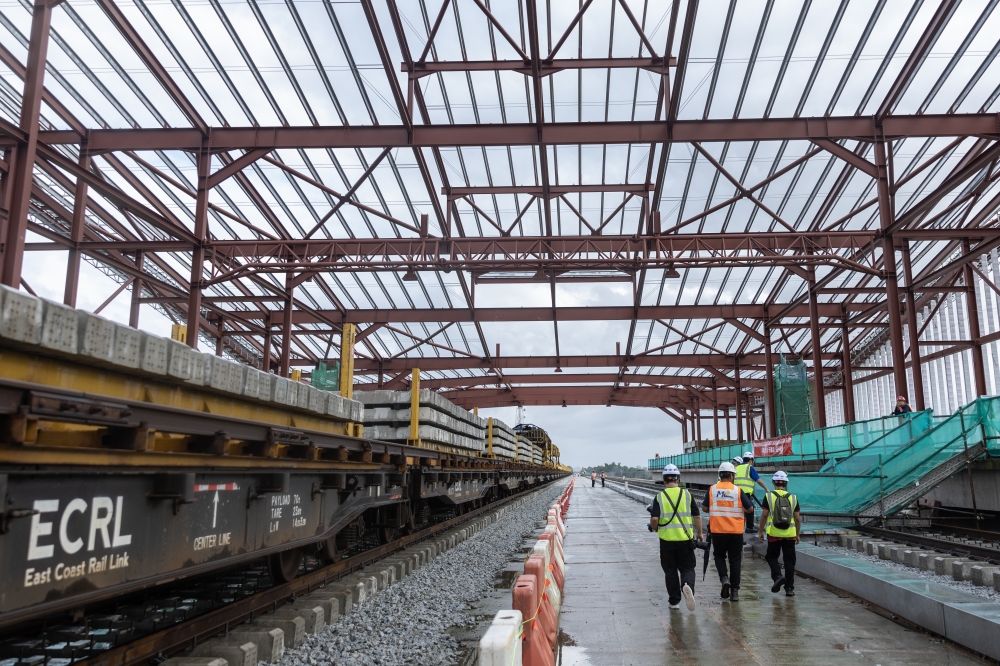
The Malaysian government has earmarked RM207 million for a comprehensive suite of 46 development initiatives across Pasir Puteh parliamentary constituency, marking a significant federal push to harness opportunities emerging from the East Coast Rail Line corridor. The package represents a calculated investment strategy targeting constituencies along the ECRL route, with Pasir Puteh positioned as a focal point for generating economic activity and improving living standards in Terengganu's interior districts.
The infrastructure-heavy development agenda demonstrates how Putrajaya views the ECRL beyond merely a transportation artery. Rather than treating the railway in isolation, authorities intend to create an integrated ecosystem of supporting projects that unlock the corridor's full potential. This approach aligns with broader Southeast Asian development patterns, where major transport links increasingly serve as anchors for cluster-based economic growth rather than standalone facilities.
Pasir Puteh's selection reflects geographical and political considerations. The constituency, represented in parliament, occupies a strategic position relative to ECRL stations and alignment, positioning it to benefit substantially from enhanced connectivity to other economic nodes. The allocation signals Putrajaya's intention to distribute ECRL-related gains beyond major urban concentrations, a deliberate counter-measure against regional inequality that has periodically emerged as a political flashpoint in Malaysia's electoral cycles.
The 46-project portfolio likely encompasses diverse categories ranging from road upgrading and water supply schemes to educational facilities and healthcare infrastructure. Such breadth indicates a holistic development approach, recognising that sustainable growth requires more than transport infrastructure alone. Rural and semi-rural constituencies often face systemic deficits across multiple service sectors, and bundling improvements addresses these concurrent shortfalls simultaneously.
For Malaysian stakeholders monitoring economic disparities, the Pasir Puteh package signals renewed federal emphasis on ensuring peripheral regions capture tangible benefits from national megaprojects. The ECRL, having encountered construction delays and cost escalations in earlier phases, faced criticism regarding whether communities beyond major hubs would see meaningful returns. This investment announcement partially addresses those concerns, though implementation timelines and actual project delivery will ultimately determine impact.
The timing of the announcement coincides with ongoing discussions about optimising ECRL operations and maximising its developmental footprint. As the railway progresses toward completion and operational phases, coordinated initiatives like Pasir Puteh's development package become increasingly relevant. Without supporting infrastructure and economic stimulus in intermediate nodes, the ECRL risks becoming an efficient transport corridor that primarily services existing economic powerhouses rather than catalysing new growth poles.
From a regional perspective, Malaysia's experience with leveraging major rail infrastructure through integrated development packages holds lessons for Southeast Asian peers pursuing similar megaprojects. The Association of Southeast Asian Nations encompasses multiple large-scale transportation initiatives—including cross-border rail connections and metropolitan mass transit systems—where coordinating development across multiple governance levels remains challenging. Malaysia's Pasir Puteh model, though modest in absolute terms, exemplifies how national governments can use federal resources to bridge local development gaps.
The RM207 million allocation, while substantial, represents measured investment relative to the ECRL's overall cost profile, which exceeded RM55 billion at completion. This proportion suggests selective targeting rather than blanket infrastructure spending, implying that Putrajaya has prioritised constituencies where ECRL connectivity offers exceptional development leverage or where political and economic imperatives converge most strongly.
Implementation becomes critical for evaluating the package's success. Government projects in Malaysian constituencies frequently encounter delays, cost overruns, or incomplete execution. Establishing transparent timelines, appointing dedicated oversight bodies, and establishing community feedback mechanisms could differentiate Pasir Puteh's trajectory. Constituencies where development packages translated into genuine improvements—rather than mere announcements—tend to report higher citizen satisfaction and improved economic indicators.
The announcement also carries implications for other ECRL-proximate constituencies. Political constituencies beyond Pasir Puteh will inevitably expect comparable development attention, potentially creating pressure for expanded allocation across multiple parliamentary districts. This dynamic could reshape how federal agencies distribute infrastructure budgets, with ECRL-related development becoming an increasingly powerful lens for assessing regional investment fairness.
Looking forward, Pasir Puteh's development trajectory warrants monitoring as a case study in translating national megaproject infrastructure into distributed regional prosperity. Success would validate integrated development approaches and establish precedent for future large-scale transportation initiatives across Malaysia and Southeast Asia. Conversely, implementation shortfalls would underscore persistent challenges in converting capital investment into sustained economic outcomes in constituencies previously marginalised from major development corridors.
The allocation ultimately reflects faith that strategic infrastructure investment, coupled with complementary local development projects, can reshape regional economic prospects. Whether Pasir Puteh realises that potential depends substantially on coordinated execution across federal agencies, state authorities, and local stakeholders over the coming years.

