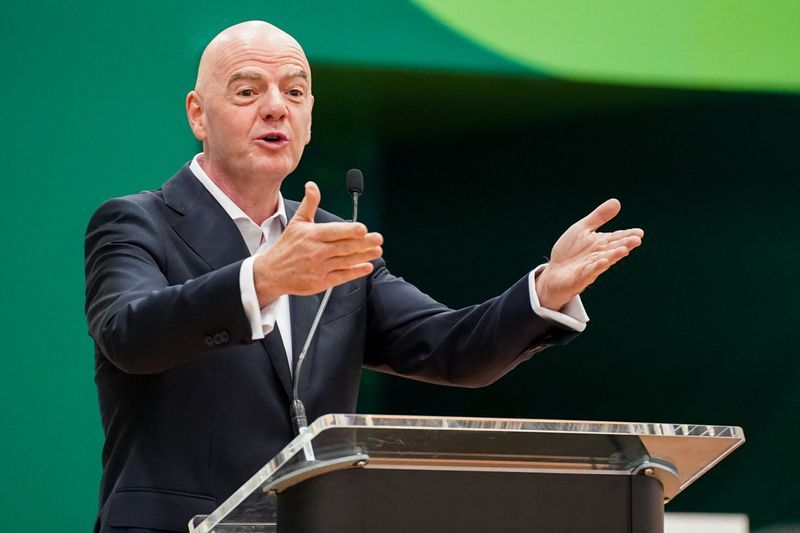
FIFA President Gianni Infantino secured a significant show of support from six Arab football confederations on Thursday, providing a crucial counterbalance to mounting pressure from major global football bodies calling for his removal. The endorsement from the heads of Qatar, Lebanon, Morocco, Sudan, Egypt, and Mauritania's national football associations represents a strategic maneuver in what has become an increasingly fractious leadership contest within world football's governing body, with Infantino preparing for a reelection campaign scheduled for March of next year.
The backing comes at a particularly delicate moment for Infantino, whose position had appeared vulnerable after three of FIFA's most influential regional confederations—UEFA, AFC, and CONCACAF—issued explicit calls for his resignation. These three confederations collectively represent 136 of the 211 member associations entitled to vote in the forthcoming FIFA presidential election, giving them substantial leverage in determining the outcome of that contest. The defections represented an unprecedented challenge to Infantino's authority, signaling that his leadership faced genuine opposition from football's traditional power centers.
At the heart of the controversy lies Infantino's now-abandoned proposal to fundamentally restructure FIFA's commercial model. The scheme would have separated the commercial broadcasting and sponsorship rights associated with the FIFA World Cup from the tournament itself, allowing FIFA to sell a 20 percent stake to private equity investors. According to Infantino's calculations, this arrangement would have generated approximately $4.2 billion in fresh capital for FIFA and its member associations, representing an injection of funds that football administrators across the developing world found tantalizing.
The financial incentive accompanying this proposal proved substantial enough to secure backing from several regional federations. Infantino had paired his investment scheme with a $20 million grant designed to distribute to member associations during the next funding cycle, with an implicit promise that this amount could potentially be doubled should associations agree to the privatization deal. For football associations operating in economically constrained environments, this represented meaningful financial support that could enhance domestic league development, youth training programs, and infrastructure investments.
Yet the three major confederations rejected both the financial inducement and the broader logic of Infantino's investment proposal. Their opposition centered on concerns that private ownership of any portion of the World Cup would fundamentally compromise FIFA's control over football's flagship competition and potentially introduce commercial pressures that could distort tournament scheduling, format, or other fundamental characteristics. The scale of their objection—spanning Europe, Asia, and North America—suggested that institutional concerns about FIFA's independence outweighed financial considerations for these organizations.
The joint statement released by the six Arab federation heads carefully framed their support around broader themes of continental development and cooperation. They emphasized Infantino's role in advancing football globally and expanding opportunities across all regions, with particular reference to strengthening Arab football's position within international competition. The language deliberately positioned their endorsement as reflecting confidence in Infantino's vision for worldwide football development rather than appearing narrowly transactional in response to financial incentives.
Four of the six federation heads who signed the statement also serve as members of FIFA's Council, the governing body's executive committee responsible for major decisions between quadrennial congresses. This dual status gave their endorsement particular institutional weight, demonstrating that Infantino retained meaningful support within FIFA's formal power structure despite the confederation-level opposition. The presence of Qatar and Morocco among the signatories carried additional significance, given their prominent roles in recent World Cup hosting—Qatar having hosted the tournament in 2022 and Morocco being designated as a co-host for the 2030 edition alongside Uruguay and Paraguay.
Morocco's inclusion in the statement represented a particularly strategic alignment, as the North African nation possesses growing influence within African football and maintains important commercial interests in the sport's future development. Qatar's support proved equally symbolically valuable, reflecting the Gulf nation's continuing investment in football infrastructure and its ambitions to maintain influence over FIFA's strategic direction despite periodic controversies surrounding its World Cup hosting record.
Infantino's capacity to mobilize support from multiple continental confederations, despite the high-profile opposition from UEFA, AFC, and CONCACAF, underscores FIFA's genuinely multipolar structure. While the three opposing confederations represent the greatest absolute number of member associations, they do not possess the unanimous support of all regional football bodies. The African confederation, CONMEBOL in South America, and now explicitly the Arab federations have either remained neutral or actively supported Infantino, preventing the opposition from achieving the overwhelming consensus that would make his continuation untenable.
The resolution of this leadership contest will likely shape FIFA's strategic direction for years to come. Should Infantino survive the March election, his opponents may face difficulty mounting future challenges to his authority. Conversely, if his opponents successfully coalesce behind an alternative candidate, FIFA's priorities would shift substantially, potentially resulting in more conservative approaches to commercial innovation and a reassertion of member association authority over executive decision-making.
For Malaysian and Southeast Asian readers, the Infantino succession question carries implications for regional football development. The AFC confederation, which includes Malaysia, has aligned itself with the anti-Infantino coalition, suggesting that Southeast Asian football leaders share concerns about privatization of World Cup rights. However, the existence of alternative centers of power within FIFA—including the Arab federations and potentially others in Africa and South America—means that AFC's preferences alone cannot determine FIFA's future direction, making the outcome of the March election genuinely unpredictable.

