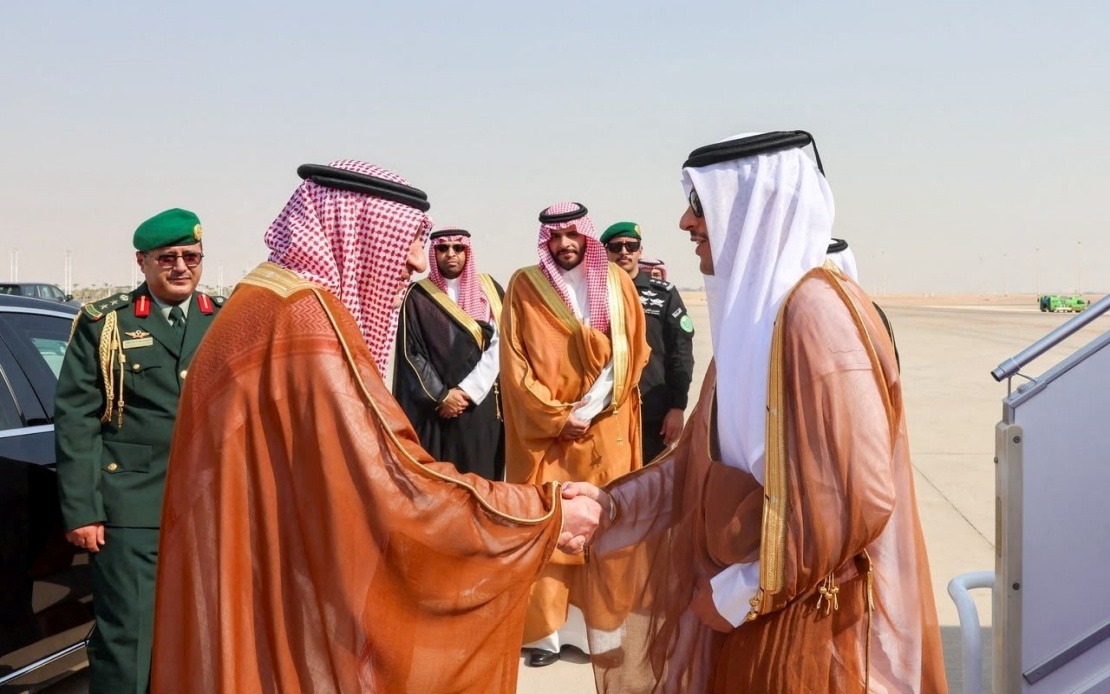
The Qatari Prime Minister Sheikh Mohammed bin Abdulrahman bin Jassim Al Thani arrived in Riyadh on Wednesday for a state visit centred on efforts to defuse mounting tensions across the Middle East and chart a course toward greater regional stability. His discussions with Saudi officials underscored the critical role that direct diplomatic engagement between major Gulf powers can play in addressing interconnected security challenges that threaten the broader region and global commerce.
During his time in the Saudi capital, Sheikh Mohammed—who doubles as Qatar's foreign minister—held substantive talks with Saudi Foreign Minister Faisal bin Farhan on the state of bilateral relations and the wider security landscape. Their conversation encompassed the full spectrum of contemporary regional concerns, with particular emphasis on pursuing peaceful resolution mechanisms over confrontational postures. Both officials reaffirmed their commitment to resolving outstanding disputes through negotiation rather than coercion, signalling to other regional actors that dialogue remains the preferred pathway forward.
Coordination between Doha and Riyadh has taken on heightened significance given the complex geopolitical currents flowing through the Gulf. The two nations stressed the importance of synchronising efforts at both regional and international levels to place dialogue at the centre of conflict resolution strategies. This multilayered approach reflects recognition that stability in the Middle East cannot be achieved through bilateral arrangements alone but requires sustained commitment from established powers and international stakeholders.
A particularly salient concern discussed during the visit relates to freedom of navigation and commercial shipping lanes. Both officials underscored the urgency of safeguarding maritime trade routes in the Arabian Gulf and the Red Sea—waterways through which flows critical energy supplies and goods destined for markets across Asia, Africa, and beyond. Disruptions to these vital corridors reverberate through global supply chains and affect economies far from the Middle East, including Southeast Asia, making maritime security a matter of legitimate concern for regional observers.
Saudi Deputy Foreign Minister Waleed bin Abdulkarim Al-Khereiji welcomed the Qatari leader upon arrival in Riyadh, reflecting the diplomatic importance attached to the visit by Riyadh. However, Saudi officials provided scant information about the anticipated length or detailed agenda of the engagement, maintaining a degree of discretion typical of high-level diplomatic visits where sensitive topics may be under discussion.
The timing of this engagement proves significant given the prevailing tension between two major external powers with competing interests throughout the region. Saudi Arabia's longstanding alliance with the United States stands in stark contrast to the more measured posture adopted by some other regional players. Amid these geopolitical fractures, the dialogue between Qatar and Saudi Arabia represents an attempt by Gulf states themselves to take initiative in addressing regional grievances and security concerns without waiting for external powers to dictate outcomes.
For Malaysian observers and Southeast Asian nations more broadly, developments in Gulf stability carry practical implications. The region supplies a substantial proportion of global oil and liquefied natural gas, resources critical to energy-dependent economies throughout Asia. Additionally, Middle Eastern tensions have a demonstrated track record of spilling over into international waters used by shipping vessels bound for Asian ports, creating insurance and operational costs that ultimately affect consumer prices and business competitiveness across Southeast Asia.
The Qatari Prime Minister's willingness to engage directly with Saudi counterparts also signals that despite historical tensions and disagreements within the Gulf Cooperation Council framework, pragmatic dialogue channels remain open. This capacity for direct communication, even amid disagreements, provides a foundation upon which regional powers can build collaborative responses to shared challenges. The emphasis on diplomatic channels and peaceful resolution mechanisms stands in contrast to more inflammatory rhetoric that has periodically emerged from various quarters in recent years.
Further, the focus on maritime security resonates particularly with Southeast Asian concerns about freedom of navigation and the preservation of open sea lanes. Regional states from Malaysia to Indonesia have consistently advocated for the peaceful resolution of disputes and the maintenance of rules-based international order. When major Middle Eastern powers actively pursue diplomatic solutions rather than military confrontation, they contribute to the stability of international maritime corridors that Southeast Asian shipping and commerce depend upon heavily.
The absence of specific details about visit duration or comprehensive agendas released by either government reflects the sensitivity of discussions that likely encompassed Iran-related developments, Israel-Palestinian tensions, and Yemen's ongoing humanitarian crisis. These interconnected conflicts have created a volatile environment where miscalculation or escalation could quickly overwhelm the region and affect energy markets and security worldwide.
Moving forward, the success of such diplomatic initiatives will be measured not merely by the statements released or meetings conducted, but by tangible shifts toward de-escalation and renewed commitment to multilateral frameworks that address underlying regional grievances. For Malaysia and other Southeast Asian nations, continued stability in the Middle East remains preferable to scenarios involving military confrontation or resource disruptions that would reverberate through Asian economies and security arrangements.

