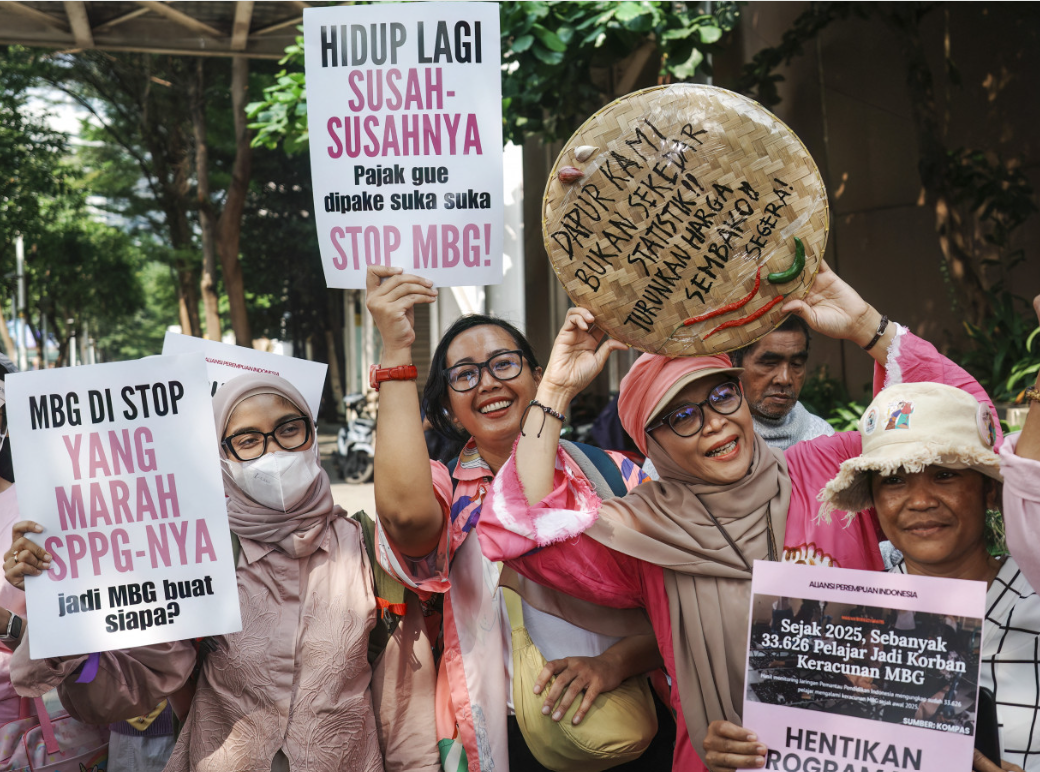
Controversy surrounding President Prabowo Subianto's flagship initiative to provide free nutritious meals to combat child malnutrition has intensified as beneficiaries publicly voice their frustrations. Rather than defending the programme unconditionally, recipients have begun articulating a striking position: they would rather see temporary suspension or restructuring than accept meals they consider nutritionally inadequate or unsafe for their children. This pushback reflects broader concerns about implementation quality that have emerged since the scheme's rollout, raising questions about whether throwing budgetary resources at a problem guarantees effective outcomes.
The catalyst for recent public outcry came when Nesti Nagari, a mother from Kediri in East Java, documented the meal provided for her eight-month-old child on social media platform Threads. The photograph showed what appeared to be a clumped white paste that even the beneficiary could not identify. Nagari's reaction proved visceral and unambiguous—she fed the portion to her chickens instead of her infant. Her post resonated widely, accumulating more than 11,000 likes by Thursday, June 18, and sparked a wave of similar complaints from other programme participants across Java and beyond.
Nagari's decision to reject the meals stemmed partly from her own capacity to provide nutrition independently. When interviewed by The Jakarta Post, she explained that she would support either a temporary programme suspension for comprehensive evaluation or even its complete termination, provided the freed budget could be redirected toward education and healthcare services. Her stance represents a fundamental challenge to programme design: when beneficiaries perceive the assistance as inferior to what they can self-provide, the intervention loses legitimacy and may breed resentment rather than gratitude.
Diah Farika, a breastfeeding mother in Semarang, Central Java, has registered similar grievances after enrolling in the programme in May. Her repeated complaints about meal quality to the nutrition fulfillment service unit (SPPG) responsible for meal preparation yielded dismissive responses, prompting her to decline further assistance. Among the deficiencies she documented were unripe oranges and portions she considered insufficient for nutritional needs. Like Nagari, Farika advocated for temporary suspension to allow the National Nutrition Agency (BGN) to conduct thorough kitchen inspections. Her assessment identified the core issue: the programme's fundamental concept may be sound, but execution depends entirely on the quality of individual kitchens managing meal preparation.
Beyond individual beneficiaries, organised advocacy groups have amplified concerns. On Thursday, the Indonesian Women's Alliance (API) mobilised dozens of women's rights activists for a rally in Central Jakarta, demanding that the government halt the programme pending comprehensive review. These coordinated calls for pause-and-evaluate reflect a constituency that questions whether continued implementation without quality assurance serves the intended beneficiaries or merely perpetuates a flawed system.
Paradoxically, even as beneficiaries demand improvements, programme operators face their own existential anxieties. The National Nutrition Agency's recent decision to halt further expansion of the SPPG network—currently numbering approximately 27,000 kitchens—stems from a corruption scandal involving former agency leadership. This freeze has spooked investors who reportedly invested hundreds of billions of rupiah in kitchen infrastructure. A delegation visited BGN offices seeking assurances about return on investment, fearing that programme termination could render their facilities economically unviable. The scenario illustrates tensions between accountability and investor confidence that plague large-scale social programmes.
Operational instability compounds these concerns. Early June witnessed temporary closures across several SPPGs due to delayed funding disbursement, though some facilities subsequently reopened. These disruptions undermine trust and suggest that even the programme's administrative apparatus struggles with reliability. MBG Watch, an independent oversight platform established by civil society groups, has characterised these mounting problems as further eroding public confidence. Isnawati Hidayah, a policy researcher at the Center of Economic and Law Studies (CELIOS) and MBG Watch initiator, articulated the public's mounting scepticism: communities increasingly question what this multi-billion-rupiah budget actually delivers and whose interests it genuinely serves.
The financial trajectory deserves scrutiny within this context. Initial 2026 budget allocation reached Rp 335 trillion (US$18.74 billion), subsequently trimmed to Rp 268 trillion following efficiency reviews prompted by public pressure over the programme's opportunity cost relative to education funding. This budgetary scale transforms the initiative from a charitable gesture into a major fiscal commitment requiring robust outcomes justification. CELIOS research findings add another complicating layer: approximately 34 per cent of current beneficiaries—roughly 61 million children and pregnant women—do not fall within the most economically vulnerable populations requiring government intervention. This targeting inefficiency suggests resources are reaching households with adequate nutritional access and economic capacity.
In response to mounting criticism, the BGN has initiated course corrections focused on beneficiary recalibration. As of Thursday, the agency had removed 76 schools across Java from the programme, affecting over 39,000 recipients identified as capable of meeting nutritional needs independently. This refocusing strategy aims to direct limited resources toward populations with genuine nutritional vulnerability. BGN deputy head and spokesperson Agustina Arumsari framed these changes during a televised briefing as reorientation toward "Indonesian citizens who truly need government intervention," acknowledging implicitly that initial implementation lacked adequate targeting precision.
Beyond beneficiary selection, the agency is introducing operational efficiency measures. Kitchen operators will no longer receive daily incentives during non-operational periods, and underperforming facilities face evaluation for potential discontinuation. These austerity measures signal acknowledgment that the programme cannot sustain current operational costs without demonstrating corresponding quality and impact. The challenge lies in implementing these reforms without further disrupting beneficiaries who depend on the service or demoralising kitchen operators already facing financial uncertainty.
For Malaysian observers, Indonesia's experience offers instructive lessons about scaling nutritional intervention programmes. While addressing child stunting represents a legitimate public health priority across the region, the Indonesian case demonstrates that budgetary commitment alone cannot ensure programme success without simultaneous investment in quality assurance, appropriate beneficiary targeting, operational transparency, and accountability mechanisms. The willingness of Indonesian beneficiaries to forgo assistance rather than accept substandard meals suggests that communities prefer no programme to one implemented poorly—a principle that transcends borders and cultural contexts.
The broader implication concerns how Southeast Asian governments approach flagship social initiatives. Indonesia's experience suggests that programmes requiring coordination across thousands of distributed service points demand extraordinarily robust quality oversight systems that are themselves labour-intensive and costly. Smaller, more locally-controlled initiatives with stronger community participation might achieve superior outcomes than massive, centralised programmes vulnerable to corruption, administrative dysfunction, and quality degradation at the point of service delivery.
%22%2F%3E%3C%2Fpattern%3E%3C%2Fdefs%3E%3Crect%20width%3D%22100%25%22%20height%3D%22100%25%22%20fill%3D%22url(%23ph48y62g)%22%2F%3E%3Crect%20width%3D%22100%25%22%20height%3D%22100%25%22%20fill%3D%22url(%23ph48y62p)%22%2F%3E%3Ctext%20x%3D%2250%25%22%20y%3D%2250%25%22%20text-anchor%3D%22middle%22%20dominant-baseline%3D%22central%22%20fill%3D%22rgba(255%2C255%2C255%2C0.95)%22%20font-family%3D%22Georgia%2C%20'Times%20New%20Roman'%2C%20serif%22%20font-weight%3D%22700%22%20font-size%3D%22320%22%20letter-spacing%3D%22-0.02em%22%3EPKR%3C%2Ftext%3E%3C%2Fsvg%3E)
%22%2F%3E%3C%2Fpattern%3E%3C%2Fdefs%3E%3Crect%20width%3D%22100%25%22%20height%3D%22100%25%22%20fill%3D%22url(%23ph50dweg)%22%2F%3E%3Crect%20width%3D%22100%25%22%20height%3D%22100%25%22%20fill%3D%22url(%23ph50dwep)%22%2F%3E%3Ctext%20x%3D%2250%25%22%20y%3D%2250%25%22%20text-anchor%3D%22middle%22%20dominant-baseline%3D%22central%22%20fill%3D%22rgba(255%2C255%2C255%2C0.95)%22%20font-family%3D%22Georgia%2C%20'Times%20New%20Roman'%2C%20serif%22%20font-weight%3D%22700%22%20font-size%3D%22320%22%20letter-spacing%3D%22-0.02em%22%3EUS%3C%2Ftext%3E%3C%2Fsvg%3E)