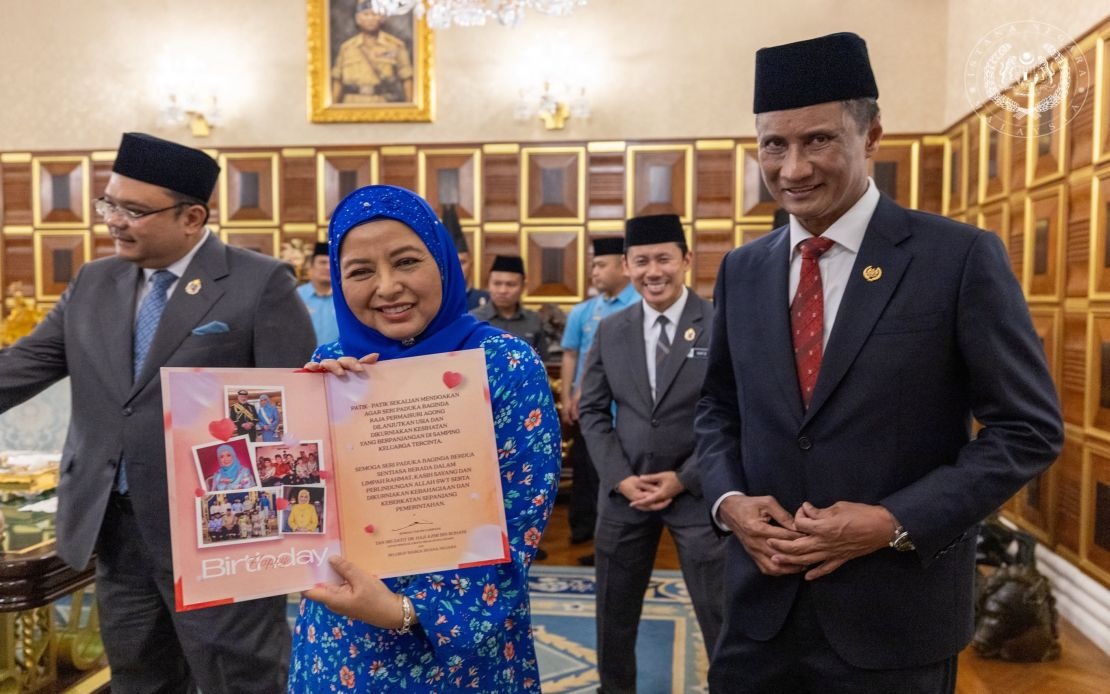
Her Majesty Raja Zarith Sofiah, Queen of Malaysia, received a ceremonial courtesy call from senior officials of Istana Negara on her birthday, marking the occasion with traditional palace protocols and well-wishes. The gathering took place at Istana Bukit Serene in Johor, with the Queen meeting Tan Sri Dr Azmi Rohani, Comptroller of the Royal Household, and Datuk Azuan Effendy Zairakithnaini, the Grand Chamberlain. The visit was documented and shared on the official Facebook page of Sultan Ibrahim Sultan Iskandar, reflecting the openness with which such royal events are now communicated to the public in Malaysia.
The courtesy call represents a longstanding tradition within Malaysian palace culture, whereby senior household officials formally mark the birthdays of members of the royal family. Such visits serve multiple functions within the royal establishment: they demonstrate respect and loyalty to the monarch, provide an opportunity for the palace hierarchy to express collective best wishes, and offer a symbolic moment of connection between the royal personage and the institutional machinery that supports the monarchy. The formal nature of the gathering, with named officials present and specific ceremonial elements, underscores the structured protocols that govern life within Istana Negara and its sister palaces throughout the federation.
Accompanying Azmi during the visit was Puan Sri Dr Noor Azizah Abdul Latif, his wife, whose presence added a personal dimension to what might otherwise be a purely official engagement. The inclusion of spouses at palace events reflects the contemporary approach to royal protocols, where the rigid ceremonialism of previous eras has been tempered with more inclusive and human-centred elements. This shift mirrors broader changes across Southeast Asian monarchies, where balancing formality with accessibility has become increasingly important for maintaining public support and relevance.
During the meeting, Her Majesty received two symbolic gifts that carried cultural significance within Malaysian context. A specially prepared cake, a Western culinary tradition that has become standard for birthday celebrations across Malaysia regardless of cultural background, was presented alongside yellow glutinous rice, a dish deeply rooted in Malay and Southeast Asian festive traditions. The combination of these two items reflects Malaysia's multicultural character and the ways in which the institution of the monarchy itself incorporates diverse cultural elements into its ceremonial practices. Such gifts are invariably prepared by palace kitchens and represent the collective effort of numerous staff members.
On behalf of the entire management and administrative structure of Istana Negara, Azmi formally conveyed prayers and heartfelt wishes for the Queen's continued health, wellbeing, and happiness. These expressions, while formulaic in nature, carry significant weight within palace culture. They represent not merely the personal sentiments of individual officials but rather the formal endorsement and support of the royal household as an institution. In the Malaysian context, where the monarchy occupies a constitutionally protected position and commands significant public reverence, such blessings carry both spiritual and political dimensions.
The timing of this birthday observation reflects the calendar of Malaysian royal engagements, which is typically marked by numerous such ceremonial occasions throughout the year. Each member of the royal family has their designated birthday, and the observance of these dates through official channels and public acknowledgment reinforces the continuity and stability of the institution. The fact that such events are now routinely documented and shared through social media demonstrates how the Malaysian monarchy has adapted to contemporary communication practices while maintaining ceremonial traditions.
Istana Bukit Serene, the venue for this birthday reception, holds particular significance as a royal residence with deep historical roots in Johor's royal heritage. The choice to hold the gathering at this specific location rather than at Istana Negara's federal territories facilities suggests the Queen's presence in Johor and underscores the federal nature of Malaysia's constitutional monarchy, where the Yang di-Pertuan Agong shares sovereignty with nine constituent sultans. The palace setting itself, steeped in royal protocol and tradition, creates an appropriate atmosphere for the formal expression of respect and loyalty that such occasions demand.
For observers of Malaysian politics and constitutional affairs, birthday observances of this nature provide valuable insights into the functioning of royal institutions and the relationships between different levels of palace hierarchy. The careful documentation of attendance and the formal announcement of proceedings through official channels demonstrate the transparency that contemporary Malaysian royal institutions maintain. This openness contrasts sharply with earlier decades when palace affairs remained largely opaque to public scrutiny, representing an evolution in how the monarchy engages with public consciousness and media representation.
The involvement of Istana Negara's senior administrative officials in these birthday courtesies also illuminates the bureaucratic structures that support the Malaysian monarchy. These officials, holding positions of considerable influence and responsibility within the palace system, serve as critical intermediaries between the royal family and the broader governmental apparatus. Their participation in such ceremonies reinforces organisational cohesion and signals the importance placed upon maintaining proper protocols and institutional continuity. In a constitutional monarchy like Malaysia, where the symbolic authority of the ruler is carefully balanced against democratic governance, these formal observances take on added significance.
The broader context for such royal events in Malaysia includes the continued importance of the monarchy as a unifying symbol across the nation's diverse population. Birthday celebrations and formal courtesies help maintain public awareness of and affection toward the royal institution. In recent years, as Malaysia has navigated complex political transitions and constitutional debates, the visible functioning of royal protocols and the continuation of traditional ceremonies provide reassurance about institutional stability. The Queen's active participation in receiving her birthday courtesies demonstrates engagement with palace affairs and the institutional life that surrounds the federal monarchy.

