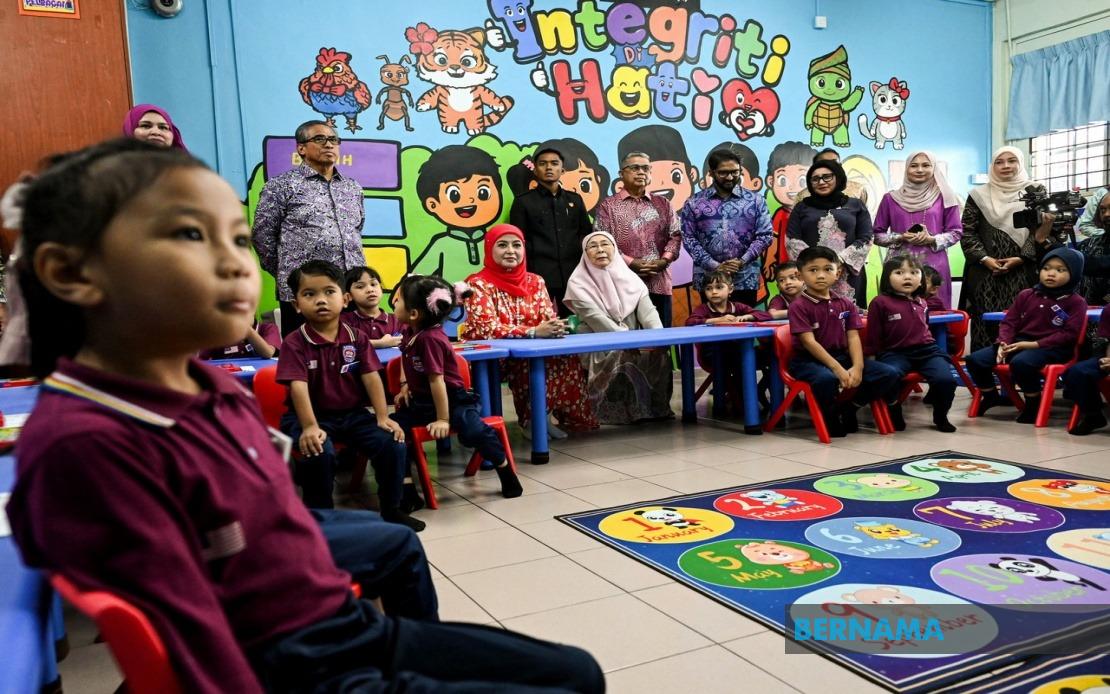
Her Majesty Raja Zarith Sofiah, Queen of Malaysia, officially launched the Children's Integrity Module (MIKa) at Tabika Perpaduan Taman Bukit Cheras in Kuala Lumpur on August 27, underscoring the royal family's commitment to fostering ethical values from the earliest stages of childhood development. The Queen's presence at the inaugural event highlighted the national significance of the initiative, which represents a comprehensive effort to embed principles of honesty and responsibility into Malaysia's youngest learners.
The formalities began with Her Majesty's arrival at 9:45 am, where she was received by National Unity Minister Datuk Aaron Ago Dagang, Chief Secretary to the Government Tan Sri Shamsul Azri Abu Bakar—who also chairs the Malaysian Institute of Integrity (IIM)—and Bandar Tun Razak Member of Parliament Datuk Seri Dr Wan Azizah Wan Ismail. This gathering of high-ranking officials reflected the cross-governmental coordination required to advance such an ambitious educational agenda. Following the ceremonial launch, the Queen toured the classroom premises to observe firsthand how the module operates in practice, participating in interactive sessions with the young students enrolled in the programme.
The Malaysian Institute of Integrity developed MIKa with a specific focus on children aged two to six, a critical developmental window when foundational values and behavioural patterns are established. By targeting this age group through early childhood education platforms, the initiative acknowledges the psychological principle that moral frameworks absorbed during early years tend to become ingrained habits rather than imposed obligations. This approach represents a shift from traditional integrity-building strategies that typically emerge only in later educational stages or through legislative mechanisms.
According to Tan Sri Shamsul Azri, the ambitious scope of MIKa extends far beyond its current pilot phase. The Malaysian Institute of Integrity has set a target of 2030 for full implementation across Malaysia's entire early childhood education ecosystem, encompassing more than 31,000 childcare centres, kindergartens, and preschools scattered throughout the country. This expansion would represent one of the most comprehensive moral education rollouts in the region, potentially influencing hundreds of thousands of children during their formative years and establishing a nationwide culture of integrity from the ground up.
Development of the MIKa curriculum began in 2024, drawing upon the expertise of 35 early childhood education specialists who collaborated to create age-appropriate frameworks for teaching integrity concepts. The module's design reflects contributions from multiple government ministries, regulatory agencies, higher education institutions, and organisations specialising in early childhood development. This multi-stakeholder approach ensured that the curriculum addresses practical implementation challenges and aligns with existing early childhood educational standards across diverse institutional settings, from urban kindergartens to rural childcare facilities.
Tan Sri Shamsul Azri articulated a philosophical foundation for the initiative that distinguishes it from conventional compliance-based approaches. He emphasised that integrity cannot be externally imposed through laws and regulations alone, but must instead be cultivated through early exposure and modelling, allowing ethical behaviour to transition from conscious effort into habitual practice. This perspective reflects contemporary educational psychology, which recognises that children who internalise values through experience and reinforcement develop stronger moral compasses than those who merely memorise rules.
The Chief Secretary framed the MIKa launch as the beginning of a larger transformational project aimed at developing a generation of Malaysians characterised by honesty, trustworthiness, personal responsibility, and principled conduct. This vision extends beyond institutional programming to encompass parental involvement and community support. Recognising that children's moral development occurs primarily within family contexts, the initiative implicitly calls upon parents to model integrity in their daily lives, creating consistency between what children learn in educational settings and what they observe at home.
For Malaysia's policymakers and educators, MIKa represents an investment in social cohesion and institutional trust at a time when public discourse increasingly focuses on accountability and ethical governance. By establishing integrity as a cultural norm during childhood, the programme aims to create downstream benefits affecting institutional performance, public service delivery, and social capital across multiple sectors. The initiative also positions Malaysia as a regional leader in early childhood moral education, potentially influencing how neighbouring countries approach values-based learning.
The programme's success will depend significantly on consistent implementation across diverse institutional environments and ongoing training for educators tasked with delivering the curriculum. Early childhood teachers often operate with minimal resources and heavy workloads, requiring substantial support systems and incentives to incorporate new pedagogical approaches effectively. The involvement of multiple government agencies and educational organisations suggests recognition of these implementation challenges, though translating bureaucratic coordination into classroom reality remains a persistent challenge in Malaysian education reform efforts.
Beyond the immediate educational impact, MIKa addresses a broader concern about maintaining social trust and institutional credibility in an increasingly complex modern society. By intentionally building ethical foundations during early childhood rather than attempting remedial character education later, the programme acknowledges that prevention through early intervention typically proves more cost-effective than later interventions. This prevention-oriented strategy represents a maturing approach to social policy, moving beyond reactive measures to proactive investments in human development.

