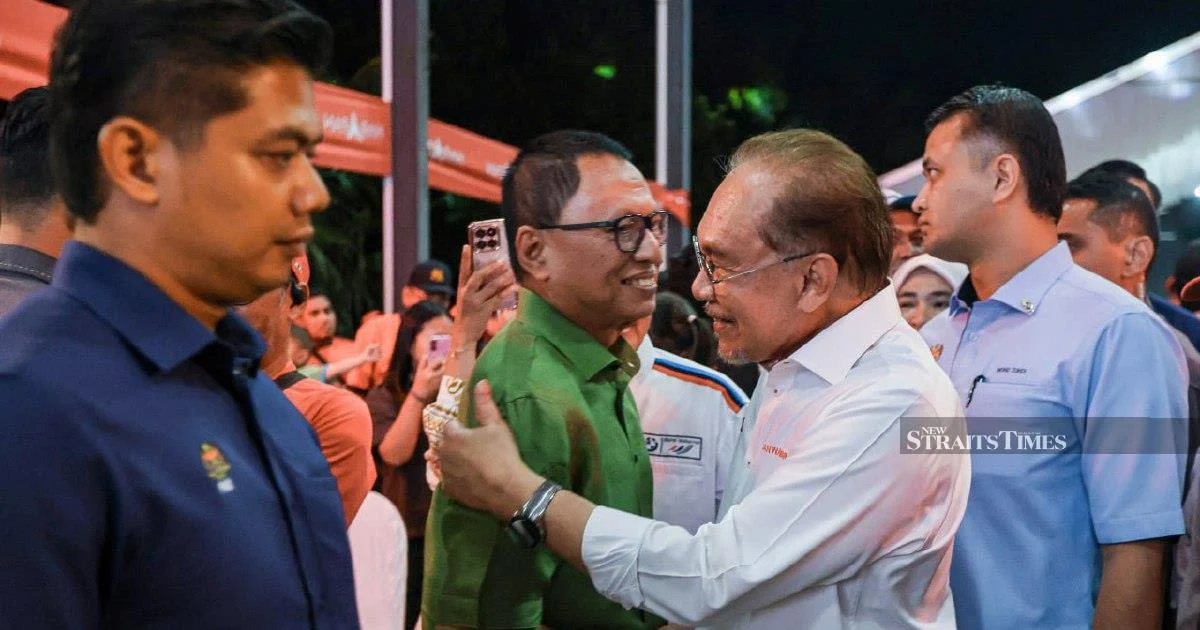
Bersama leader Datuk Seri Rafizi Ramli has turned his sharp wit on Datuk Dr Mohd Puad Zarkashi, offering a barbed jest about the latter's apparent political repositioning after a conspicuous public exchange with Prime Minister Anwar Ibrahim on Saturday. The jab, delivered in Johor Baru, underscores the high-stakes positioning and calculated symbolism that characterises contemporary Malaysian coalition politics, where public gestures carry weight far beyond mere pleasantries and proximity to power translates into political currency.
The interaction between Anwar and Puad, captured in public view, prompted Rafizi's characteristically cutting observation. The Bersama chief, through his comment, appears to be flagging what he perceives as Puad's shifting allegiances or at minimum his growing comfort within the circles surrounding the prime minister. In Malaysian politics, such public needling rarely exists in isolation; rather, it reflects deeper concerns about coalition cohesion, factional maneuvering within larger blocs, and the perpetual challenge of managing diverse and sometimes competing interests within multiparty governing arrangements.
Puad's background as an Umno-linked figure makes Rafizi's insinuation particularly pointed. The suggestion that someone might be abandoning party loyalty or restructuring their political portfolio carries real implications within Malaysia's coalition-dominated system, where politicians often move between groupings and where proximity to the prime minister can reshape career trajectories significantly. For those monitoring the stability of the current government, such comments—whether intended seriously or as humour—warrant attention as potential indicators of underlying tensions.
The episode reflects the broader realities of Malaysian coalition governance, where building and maintaining majority requires accommodating personalities from multiple parties with sometimes divergent interests. Anwar's administration relies on complex arrangements spanning Pakatan Harapan components, Umno, Gabungan Parti Sarawak, and various other partners. Within this architecture, individual politicians must navigate competing pressures: loyalty to their home parties, alignment with coalition partners, and personal ambition. Public moments of apparent warmth between figures from different camps inevitably trigger scrutiny and commentary from rivals.
Rafizi's jest also suggests Bersama's consciousness of its own position within the governing coalition. As a newer and smaller component, the party must work to maintain relevance and carve out distinct political space. Commentary on other politicians' movements or repositioning serves multiple purposes: it can signal vigilance against coalition drift, maintain factional boundaries, or simply stake claim to political influence through public commentary. The timing and tone of such remarks often matters as much as their content.
The relationship between Umno and the federal government has evolved considerably since Anwar's appointment as prime minister in late 2022. What was initially cautious cooperation has developed into something more substantive, with Umno playing an active role in government and holding ministerial portfolios. Yet tensions persist, particularly when individual Umno figures appear to cultivate especially close ties with Anwar or his inner circle. Rafizi's comment may reflect apprehension about whether such individual relationships might eventually facilitate further realignment at the party level.
Puad's specific circumstances merit consideration. As someone with Umno connections engaging visibly with Anwar, he occupies a position that invites both attention and interpretation. Whether such interactions represent anything beyond ordinary government functioning depends partly on patterns of behaviour and partly on how they are perceived and framed by political competitors. Rafizi's intervention injects a particular narrative—one suggesting opportunistic repositioning—into public discourse.
The Malaysian political landscape remains characterised by personality-driven dynamics, internal party contests, and the strategic importance of individual politicians. A single public embrace can become fodder for weeks of commentary and speculation, particularly when it involves figures operating across party and coalition lines. These symbolic moments matter because they can presage larger shifts, signal changing alliances, or simply demonstrate which individuals are benefiting most from their proximity to power.
For observers of Malaysian governance, such interactions and the commentary they generate offer insights into coalition stability, factional competition, and the personal networks through which power actually operates. While Rafizi's remark was delivered with humour, it represents a substantive political intervention—a staking of position, a marking of territory, and a gentle warning about the fluidity of political allegiances. In Malaysia's current coalition environment, where no single grouping commands outright majority and where therefore all partners possess leverage, such interventions carry significance beyond mere joshing. They reflect real anxieties about coalition durability and real competitions for influence within the governing arrangement.

