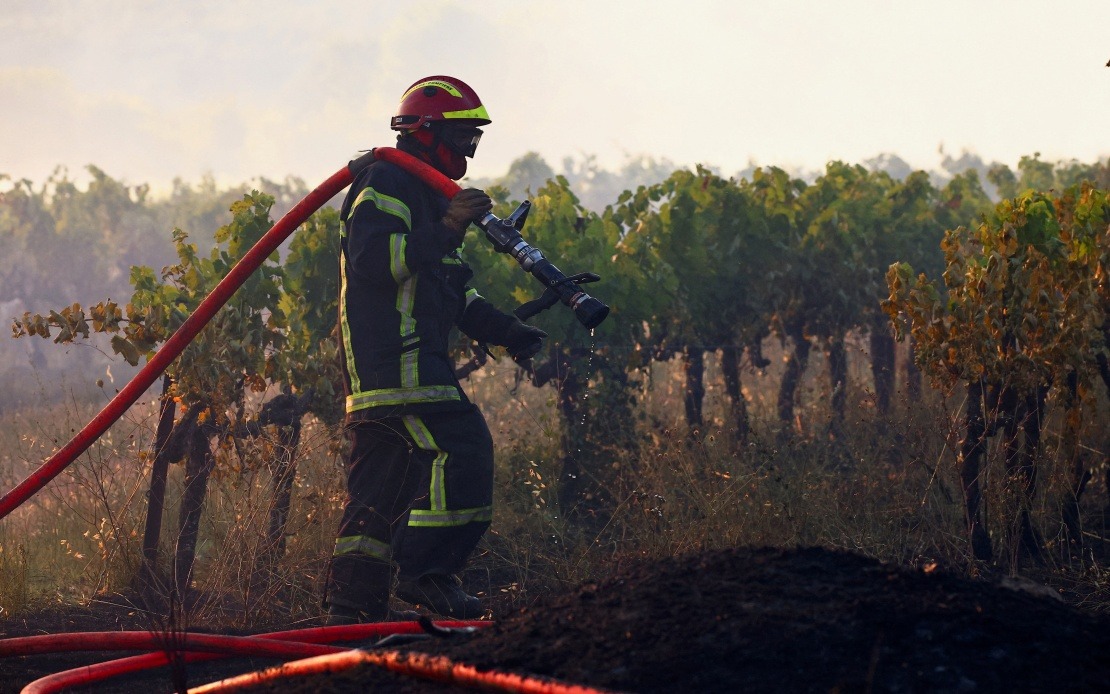
The battle against a catastrophic wildfire threatening the French Atlantic coastal city of Bordeaux received unexpected assistance on Thursday morning when rainfall swept across the fire-affected region. After days of intense combat against the advancing flames, firefighting teams welcomed the moisture as a decisive turning point in their efforts to contain and extinguish the remaining hotspots scattered across the devastated landscape.
Regional fire service commander Matthieu Jomain expressed cautious optimism about the meteorological conditions, noting that the morning's relative humidity level of 80 per cent had created circumstances favourable for continued suppression work. With the additional precipitation expected throughout the day, emergency personnel positioned themselves to capitalise on the improved atmospheric conditions by systematically tackling lingering embers and preventing fresh outbreaks. The commander's assessment suggested that the convergence of higher moisture levels and rainfall would allow crews to work more efficiently, reducing the risk of flames reigniting in areas already fought over.
The scale of destruction wrought by this fire crisis underscores the severity of wildfire phenomena gripping southwestern Europe. The blaze has consumed approximately 42,000 hectares of forest and scrubland—equivalent to 420 square kilometres—transforming vast stretches of countryside into charred terrain. The advancing flames had driven a terrifying trajectory toward Bordeaux itself, at one point reaching within 15 kilometres of the city, raising prospects of urban conflagration that would have been catastrophic for France's sixth-largest metropolitan area.
The evacuation orders affecting tens of thousands of residents and tourists represent one of the most significant internal displacement events France has experienced in recent memory. Holiday parks and campsites across the region were emptied of their occupants, with families and visitors forced to abandon summer plans and seek shelter further inland. The disruption extended beyond the immediate fire zone, affecting tourism infrastructure and local economies dependent on the summer season.
France and Spain have simultaneously grappled with multiple wildfire outbreaks across the Iberian Peninsula and French territories, creating a coordinated emergency response spanning international borders. The severity and frequency of these fires have prompted scientific discourse about underlying environmental drivers, with climate researchers consistently identifying escalating global temperatures and prolonged drought cycles as primary factors intensifying fire behaviour.
Concerns about climate change's role in fire dynamics carry particular significance for Mediterranean and Atlantic-adjacent regions where traditional summer drought patterns are becoming more pronounced and extended. The fires devastating southwestern France exemplify how rising atmospheric temperatures interact with vegetation desiccation to create conditions where ignition sources—whether natural lightning or human activity—can rapidly propagate into uncontrollable conflagrations.
Despite the temporary improvement provided by Thursday's rainfall, emergency services maintained elevated preparedness levels throughout the affected territories. The transition from deteriorating to improving conditions does not eliminate the underlying fire danger; rather, it provides a window for tactical advancement. Jomain's characterisation of the overnight period as unusually quiet proved misleading regarding overall stability, as six separate fire outbreaks required intervention during those hours, demonstrating that vigilance could not be relaxed.
The human toll of firefighting operations has been substantial, with 230 personnel sustaining injuries while conducting suppression activities near Bordeaux. These casualties reflect both the physical demands of working in extreme heat and hazardous terrain, and the perilous encounters with active flames and toxic smoke. The prefecture's documentation of this injury toll provides objective measurement of the operational intensity and danger crews faced during the most acute phases of the emergency.
For regional populations and observers across Southeast Asia watching European climate dynamics, the Bordeaux fires illustrate how climate change transcends geographic boundaries and affects wealthy industrialised nations with established emergency infrastructure. Malaysia and other tropical regions face increasingly sophisticated fire management challenges, particularly during dry seasons in areas with peatland and forest resources. The French experience demonstrates that even technologically advanced societies struggle to contain megafires, suggesting that regional preparedness improvements require substantial investment in early warning systems, firefighting capacity, and landscape management strategies.
The convergence of rainfall with improving operational conditions near Bordeaux does not signal complete resolution of the crisis. Rather, it represents a tactical breakthrough that permits emergency services to transition from pure firefighting toward fire recovery and prevention phases. Long-term assessment of damage, environmental restoration, and investigation into fire origins would follow as the immediate threat diminished. The experience would likely inform policy discussions across European governments regarding fire preparedness budgeting and climate adaptation strategies.

