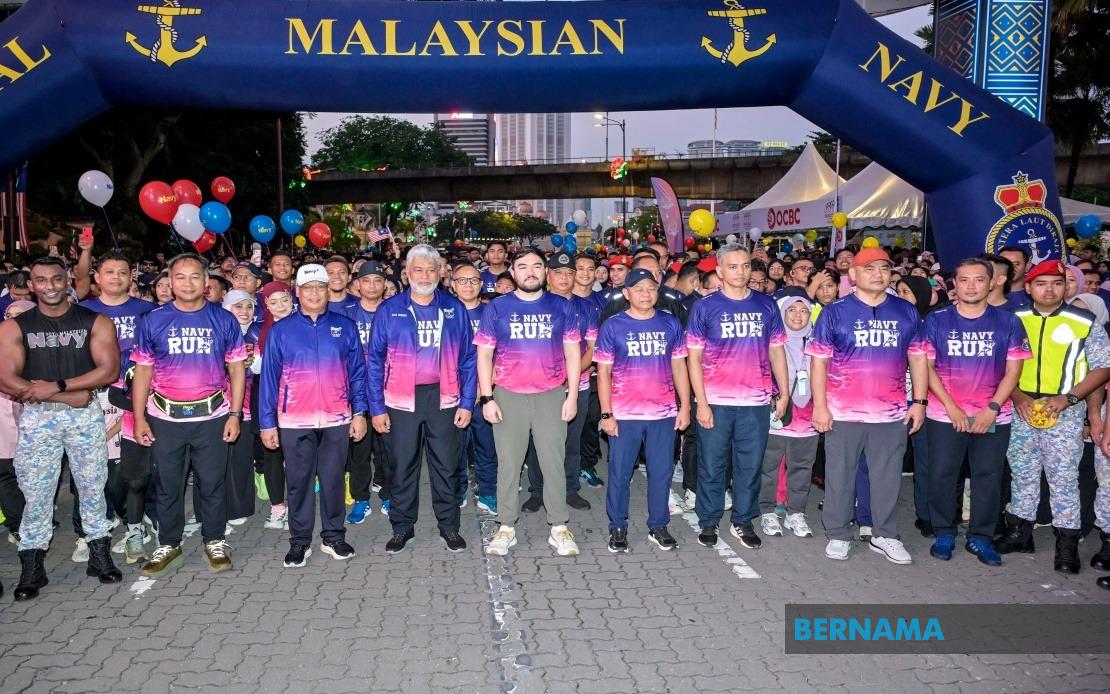
The Raja Muda of Selangor, Tengku Amir Shah Sultan Sharafuddin Idris Shah, formally launched the Navy Run 2026 at Dataran DBKL, setting off the nation's largest iteration of the annual fitness event to date. The seven-kilometre community run attracted an unprecedented 15,000 participants, underscoring growing public interest in a programme that has become a fixture on Malaysia's sporting calendar since its inaugural edition in 2023. The royal patron demonstrated his commitment to the initiative by completing the entire course alongside ordinary runners, a gesture that highlighted the event's inclusive nature and accessibility across all fitness levels.
The fourth edition benefited from high-profile attendance, with Royal Malaysian Navy Chief Admiral Tan Sri Dr Zulhelmy Ithnain, Kuala Lumpur Mayor Datuk Fadlun Mak Ujud, and Lumut Naval Shipyard Sdn Bhd Chief Executive Officer Azhar Jumaat present throughout the proceedings. Their participation underscored the collaborative approach involving military leadership, municipal administration, and defence industry stakeholders in promoting public engagement with Malaysia's maritime security apparatus. The convergence of these figures reflected the broader institutional support underpinning the Navy Run's expansion into a major community event.
Beyond the physical participation of thousands, the Navy Run 2026 extended its reach through digital infrastructure, with proceedings simultaneously broadcast live and attended remotely by naval personnel stationed at RMN bases across Lumut, Kuantan, and Kota Kinabalu. This hybrid format represented an evolution in how defence organisations engage with distributed military communities while maintaining central coordination and visibility. Such technological integration demonstrates how contemporary Malaysian institutions leverage connectivity to foster cohesion across geographically dispersed operational locations.
The Royal Malaysian Navy articulated an explicit strategic purpose underlying the event, positioning Navy Run as more than recreational athletics. According to the service's statement, the initiative functions as a substantive platform for public-military interface, designed to deepen familiarisation between civilian society and maritime defence capabilities. The framing emphasised how such engagement generates trust and institutional legitimacy through direct personal interaction, transforming abstract notions of defence into tangible human connection.
From a civil-military relations perspective, the Navy Run's expansion reflects contemporary understanding that defence effectiveness depends partly on public confidence and informed citizenship. By inviting 15,000 Malaysians to participate directly in an RMN-organised event, the service created organic opportunities for civilians to associate naval professionalism with community values. This approach contrasts with traditional models relying primarily on formal communication channels, instead enabling grassroots exposure to military institutions through shared recreational experience.
The supporting programming enhanced the event's educational and entertainment dimensions substantially. An aerobics session provided accessible physical activity content for varying fitness levels, whilst performances by the RMN Central Band created cultural resonance and professional polish. The inclusion of a silent drill display offered spectacle that illustrates naval discipline and precision to civilian audiences, translating military training into visually compelling demonstration. Concurrently, the RMN career exhibition provided direct recruitment and information pathways for potential military personnel or defence-sector professionals, converting the event into a practical talent-acquisition mechanism alongside civic engagement.
The lucky draw component ensured participation incentives extended beyond the intrinsic satisfaction of physical exertion, potentially broadening appeal to demographics less motivated purely by running. Such gamification elements reflect recognition that successful large-scale community events require multi-layered appeal addressing varied participant motivations. The prize structure thus functioned as inclusive mechanism rather than exclusive inducement, theoretically welcoming both dedicated athletes and casual fitness enthusiasts.
Navy Run's growth trajectory from introduction in 2023 through the 2026 edition's record turnout indicates successful positioning within Malaysia's annual event calendar. The progression from initial concept to 15,000-participant extravaganza within three years suggests the programme has identified genuine demand for civilian-military engagement platforms. For Malaysian readers, this expansion reflects broader national conversations about defence awareness and civil-military integration at community levels.
The geographical distribution of participating bases—spanning peninsular locations in Lumut and Kuantan alongside the Sabah-based Kota Kinabalu facility—underscores the Navy Run's national rather than merely Selangor-centric significance. This distribution acknowledges Malaysia's maritime interests spanning both peninsular and East Malaysian waters, demonstrating institutional commitment to inclusive defence culture across federal boundaries. The simultaneous participation structure ensures personnel deployed far from the capital can participate meaningfully in flagship RMN initiatives.
For regional observers, Malaysia's Navy Run exemplifies how Southeast Asian defence establishments increasingly prioritise public engagement beyond traditional military-focused audiences. The involvement of the Raja Muda validates defence activities through royal patronage whilst democratising access to normally insular institutions. This model potentially offers templates for other ASEAN nations considering strengthened civil-military communication mechanisms that build confidence without compromising operational security.
The Navy Run's success in attracting record participation also reflects Malaysian society's growing health consciousness and appetite for organised running events. The run capitalises on broader fitness trends whilst channelling participation toward defence-related objectives, creating mutual benefit whereby the RMN gains visibility and public engagement whilst runners access a professionally organised event with compelling institutional backing and comprehensive supporting programming.
Looking forward, the Navy Run's demonstrated scalability suggests potential for continued expansion, though organisers will likely contemplate capacity management and sustainability questions as participation plateaus or approaches venue limitations. The precedent of record-breaking 2026 turnout establishes a baseline from which future editions either consolidate current momentum or pursue further growth, each trajectory carrying different implications for resource allocation and strategic civil-military engagement planning.

