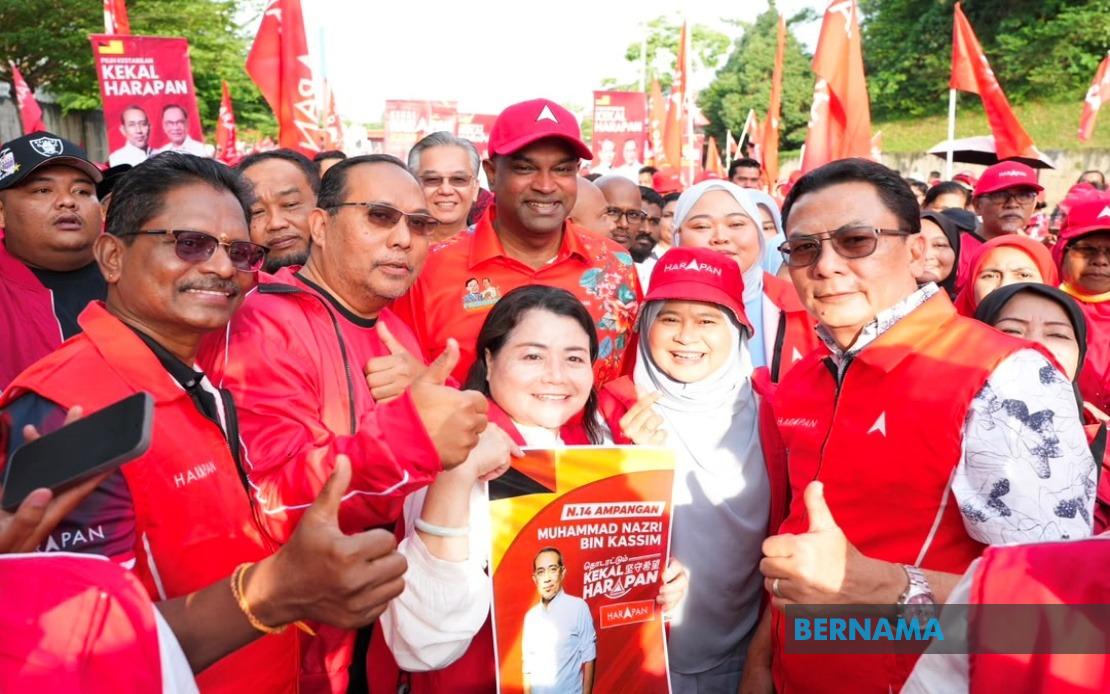
High-profile leadership from Pakatan Harapan converged at the Seremban City Council Building on July 18 to throw their weight behind six party candidates standing in the 16th Negeri Sembilan state election. PKR vice-president and Sungai Buloh MP Datuk Seri R. Ramanan attended the nomination ceremony at Wisma MBS alongside key coalition figures, signalling unified party support as the campaign period formally commenced. The display of senior party machinery reflected broader coalition efforts to consolidate voter backing ahead of polling day on August 1.
The six candidates receiving official backing span constituencies across the state. Nor Azman Mohamad will contest in Sikamat, while Datuk Muhammad Nazri Kassim represents Ampangan. Zarinna Abu Zarin is the PH candidate in Lenggeng, with Chew Seh Yong standing in Lobak. The party has fielded J. Arul Kumar in Nilai and Ho Weng Wah in Temiang. This slate of candidates represents the coalition's attempt to retain influence in a state where it previously held significant ground, though the 16th election will test whether PH can consolidate its support across diverse constituencies.
DAP deputy secretary-general Steven Sim's presence at the nomination centre underscores the multi-ethnic character of the Pakatan Harapan coalition, bringing the Democratic Action Party's organisational muscle to complement PKR's mobilisation efforts. The appearance of such senior figures at the nomination stage, rather than merely during campaign rallies, demonstrates that coalition leadership views this state election as strategically important. For Negeri Sembilan, which has 36 State Legislative Assembly seats up for contestation, securing strong showings in multiple constituencies remains crucial to any party's ability to form government.
Ramanan's remarks highlighted the coalition's confidence in its ground organisation and volunteer networks. He characterised the attendance of supporters and party machinery as evidence of robust commitment to the campaign ahead. His statement that party workers would "continue engaging with the people and work tirelessly throughout the campaign period" reflects standard pre-election rhetoric, yet the emphasis on constituency-level machinery suggests PH recognises that modern state elections are decided through granular, ward-by-ward mobilisation rather than broad messaging alone. The coalition appears to be banking on intensive grassroots organisation to translate whatever broader political sentiment favours them into actual seats.
The campaign timeline compressed into a fortnight presents both opportunities and constraints. With the nomination period concluded on July 18, candidates and their teams have until July 31 to campaign before the August 1 polling day. This condensed schedule means that early voting on July 28 will capture a significant portion of the electorate before the final intensive campaign push. For Pakatan Harapan, the early presence of senior leaders at nomination centres serves a dual purpose: it energises grassroots volunteers whose effort will be essential during this compressed timeframe, and it signals to voters that the coalition takes the election seriously.
Negeri Sembilan's political landscape has undergone considerable shifts in recent years. The dissolution of the state assembly on June 5 triggered this election, creating a fresh slate where previous incumbents cannot claim automatic advantage. PH's ability to field candidates across multiple constituencies and secure visible backing from national leadership suggests the coalition has invested in candidate selection and campaign readiness. However, the diversity of constituencies, ranging from urban centres like Nilai to more rural areas like Sikamat and Temiang, means the coalition must calibrate its messaging to appeal across different demographic and economic profiles.
The presence of both PKR and DAP at the nomination centre illustrates the coalition's structure as a multi-party arrangement rather than a monolithic entity. While this diversity provides electoral advantages—enabling the coalition to present different faces to different voter groups—it also requires careful coordination. Competition between coalition partners for favourable seat allocations and campaign resources remains a perpetual challenge in Malaysian coalition politics. The unified public front displayed at Wisma MBS masks ongoing internal negotiations about which party contests which seats and how campaign resources are distributed.
Malaysian state elections have increasingly become proving grounds for national political trends and shifting voter preferences. Negeri Sembilan, positioned between the Klang Valley and southern Johor, encompasses constituencies that span urban, suburban, and rural voters. The state's mixed electorate—combining Malay-Muslim majority areas with significant Chinese and Indian communities—makes it representative of broader Malaysian demographic patterns. How Pakatan Harapan performs here will provide indicators for potential future general elections regarding the coalition's ability to mobilise support across different community lines.
For regional political observers monitoring Malaysian politics, the Negeri Sembilan election offers a smaller-scale test of current political dynamics without the complexity of a national ballot. Voter turnout, the performance of specific candidates, and shifts in traditional strongholds will all provide data points for understanding whether the political realignments visible at previous elections have stabilised or continue evolving. The coalition's investment in fielding candidates across multiple constituencies and securing high-level backing suggests it believes Negeri Sembilan remains competitive and worth resource allocation.
The campaign period beginning July 18 will determine whether PH's grassroots mobilisation translates into electoral success. Ramanan's emphasis on party machinery and community engagement highlights that in contemporary Malaysian elections, victory depends less on charismatic national figures than on how effectively candidates and volunteers connect with voters at the constituency level. The six candidates backed by senior PH leaders will ultimately succeed or fail based on their individual appeal and their ability to articulate why voters should choose them over opponents from rival coalitions.

