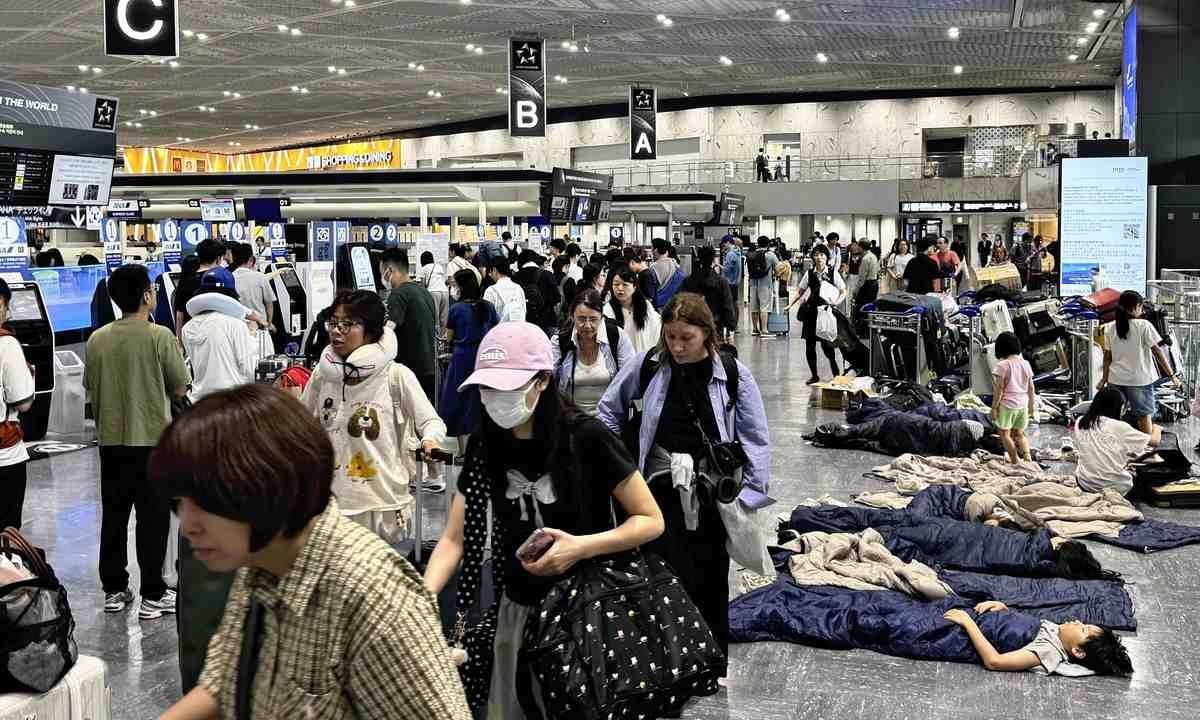
Japan's Chiba Prefecture faced a major transportation crisis on Thursday as record-breaking heavy rainfall triggered widespread service cancellations, trapping more than 10,000 residents and travellers unable to return home. The deluge prompted an emergency response that extended into Friday, with authorities mobilising shelters and military transport assistance to manage the humanitarian fallout from the unprecedented weather event.
The cascading effect of suspended train services created a bottleneck of stranded commuters throughout the prefecture. One of the most visible impacts occurred at Narita International Airport, where approximately 7,000 people spent the night in the passenger terminal after buses and trains connecting to central Tokyo ceased operations. Airport authorities distributed sleeping bags, drinking water, and food rations to those forced to remain at the facility. The suspension of ground transport links represented a significant disruption to one of East Asia's busiest aviation hubs, underscoring the severity of the weather conditions.
Locally, the situation proved equally desperate for residents. The area surrounding JR Soga Station became partially submerged, with floodwaters rising to waist level in certain sections. Approximately 4,000 people sheltered within the station building overnight, waiting for conditions to improve sufficiently for safe passage. This scene exemplified the vulnerability of Japan's railway infrastructure to extreme weather, particularly in coastal prefectures prone to seasonal storms and unprecedented rainfall patterns.
Chiba prefectural authorities moved swiftly to establish emergency shelter capacity in response to the crisis. By Thursday evening at 7pm, temporary accommodation had been activated at the prefectural government building and the nearby Chiba Prefectural Enterprise Bureau building, both located in Chuo Ward, Chiba City. These two facilities alone provided capacity for approximately 1,700 displaced persons. An additional 11 locations across Chiba City, including the prefectural government headquarters, were designated as emergency shelters as the situation developed and demand for safe accommodation increased.
The scale of the overnight displacement raised questions about disaster preparedness in one of Japan's most densely populated metropolitan regions. With thousands scattered across train stations, airport terminals, and makeshift shelter facilities, the prefecture's emergency services faced significant logistical challenges in coordinating care and information provision. The reliance on temporary measures highlighted gaps in infrastructure resilience when transportation networks collapse under extreme weather stress.
Recognising the scope of the humanitarian emergency, Chiba Prefecture submitted a formal disaster dispatch request to Japan's Self-Defence Forces on Friday morning. The military responded promptly, deploying buses to begin transporting stranded individuals from various locations to the prefectural cultural hall in Chiba City. These operations commenced shortly after 6.30am, marking the escalation from civilian emergency management to coordinated military assistance. This step signalled both the severity of the situation and the established protocols for natural disasters within Japan's emergency response framework.
The implications of this event extend beyond immediate disruptions. For Malaysian and Southeast Asian observers, the incident demonstrates how developed economies with sophisticated infrastructure remain vulnerable to climate-related shocks. Japan's experience with record-breaking rainfall illustrates a pattern increasingly affecting the broader Asian region. Climate change is intensifying precipitation events, and nations across Southeast Asia—already dealing with monsoon systems and typhoons—face rising exposure to similar transportation paralysis and mass displacement scenarios.
The incident also reflects the particular vulnerability of transport hubs and modern cities to cascading infrastructure failures. When railway networks shut down simultaneously, the alternative systems—airports, bus services, road networks—become overwhelmed within hours. This pattern has parallels in Malaysian cities, where heavy monsoon rains periodically disrupt the Klang Valley and other metropolitan areas. The Chiba case study offers instructive lessons about shelter capacity planning, inter-agency coordination, and the necessity for redundancy in critical transport systems.
For Japan, record-breaking rainfall events have become increasingly frequent, prompting ongoing debates about climate adaptation and infrastructure upgrading. The Self-Defence Forces' deployment for weather-related disasters, once exceptional, has become routine in recent years. This normalisation of military involvement in civilian disaster response suggests that Japan, like many nations in the region, views extreme weather not as aberration but as an emerging structural challenge requiring permanent institutional readiness.
The immediate crisis resolved as conditions stabilised, but the episode underscores the fragility of modern urban systems when natural forces exceed historical parameters. For Southeast Asian governments and planners, the Chiba incident serves as a cautionary reminder that even nations with advanced early warning systems, robust infrastructure, and efficient bureaucracies face limits when weather patterns shift beyond recorded norms. Building resilience into transport networks and establishing clear protocols for mass displacement will become essential policy priorities across the region in coming decades.

