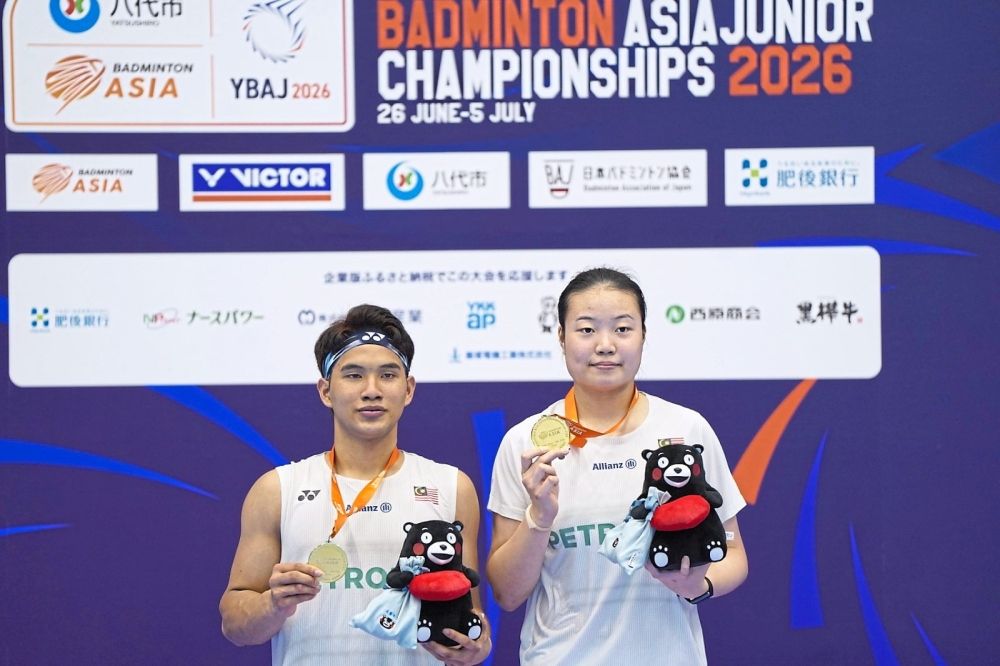
Ahmad Redzuan Zulwaqqarizal and Low Zi Yu have restored Malaysia to the mixed doubles throne at the Asian Junior Championships, capturing a title that has eluded the nation for nearly two decades. The pair's victory over China's Zheng Weigang and Li Menghan in Yatsushiro, Japan, marks the first Malaysian triumph in this category since Tan Wee Kiong and Woon Khe Wei claimed gold in Kuala Lumpur in 2007—a gap of 19 years that speaks to the challenges faced by Malaysia's junior badminton programme in competing at the continental level.
The final was anything but straightforward, with the Malaysian combination pushed to the brink before ultimately prevailing 21-15, 22-20 in a match lasting 43 minutes. The turning point came during a tightly contested second game where Redzuan and Zi Yu found themselves just two points away from clinching the title, only to see their Chinese opponents mount a furious rally that forced the match into a decider. The composure displayed at this critical juncture—particularly when the game reached 20-20—revealed a maturity that belied Zi Yu's youth and Redzuan's earlier struggles at this tournament.
Zi Yu credited patience as the decisive factor in navigating the pressure-cooker environment of a championship final. The 15-year-old observed that the Malaysian pair maintained greater focus during the crucial moments, while the support from their teammates watching from the sidelines provided an unexpected psychological boost. Even though several Malaysian players had already been eliminated from their respective events, their vocal encouragement served as a reminder that individual glory is intertwined with team spirit—a dynamic that appears to have made a tangible difference when the match hung in the balance. This speaks to a cultural strength within Malaysian badminton that, when properly harnessed, can elevate performance under duress.
For Redzuan, the achievement carries special resonance given his journey through three consecutive editions of the championships without tasting success at the senior level. The Terengganu-born player made his debut at the 2023 edition in Yogyakarta, competing in both boys' doubles and mixed doubles, but early exits dampened what should have been an exciting entry into the junior international circuit. Rather than serving as a deterrent, these setbacks accumulated into a reservoir of motivation. His repeat appearances at the 2024 Yogyakarta championships and the 2025 Surakarta tournament kept him focused on the longer arc of development, setting the stage for this breakthrough performance in the mixed doubles partnership with Zi Yu.
Redzuan's reflection on his performance demonstrated both humility and ambition. While satisfied with his execution—having successfully implemented strategies worked on during training sessions—he immediately pivoted to identifying areas requiring further refinement as he prepares for the professional ranks. This mindset is crucial for Malaysian badminton, which must produce players capable of competing at world level beyond the junior circuit. The pathway from junior success to senior prominence has been inconsistently navigated by Malaysian players, making Redzuan's clear-eyed assessment of his own development encouraging.
Zi Yu's ability to manage two concurrent events at the championships demonstrated both tactical flexibility and mental resilience. The teenage shuttler competed in girls' doubles alongside her mixed doubles campaign, a demanding schedule that required psychological agility and physical stamina. She ultimately secured a bronze medal in girls' doubles after losing 21-16, 17-21, 17-21 to Japan's seeded pairing of Aoi Banno and Yuzu Ueno in the semi-finals. The fact that this defeat did not derail her concentration for the mixed doubles final speaks to a composure that will serve her well in the years ahead.
Zi Yu's approach to managing multiple partnerships provides insight into modern badminton coaching philosophy. Rather than attempting to homogenise her play across different formats and partners, she focused on trusting her counterparts while maintaining disciplined execution of her own role. She highlighted that both her mixed doubles partner Redzuan and her girls' doubles partner Genevie Lim possessed the individual capability to manage themselves on court, freeing her to concentrate on consistency rather than shepherding less capable teammates. This selective delegation—accompanied by encouragement when errors occurred—suggests a maturity in how she approaches the psychological dimensions of doubles play.
The broader context of Malaysia's performance at the Asian Junior Championships reveals a badminton programme attempting to rebuild depth across multiple categories. While Redzuan and Zi Yu claimed gold in mixed doubles, Malaysia's presence across the five major categories remained relatively modest. Their achievement therefore assumes importance not merely as a title, but as a proof of concept that Malaysian junior pairs can compete and win against established badminton powers, particularly China. This validation comes at a time when Malaysian badminton is striving to maintain competitiveness in an increasingly challenging Asian landscape.
The 19-year gap since Malaysia's previous mixed doubles title at this championship underscores structural challenges that have affected the country's junior development pipeline. Between 2007 and 2024, other nations—most notably China and Japan—have invested substantially in junior badminton infrastructure and coaching expertise. The fact that Redzuan and Zi Yu succeeded despite this competitive environment suggests that targeted investment in promising young players can still yield dividends. The championship results in other categories—with victories spread across China, Japan, and Taiwan—illustrate that the junior landscape remains genuinely competitive, making Malaysia's mixed doubles success particularly noteworthy.
Looking forward, the trajectory of both Redzuan and Zi Yu will merit close monitoring. The mixed doubles victory provides a platform for both players to build ascending careers, but the transition from junior to senior competition invariably culls many promising talents. Redzuan's demonstrated resilience and willingness to improve, combined with Zi Yu's multidimensional skill set, suggests they possess the mental and technical foundations required for senior-level success. If they can sustain their partnership while developing independently as players, they may contribute to a resurgence in Malaysian mixed doubles competitiveness at senior international level.

