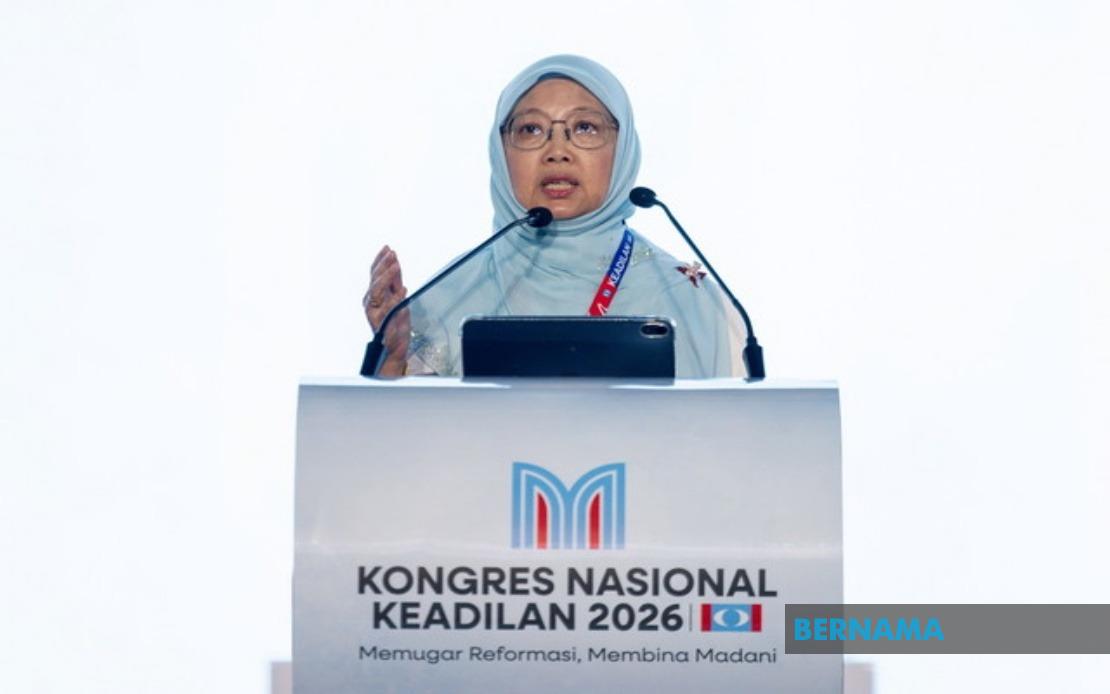
The attainment of government office represents not a culmination but rather a critical inflection point for Malaysia's two-decade-long reform movement, according to PKR vice president Datuk Seri Dr Zaliha Mustafa, who delivered her remarks during the party's 2026 National Congress in Melaka. Speaking at the Melaka International Trade Centre, she redirected focus away from the symbolic achievement of political power toward the substantive work of transforming how Malaysia functions as a nation.
Mustafa's intervention at the congress underscored a fundamental conceptual divide that has long animated PKR's political philosophy. The party's quarter-century struggle, she contended, should never be reduced to a mere mechanism for rotating which coalition occupies the administrative apparatus. Such a framing would fundamentally misrepresent the ideological foundations upon which the reform movement was constructed. Rather, the objective has consistently centred on reimagining governance structures, redistributing power, and recalibrating the relationship between state institutions and the citizens they ostensibly serve.
This distinction carries particular resonance for Malaysian observers who have witnessed numerous transitions in electoral fortunes without corresponding shifts in institutional behaviour. Mustafa's argument essentially suggests that the Reformasi movement risks becoming hollow if it treats electoral victory as terminal rather than transitional. The danger, implicit in her remarks, is that PKR could become indistinguishable from the political formations it once challenged, merely substituting personnel while maintaining structures that facilitate the concentration of authority and the suppression of accountability mechanisms.
In articulating the substantive agenda that should define PKR's tenure in government, Mustafa identified several interconnected priorities. Institutional strengthening must form the bedrock, she argued, creating architecture capable of resisting the personalisation of power that has historically characterised Malaysian governance. Simultaneously, the anti-corruption apparatus requires genuine independence and resources, a position that stands in contrast to the instrumentalisation of such mechanisms in earlier administrations. Justice, moreover, cannot remain a commodity distributed unequally across Malaysia's socioeconomic strata but must become tangible across all segments of society.
A particularly noteworthy aspect of Mustafa's intervention involved her explicit permission for party members to police themselves. This call for internal accountability represents a departure from the defensive posturing that often characterises governing coalitions, which typically circle wagons when members face scrutiny. By explicitly endorsing criticism and correction within PKR's ranks, Mustafa suggested that institutional credibility depends upon the willingness to apply standards consistently, even when doing so proves politically inconvenient.
The timing of the congress provided context for these reflections, as PKR president Datuk Seri Anwar Ibrahim had previously referenced the historical example of Khalifah Umar Abdul Aziz, invoking the caliph's measured approach to implementing comprehensive reform. Mustafa extended this analogy, arguing that genuine transformation requires calibrated implementation rather than wholesale overnight upheaval. The distinction between gradual change and indefinite postponement, she maintained, lies in maintaining directional clarity and demonstrating consistent forward momentum toward articulated objectives.
Yet even as Mustafa emphasized the importance of measured reform, she pushed back against the notion that caution should mask reluctance. The challenge, she articulated, involves identifying which transformations can be executed immediately with available resources and political capital, which require negotiation and consensus-building to ensure durability, and which demand extended timeframes for institutional adaptation. Without this calculus, reform movements risk either overextending themselves into failure or being perceived as having abandoned their original commitments.
A secondary but increasingly critical concern emerged in Mustafa's discussion of communication infrastructure and narrative management. Malaysian political parties have traditionally struggled to connect policy achievements with public understanding, a gap that opposition forces routinely exploit through social media and grassroots communication channels. Mustafa's observation that governments cannot assume citizens will intuitively comprehend accomplishments absent explicit explanation addresses a perennial failure mode in Malaysian public administration, where policy announcements often prove disconnected from popular comprehension or sentiment.
The deputy president's emphasis on mastering social media discourse reflects contemporary political reality in Southeast Asia, where online spaces have become battlegrounds for legitimacy and credibility. PKR's vulnerability to sustained opposition narrative dominance in these platforms has already cost the coalition political ground in successive electoral contests. Her explicit warning against ceding this terrain suggests recognition that institutional performance alone, however genuine, cannot translate into popular support without effective communication mediating the relationship between government action and public consciousness.
Mustafa's framework introduces a necessary tension into PKR's governing philosophy. By insisting that numerical and policy victories do not automatically generate popular acceptance, she acknowledges that political legitimacy depends upon emotional resonance and narrative persuasiveness alongside substantive achievement. This recognition, while obvious in retrospect, often eludes governments that assume their own righteousness will eventually overcome opposition messaging. The Malaysian context, where competing narratives regarding governance, corruption, and institutional integrity circulate continuously across multiple platforms, makes this insight particularly applicable.
The broader significance of Mustafa's congress address lies in its recalibration of what success should mean for PKR in government. Rather than accepting the conventional benchmarks of electoral durability or legislative effectiveness, she has proposed a more demanding standard: genuine institutional transformation that changes not merely who governs but how governing occurs. This repositioning establishes a framework against which PKR's performance can eventually be measured, creating accountability even as the party occupies positions of executive power.
For Malaysian observers concerned with institutional quality and governmental accountability, Mustafa's remarks signal that at least some PKR leadership recognizes the pitfalls that have historically transformed reform movements into mere vehicles for personal or factional advancement. Whether the party's broader membership and government representatives will maintain this focus remains an open question, one that will likely define PKR's legacy over the coming years.

