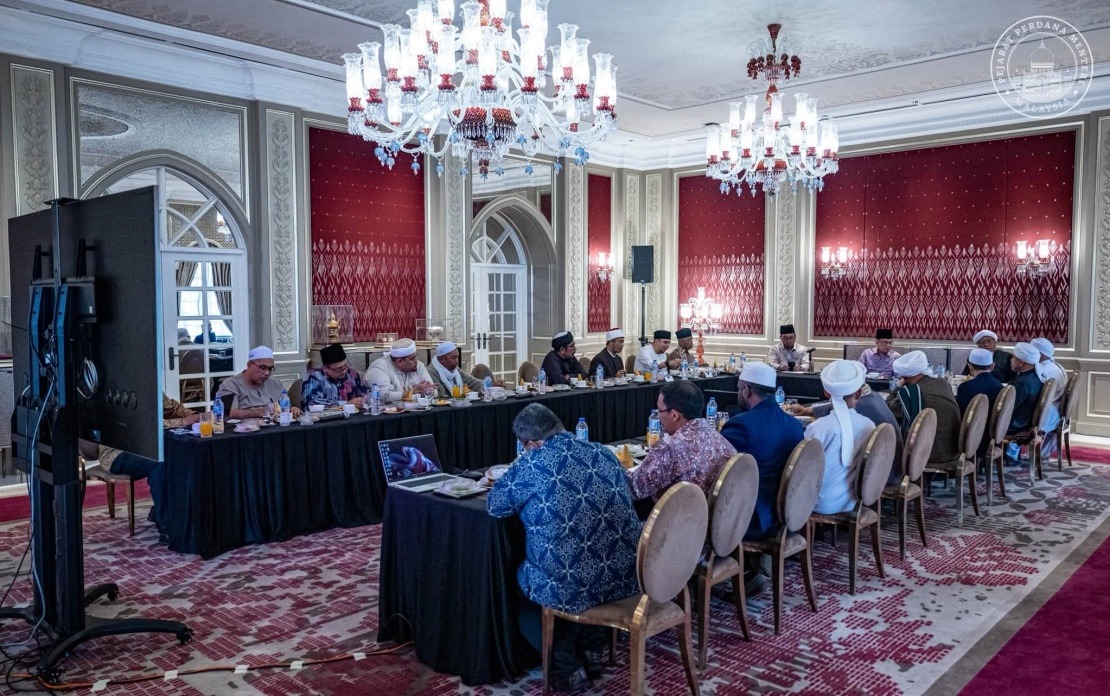
Prime Minister Datuk Seri Anwar Ibrahim has underscored the strategic importance of engaging Malaysia's Islamic scholarly community in the policymaking process, characterizing such interactions as essential mechanisms for ensuring government initiatives are intellectually rigorous and spiritually aligned. Speaking through a social media post on August 27, Anwar framed these consultations not as perfunctory ceremonial meetings but as deliberative forums where officials actively seek guidance, validate approaches against Islamic principles, and calibrate policies to address evolving community requirements.
The Prime Minister's remarks came during a series of muzakarah—traditional Islamic scholarly discussions—organized to commemorate Maulidur Rasul, the birthday of the Prophet Muhammad. During the afternoon session, Anwar engaged with Sheikh Dr Muhyiddin Awwamah, a representative of Darul Hadis al-Awwamiyyah, a respected Islamic institution known for its focus on hadith scholarship and Islamic jurisprudence. This particular engagement reflects a broader pattern of the government seeking counsel from established Islamic intellectual centers across Malaysia and the broader Muslim world.
The selection of Sheikh Dr Muhyiddin carries particular significance given his lineage within Islamic scholarship. As the son of Al-'Allamah Sheikh Muhammad bin Awwamah, a distinguished hadith expert whose contributions have earned widespread recognition across Islamic academic circles, the younger scholar represents continuity in a longstanding tradition of rigorous Islamic learning. Such generational connections underscore how knowledge transmission within Islamic scholarly traditions operates through both institutional frameworks and family networks, creating deep reservoirs of expertise spanning decades.
Anwar's approach reveals a conception of governance that views religious consultation not as a constraint on executive decision-making but as a mechanism for enhancing policy quality and legitimacy. By characterizing advice from scholars as essential refinement mechanisms, the Prime Minister suggests that government proposals benefit from critical examination through the lens of Islamic jurisprudence and theological understanding. This framework implies that contemporary governance challenges—from economic policy to social welfare to technological regulation—benefit from examination through both secular expertise and religious wisdom.
The temporal dimension emphasized in Anwar's statement—specifically the phrase "demands of the times"—indicates recognition that Islamic principles require contextual application. Rather than viewing Islamic law as static doctrine, this approach acknowledges that while foundational principles remain constant, their implementation must evolve to address contemporary circumstances, from digital economy questions to environmental sustainability to public health crises. This interpretive flexibility has historically characterized Islamic scholarship at its strongest, when successive generations of jurists engaged in careful reasoning to extend established principles to novel situations.
Anwar's explicit appreciation for the literary and intellectual contributions of Sheikh Muhammad bin Awwamah signals the government's valuation of the scholarly tradition itself. By characterizing academic works as intellectual legacies rather than mere repositories of historical information, the Prime Minister emphasizes how Islamic scholarship creates continuity across generations, transmitting not just facts but frameworks for thinking about religious and social questions. This perspective potentially influences how the Malaysian government approaches the preservation and advancement of Islamic learning institutions, suggesting policy consideration for educational institutions and research centers engaged in this work.
The concept of the "chain of Islamic scholarly tradition" referenced by Anwar carries particular resonance in contemporary Malaysia, where questions about Islamic education, the role of religious authority, and the relationship between traditional scholarship and modern governance remain subjects of active debate. By invoking this continuity, the Prime Minister positions his government within a longer historical arc of Muslim leadership, implying that contemporary Malaysian governance draws legitimacy not only from democratic procedures but from alignment with enduring Islamic intellectual traditions.
The practical implications of this consultative approach extend across multiple policy domains. When government agencies developing education curricula, welfare programs, financial regulations, or public health initiatives consult with religious scholars, the resulting policies potentially carry enhanced credibility within religiously observant constituencies. For a multiethnic, multireligious nation like Malaysia where Islam holds a constitutionally recognized special position, such engagement may help bridge gaps between secular governance structures and Islamic community expectations.
However, the effectiveness of such dialogue depends substantially on the nature of the engagement and the diversity of scholarly voices involved. Consultations that represent broad cross-sections of Islamic thought—including different jurisprudential schools, generational perspectives, and approaches to interpreting Islamic law—may produce more robust policy outcomes than those reflecting narrower intellectual traditions. The inclusiveness and transparency of such processes ultimately determine whether they genuinely enhance policy quality or merely provide symbolic legitimation for predetermined decisions.
For Southeast Asian observers, Malaysia's explicit integration of Islamic scholarly consultation into governance structures offers instructive lessons about accommodating religious perspectives within secular institutional frameworks. As other Muslim-majority nations grapple with balancing democratic governance, religious community expectations, and rapid social change, Malaysia's approach of institutionalizing scholarly dialogue—rather than either marginalizing religious voices or permitting them to dominate decision-making—represents one model among several possible arrangements.
The government's emphasis on listening to scholarly voices also potentially shapes public discourse about the relationship between Islamic authority and democratic governance. By publicly valuing religious expertise and treating scholar input as substantive rather than decorative, officials may influence how religious institutions and secular authorities are perceived as interdependent rather than inherently competitive. This rhetorical positioning could have cumulative effects on how Malaysians understand legitimate governance, particularly among constituencies that have experienced tensions between religious identity and participation in secular political processes.

