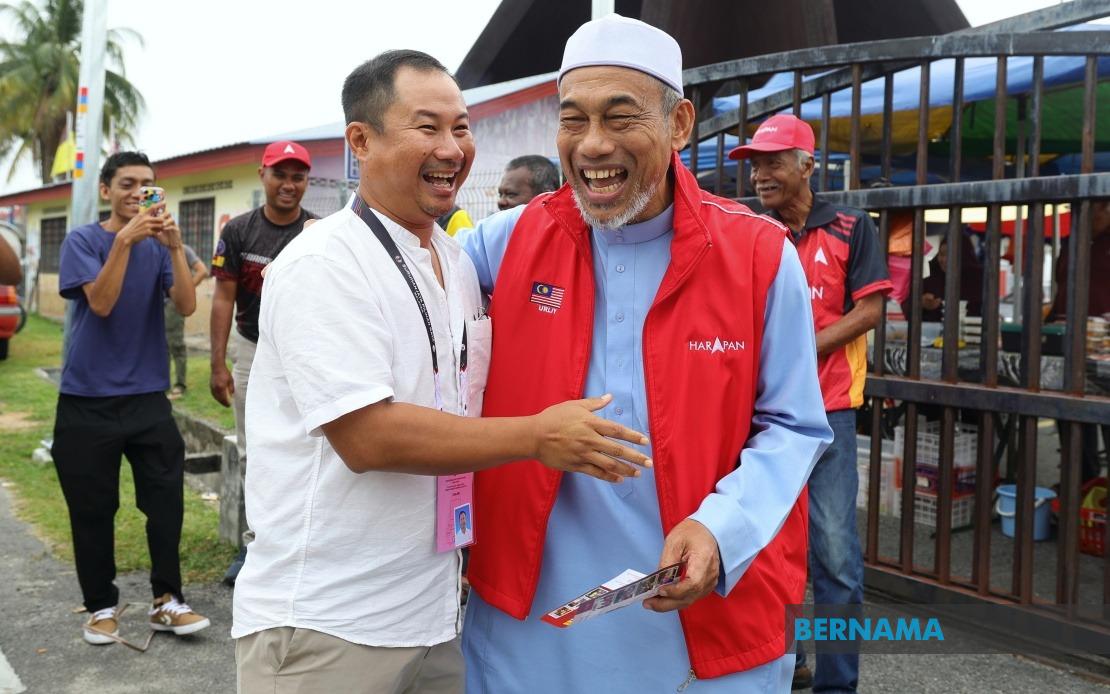
The Negeri Sembilan state election campaign has taken on a uniquely personal dimension in the Klawang constituency, where family ties have intersected with political rivalry in a way that has drawn considerable public interest. On the campaign trail at Kuala Klawang's weekend market, incumbent Datuk Bakri Sawir of Pakatan Harapan and his cousin Danni Rais, representing Perikatan Nasional, encountered each other while canvassing voters on the second day of active campaigning. The moment captured the attention of market-goers, who seized the opportunity to photograph and document the unusual scene of two family members simultaneously working to secure votes in the same constituency.
The coincidental meeting between the two candidates at the marketplace highlighted a broader question about electoral conduct and personal relationships in Malaysian politics. Rather than the encounter devolving into confrontation, both Bakri and Danni proceeded with their respective campaigns in adjacent areas of the market, maintaining professional composure throughout. Observers noted that the candidates even managed to share light moments and exchange jokes with one another, a display of personal civility that stands in contrast to the increasingly heated rhetoric that sometimes characterises political competitions at the state level.
Bakri's approach to the contest reflects a philosophical stance that transcends the immediate partisan struggle. When speaking to reporters, he emphasised that facing his cousin at the ballot box was not extraordinary or noteworthy, but rather an ordinary manifestation of the democratic process through which candidates present their service platforms to constituents. This framing depoliticises the family dimension and repositions the election as a straightforward opportunity for the electorate to choose between competing visions for local governance and development.
The incumbent's commitment to maintaining electoral standards extends beyond rhetoric into practical action. Bakri noted that when the Jelebu District Council objected to campaign flags that had been installed on the stadium fence, his team immediately complied by removing them. This incident, while seemingly minor, underscores a willingness to subordinate partisan objectives to the rule of law and regulatory requirements. Bakri articulated a fundamental principle about political leadership: candidates who seek public trust must first demonstrate respect for existing legal frameworks and institutional procedures.
Bakri's public reminder to all parties and party machinery to conduct campaigns in an orderly and respectful manner serves as an implicit call for the broader political establishment to maintain decorum throughout the election period. In a state where family connections and regional networks carry considerable weight, such appeals carry particular resonance. The emphasis on preserving harmony during the electoral process reflects awareness that communities benefit when political competition, however intense, operates within broadly accepted norms of civility and constitutional propriety.
The Klawang state seat represents a meaningful electoral contest given its voter demographics and the composition of the field. With 13,355 registered voters on the rolls, the constituency is substantial enough to require serious campaigning while remaining intimate enough that candidates can engage directly with communities. The three-cornered nature of the race introduces additional complexity, with Bersatu's Muhammad Adib Musa also in contention alongside the two cousins. This configuration means that voter fragmentation could determine the outcome, requiring all three candidates to build sufficiently broad coalitions to secure victory.
The electoral timeline established by the Election Commission structures the race toward conclusion within a relatively compressed period. Early voting has been scheduled for July 28, providing opportunities for those unable to vote on the main polling day, while the general election is set for August 1. This schedule compresses the campaign period and requires candidates to use their time efficiently, making the marketplace encounters and community engagement that both Bakri and Danni have undertaken particularly valuable as mechanisms for reaching voters directly.
From a broader Malaysian political perspective, the Klawang race exemplifies the intersection of personal relationships and party affiliation that characterises electoral politics in the country. Families often span multiple political parties, reflecting either different ideological commitments or strategic positioning over successive electoral cycles. The fact that Bakri and Danni have chosen to manage their political differences with mutual respect and cordiality sets a constructive tone for how such situations can be navigated without damaging personal relationships or community harmony.
The incumbent's emphasis on healthy campaigning and adherence to regulations also reflects an understanding that electoral conduct establishes precedents for how political discourse operates within communities. When candidates demonstrate restraint, respect institutional constraints, and prioritise civility, they model behaviour that can influence broader political culture. Conversely, campaigns characterised by acrimony and rule-breaking can normalise more destructive patterns of political engagement.
For Malaysian voters in Klawang and observers monitoring Negeri Sembilan's electoral process more broadly, the conduct of Bakri and Danni during this campaign offers a reminder that political competition need not preclude personal respect or adherence to democratic norms. The cousins' approach suggests that elections can simultaneously be serious contests for power and for ideas while maintaining the civility and institutional respect that democratic systems require to function effectively. This balance, demonstrated at the marketplace level through direct voter engagement, ultimately contributes to the health of Malaysia's electoral democracy and the sustainability of public confidence in democratic processes.

