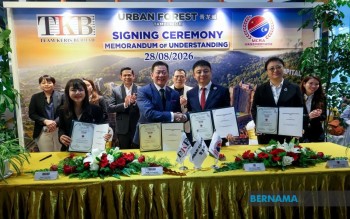
Team Keris Bhd (TKB) has unveiled plans for a transformative RM1 billion urban forest project spanning 84 acres in Tambun, Ipoh, marking a strategic pivot for Perak's tourism ambitions. Executed in partnership with RJJ Hotels Sdn Bhd and the Malaysian Chinese Restaurant Association (MCRA), the development is expected to catalyse sustained economic growth across the state once completed within three years. The initiative signals a deliberate effort to move Perak beyond its traditional domestic tourism profile, positioning it instead as a competitive player in the regional and international hospitality landscape.
The urban forest project builds deliberately upon existing infrastructure in the Tambun area, where attractions such as Lost World of Tambun have already established a foundation for leisure tourism. Rather than operating in isolation, the new development is designed as an integrated ecosystem that will amplify the appeal and capacity of the surrounding commercial and hospitality sector. Perak Tourism, Industry, Investment and Corridor Development Committee chairman Loh Sze Yee emphasised that the project represents an essential upgrade to international standards, acknowledging that merely adding more developments would be insufficient without corresponding improvements to quality and experience. The ambition extends beyond accommodating tourists—it aims to reshape how Ipoh and Perak are perceived by the global market.
At the heart of the development lies a sophisticated food and beverage strategy that leverages Malaysia's culinary diversity as a competitive asset. The urban forest will dedicate 40 per cent of its F&B operators to MCRA-affiliated establishments, predominantly Chinese restaurants, while allocating the remaining 60 per cent to other Malaysian operators. This deliberate composition reflects an understanding that international visitors increasingly seek authentic, locally rooted dining experiences rather than homogenised global chains. TKB group executive chairman Datuk Lee Seng Hee articulated the philosophy underlying this approach: food possesses the intrinsic power to draw visitors across geographical and cultural boundaries, making it a cornerstone of the broader visitor experience.
A particularly notable dimension of the F&B offering concerns halal-certified options, with 30 per cent of the overall culinary portfolio designated as Muslim-friendly. The MCRA is actively developing innovative halal selections, including halal dim sum, to accommodate diverse visitor demographics. This commitment addresses a growing market segment—Muslim travellers from Southeast Asia, the Middle East, and other regions—while simultaneously addressing domestic sensibilities around halal standards. The integration of halal certification into the marketing narrative also positions Perak as a forward-thinking destination that understands and respects the dietary requirements of an increasingly religiously diverse global tourism base.
The hospitality component, anchored by RJJ Hotels, introduces substantial international connectivity to the project. RJJ's affiliation with Jin Jiang Hotels, which operates over 40 hotel brands and maintains membership networks spanning more than 200 million people across 50 countries, provides unprecedented access to global distribution channels. This partnership effectively eliminates a traditional barrier facing Perak tourism—the perception that the state is difficult to reach or integrate into broader travel itineraries. Rather than positioning Ipoh as a secondary destination requiring extra logistical effort, the RJJ partnership enables travel agents and tour operators to package Perak as a standalone or integrated component of broader Southeast Asian holiday experiences.
RJJ Hotels chief executive officer Yap Lip Seng articulated the competitive advantage this connectivity affords, emphasising that international visitors arriving via Kuala Lumpur or Penang would receive seamlessly integrated packages eliminating travel friction. The strategy explicitly targets extended stays rather than brief overnight visits, with bundled offerings encompassing accommodation, meals, and curated experiences. This approach transforms the economics of tourism for participating operators—visitors committing to multi-night stays generate substantially higher per-capita spending than transit tourists. It also distributes visitor flows across more establishments within the ecosystem, dispersing economic benefits more broadly throughout the local community.
The emphasis on visitor experience extends beyond immediate consumption to encompass the entire journey. TKB Tours & Hospitality, a newly established subsidiary, coordinates the visitor experience holistically, integrating accommodation, dining, transport, and discovery activities. This integrated approach reflects contemporary tourism industry best practices, wherein competitive advantage accrues to destinations offering seamless, cohesive experiences rather than fragmented collections of independent attractions. The philosophy implicitly acknowledges that memorable travel experiences depend upon how comprehensively a destination addresses visitor needs—from practical logistics to emotional satisfaction.
The culinary dimension of the project carries particular significance for Malaysian food operators, providing exposure to affluent international tourists from Australia, Britain, and the United States. These markets represent substantial economic opportunity, as visitors from these regions typically possess higher disposable incomes than domestic or regional tourists. The partnership therefore functions as a form of export promotion, enabling Malaysian restaurants and food entrepreneurs to build international clientele and potentially establish operations in global markets. For MCRA member establishments, the urban forest essentially functions as an incubator for international brand development, mitigating the risks associated with direct overseas expansion by first establishing proven concepts in a controlled environment.
Beyond immediate commercial considerations, the project encompasses workforce development and skills upgrading. Gao Houyun, MCRA president, identified training and skills development as central to the collaboration, with the association committed to ensuring local operators and workers acquire capabilities meeting international hospitality standards. This emphasis on human capital development acknowledges that infrastructure alone cannot deliver world-class service experiences—these depend fundamentally upon the knowledge, attitudes, and capabilities of service workers. By embedding training into the project structure, the collaboration ensures that economic benefits extend beyond corporate entities to encompass improved earning capacity and career prospects for hospitality workers throughout Perak.
The project architecture also encourages localised supply chain development, with MCRA actively promoting opportunities for Chinese manufacturers of sauces, spices, and food ingredients to establish production facilities in Perak. This vertical integration strategy creates additional employment and investment opportunities while reducing ingredient costs through proximity to end-users. The supply chain dimension is particularly significant because it catalyses industrial clustering—the concentration of related businesses in geographic proximity—which historically generates innovation, competitive advantage, and sustained economic dynamism. By encouraging ingredient manufacturers to locate in Perak, the project creates foundation for longer-term industrial development beyond tourism itself.
Malaysia's halal certification framework emerges as a strategic asset within this development logic. Products and restaurant brands initially established in Perak can leverage Malaysia's globally recognised halal standards to expand into broader Southeast Asian markets, potentially generating export revenues and foreign investment. This recognition that halal certification functions as a tradeable asset reflects sophisticated economic thinking—the project does not merely serve tourists who visit Ipoh but creates platforms for Perak-based enterprises to expand internationally. The halal advantage is particularly significant in Southeast Asia, where Muslim-majority populations and growing religious consciousness among middle-class consumers create expanding demand for certified products and services.
The urban forest project ultimately represents a comprehensive strategy for economic repositioning rather than a simple hospitality development. It combines infrastructure investment, strategic partnerships, workforce development, supply chain integration, and international market linkage into a coherent framework designed to capture sustained economic benefits. For Malaysia more broadly, the project demonstrates how secondary cities like Ipoh can compete for international tourism through differentiation—emphasising authentic culinary experiences, cultural specificity, and integrated service ecosystems rather than attempting to replicate the offerings of established major destinations. The three-year completion timeline creates urgency around execution while the RM1 billion investment signals genuine commitment from participating entities. If successful, the Tambun urban forest may serve as a replicable model for tourism-led development in other Malaysian states.

