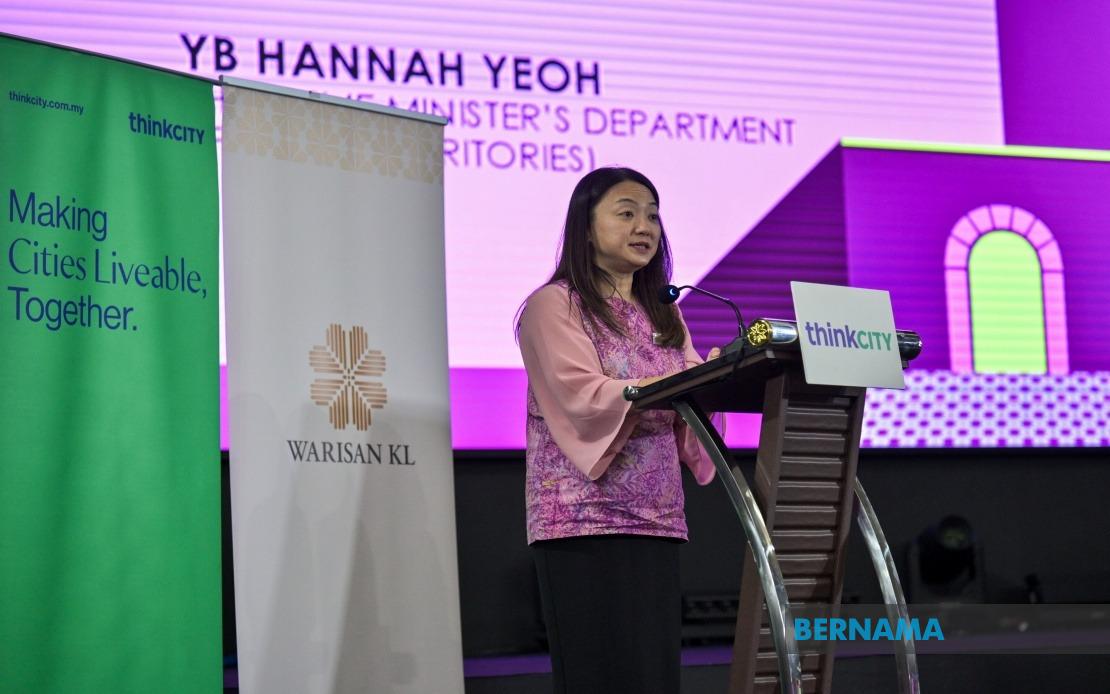
Malaysia's federal government has committed RM1 million towards revitalising the heart of Kuala Lumpur through a new grants programme designed to balance heritage conservation with contemporary urban development. Minister in the Prime Minister's Department (Federal Territories) Hannah Yeoh unveiled the initiative during a ceremony in the capital, signalling renewed emphasis on cultural and economic regeneration as core components of the nation's urban policy framework.
The Downtown Kuala Lumpur Grants Programme 2026 represents a shift in how Malaysian authorities approach city centre development. Rather than relying solely on large-scale construction projects, the initiative distributes funding in smaller tranches of RM30,000 to RM100,000 per approved project, creating opportunities for grassroots entrepreneurs, heritage organisations, and creative practitioners to participate directly in reshaping their communities. This calibrated approach acknowledges that urban renewal requires both capital injection and institutional support for smaller stakeholders who often struggle to access conventional funding channels.
Yeoh's remarks during the launch emphasised a philosophical commitment to preserving Kuala Lumpur's dual identity. She articulated a vision where the city's future success depends not merely on erecting new structures, but on sustaining the conditions that keep residents, workers, and investors choosing to remain in the federal capital. This perspective challenges the assumption that urban progress inherently demands wholesale demolition and replacement, instead positioning heritage preservation as economically rational and socially necessary.
The connection to Kuala Lumpur's UNESCO Creative City designation provides additional context for the initiative. This recognition, awarded to cities demonstrating cultural vitality and innovation, opens pathways for international recognition and tourism opportunities. Yeoh explicitly linked cultural investment to job creation and visitor attraction, reframing arts and heritage not as luxury expenditures but as economic drivers capable of generating employment and strengthening domestic commerce. For a nation seeking diversified revenue streams beyond traditional sectors, this positioning carries particular relevance.
A critical component of the programme involves reforming institutional attitudes at Kuala Lumpur City Hall (DBKL). Yeoh acknowledged persistent perception problems, describing her ambition to transform DBKL's image from regulatory obstacle to enabling facilitator. This candid assessment reflects broader frustrations within Malaysia's creative and entrepreneurial communities about bureaucratic delays and hostile regulatory environments. By explicitly committing to institutional culture change, Yeoh signals that funding alone proves insufficient without accompanying shifts in how government departments interact with applicants and project managers.
Think City, designated as the strategic partner managing programme implementation and coordination, assumes responsibility for developing and communicating eligibility criteria. This intermediary role carries significance in Southeast Asia's development context, where NGOs and specialist organisations frequently bridge gaps between government resources and grassroots beneficiaries. Think City's involvement suggests the government recognises that technical expertise in heritage assessment, project evaluation, and creative industry support exceeds what conventional civil service departments typically possess.
The timing of this allocation merits examination within Malaysia's broader fiscal priorities. Federal funding for urban cultural initiatives competes against demands for infrastructure, healthcare, and social welfare spending. That the government approved RM1 million specifically for Downtown KL revitalisation indicates recognition that the nation's capital requires targeted intervention to remain competitive internationally and maintain livability standards that attract talent and investment.
For neighbouring Southeast Asian countries observing Malaysia's approach, the Downtown KL programme offers a potential model for managing heritage districts under pressure from development. Thai and Indonesian authorities grapple with similar tensions between modernisation and cultural preservation in central Bangkok and Jakarta. Malaysia's distributed grant system, if effectively managed, demonstrates how governments can empower multiple stakeholders rather than concentrating redevelopment authority in single mega-projects.
The programme's success will ultimately depend on execution quality and the calibre of applications submitted. With Think City providing technical guidance, successful projects may generate replicable templates for heritage-led regeneration elsewhere in Malaysia. However, questions remain about whether RM30,000 to RM100,000 grants suffice for transformative interventions, and whether DBKL institutional change will materialise quickly enough to meet applicant expectations.
Yeoh's emphasis on welcoming fresh ideas and innovative approaches suggests openness to unconventional proposals beyond traditional heritage restoration. This framing could attract younger entrepreneurs and artists who might otherwise perceive government programmes as conservative or ossified. The critical test arrives when applications are evaluated and whether truly experimental, boundary-pushing projects receive support or whether decision-making defaults to safer, conventional interventions.
For Malaysian creative practitioners, entrepreneurs seeking to establish Downtown KL operations, and heritage organisations managing historical sites, this programme represents a rare opportunity to access government funding without competitive bidding against large corporate entities. The availability of grants specifically sized for individual practitioners and small enterprises democratises access to capital in ways that larger development funds typically cannot achieve.
The broader implications extend beyond Downtown Kuala Lumpur itself. If the programme succeeds in demonstrating that cultural investment generates measurable economic and social returns, Malaysian policymakers may allocate greater resources to similar initiatives in other urban centres. This could eventually catalyse a national reorientation towards cultural economics, elevating the creative sector's position in policy discussions alongside traditional manufacturing and services sectors. For Malaysia's long-term competitiveness, particularly as the economy matures and knowledge-intensive sectors grow in importance, such recalibration proves strategically sound.

