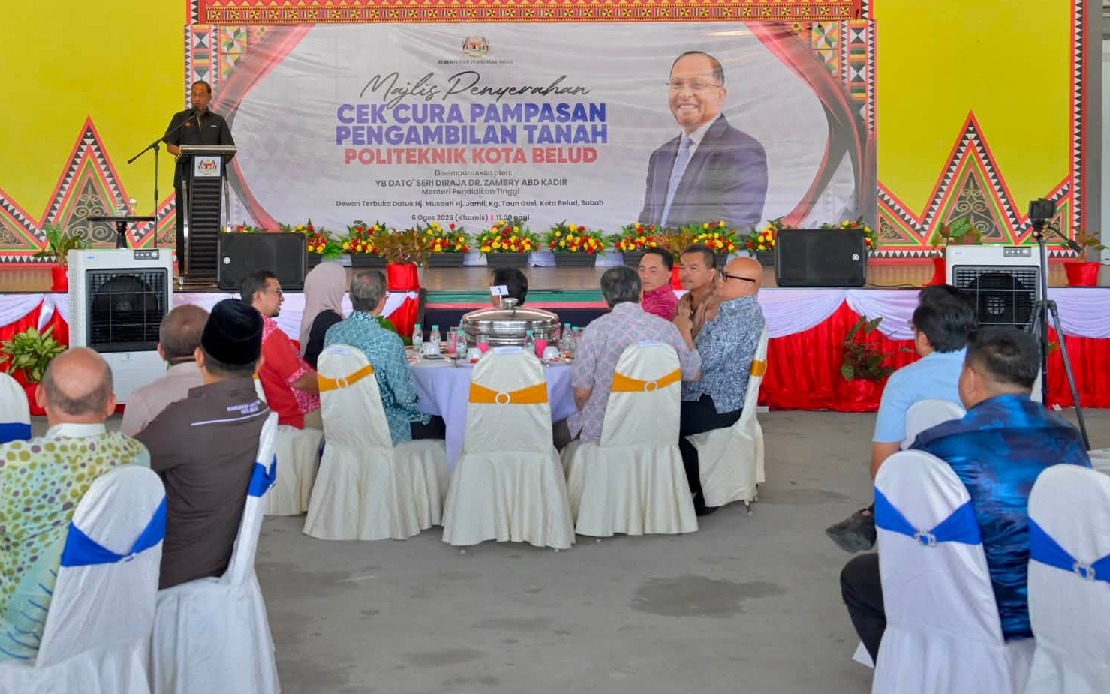
Higher Education Minister Datuk Seri Zambry Abd Kadir has confirmed that the RM250 million Politeknik Kota Belud will be ready for operations by 2030, marking a significant expansion of technical education infrastructure in Sabah. The announcement came during a ceremony in Kota Belud where compensation cheques were presented to affected landowners, formally signalling the start of construction for what is envisioned as a modern hub for high-technology education and skills development.
The polytechnic represents the culmination of a planning initiative that began in 2017, when then Kota Belud Member of Parliament Datuk Seri Abdul Rahman Dahlan first proposed the establishment of a dedicated technical institution in the district. Over the intervening years, the project navigated the lengthy process of land acquisition and administrative approval, with the compensation payments now marking the transition from planning to active construction and development phases.
According to Zambry, the institution will be strategically designed to address immediate and emerging workforce demands specific to Sabah's economic landscape. The curriculum is expected to prioritise programmes in green energy technologies, artificial intelligence, computer science, and smart agriculture systems—fields increasingly recognised as critical to the state's economic diversification and competitiveness in the regional and global markets. This focus reflects a broader Malaysian policy direction toward elevating technical education to meet the skill requirements of a rapidly evolving digital and sustainability-driven economy.
The implementation roadmap is structured around Malaysia's Third Rolling Plan, which falls within the broader 13th Malaysia Plan framework scheduled to commence next year. Officials anticipate that with this planning cycle, the detailed design specifications, infrastructure planning, and other preparatory elements can be accelerated, creating the conditions necessary to meet the targeted 2030 completion timeline. The phased approach underscores the complexity of establishing a fully functioning polytechnic institution from the ground up, requiring coordination across multiple government agencies and adherence to evolving educational standards.
Operationally, the Kota Belud Polytechnic will commence with an intake of approximately 500 students in its inaugural cohort, a figure that reflects both the institution's initial capacity constraints and realistic enrolment projections for a newly established facility in a district of moderate population density. However, planners have incorporated expansion capacity into the project design, with the facility intended to accommodate between 1,000 and 1,500 students once fully operational and following any necessary infrastructure augmentation. This scalability reflects lessons learned from similar institutions established elsewhere in Malaysia and acknowledges the uncertainty surrounding the pace and scale of demand for technical education in rural Sabah.
For Malaysian policymakers and education advocates, the Kota Belud Polytechnic represents an important commitment to reducing urban-rural disparities in access to quality technical training. Historically, students in East Malaysian states have often needed to relocate to peninsular institutions to pursue technical qualifications at the polytechnic level, creating financial and social barriers that limit participation. By establishing such a facility in Sabah, the government signals intent to democratise access to skills-based education and to develop local talent pools that can support regional economic initiatives.
The timing of this project also aligns with Malaysia's broader economic diversification agenda, particularly as Sabah increasingly seeks to develop knowledge-intensive industries beyond resource extraction. Green energy and artificial intelligence programmes are not peripheral additions to a traditional polytechnic curriculum—they represent a strategic bet on the state's capacity to attract investment in emerging sectors and to position itself competitively within Southeast Asia's innovation ecosystems. Agricultural technology, too, carries particular significance for Sabah, where farming remains economically important but faces productivity challenges and climate resilience concerns.
From a regional perspective, the Kota Belud initiative contributes to Malaysia's broader effort to strengthen technical vocational education and training (TVET) infrastructure. The government has consistently emphasised that TVET pathways are essential alternatives to conventional university routes, offering faster routes to employment and more direct alignment with industry needs. By investing substantially in polytechnic capacity, particularly in underserved regions, policymakers are signalling commitment to this educational philosophy and attempting to shift cultural perceptions that have historically favoured academic over technical qualifications.
The project's financing structure, with an allocated budget of RM250 million, positions it among Malaysia's more significant recent investments in polytechnic infrastructure. This level of commitment reflects confidence in the economic case for the institution and recognition that quality technical facilities require substantial capital investment to meet contemporary standards. Such investment decisions also carry implicit assumptions about future government revenue and budgetary priorities, making them politically significant statements of intent beyond their immediate educational implications.
Implementation risks remain present, including potential delays in design finalisation, supply chain challenges for construction materials, and the ever-present uncertainty of budgetary availability across multiple fiscal years. However, by formalising the land acquisition through compensation payments and embedding the project within the formal Malaysia Plan framework, the government has created institutional mechanisms and accountability structures intended to maintain momentum and ensure continuity across political cycles.
For Kota Belud and surrounding communities, the polytechnic promises tangible benefits beyond education, including construction employment, eventual skilled job creation, and potential secondary economic activity as the campus establishes itself as a community anchor. The facility may also catalyse broader infrastructure improvements in the district and enhance the region's appeal to individuals and families seeking areas offering enhanced educational and economic opportunities.
Looking ahead to 2030, the success of the Kota Belud Polytechnic will be measured not merely by whether construction is completed on schedule, but by whether the institution effectively bridges the gap between Sabah's educational offerings and its economic aspirations. The choice to emphasise technology-focused programmes suggests planners have identified genuine skills gaps and assessed that such training aligns with realistic employment prospects for graduates. Whether these assessments prove accurate will become clear only as the first cohorts move through the institution and enter the job market.

