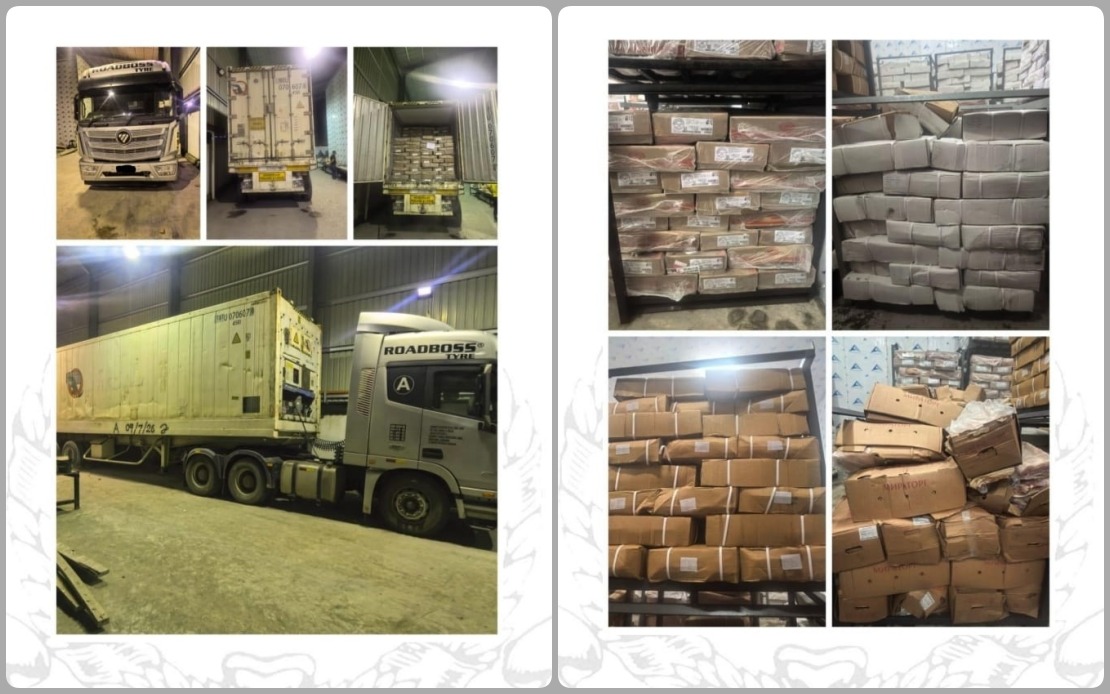
Authorities in Sarawak have dismantled a significant smuggling operation involving frozen pork products, uncovering approximately RM6.19 million in contraband at a warehouse facility in Miri last night. The enforcement action, conducted under Operation Taring Chiller, resulted in the detention of a 26-year-old local resident who allegedly orchestrated the illegal importation scheme. Police moved on the warehouse at 8 pm, discovering an extensive cache of pork products that had entered the country without the requisite customs and veterinary clearances.
The seizure underscores persistent vulnerabilities in Malaysia's food security apparatus, particularly regarding products that circumvent halal certification requirements and standard import protocols. The confiscated stockpile comprised 30,000 kilogrammes of cooked frozen pork large intestines, 18,000 kilogrammes of pork loin distributed across 15 pallets, 750 kilogrammes of pork cuts, multiple pallets of bone-in pork bellies with rind, and frozen pork shoulder. The sheer volume indicates an operation designed for large-scale distribution rather than personal consumption, suggesting the suspect may have been acting as a conduit for a larger smuggling network operating across Borneo.
Datak Seri Mohd Yusri Hassan Basri, director of the Internal Security and Public Order Department, framed the operation as part of a broader crackdown on the movement of unverified foodstuffs through Malaysian supply chains. He emphasised that law enforcement agencies remain focused on identifying and dismantling distribution networks that pose risks to public health and consumer trust. The operation involved coordinated efforts between the Wildlife Crime Bureau and Special Investigation Intelligence unit alongside local Miri police and Sarawak's veterinary services, demonstrating how Malaysian authorities increasingly deploy integrated task forces against organised smuggling.
Investigators have proceeded under provisions of the Veterinary Public Health Ordinance 1999, specifically Sections 9(1) and 9(3), which establish liability for handling unvetted animal products. The authorities have additionally issued a compound notice valued at RM25,000, creating financial consequences that extend beyond criminal charges. This dual approach—criminal prosecution combined with administrative penalties—represents the enforcement strategy Malaysian authorities employ to deter participation in illegal food importation ventures. However, such penalties may prove insufficient if they do not address the economic incentives that make smuggling profitable for coordinating networks.
The Miri discovery represents merely one manifestation of smuggling pressures affecting Malaysia's eastern states. Sarawak, positioned along shipping routes linking Southeast Asia to China and beyond, has emerged as a recurring focal point for illegal trade in controlled commodities. The porous nature of Borneo's maritime boundaries and the region's reliance on informal cross-border commerce create environments where contraband can change hands multiple times before reaching end consumers. The Miri warehouse operation suggests that smugglers maintain sophisticated storage and distribution infrastructure, rather than operating on an ad-hoc basis.
Data released by the Internal Security and Public Order Department reveals the magnitude of smuggling pressures across Malaysia. Between January 1 and July 10 of this year alone, the Wildlife Crime Bureau executed 201 raids nationwide, culminating in 375 arrests. These operations recovered contraband valued at RM264.86 million, spanning non-duty-paid goods, subsidised commodity leakage, frozen foodstuffs, wildlife products, and electronic waste. The frozen pork seizure therefore represents approximately 2.3 percent of total recovered contraband value during the seven-month period, indicating that food smuggling, whilst significant, competes with other illicit commodity flows for resources and attention.
The implications for Malaysian consumers extend beyond the immediate regulatory breach. Products entering without veterinary inspection cannot be certified as meeting halal standards, creating potential complications for Muslim purchasers who may unwittingly acquire non-compliant items. Additionally, unvetted imports bypass disease screening protocols, introducing potential biosecurity risks. Frozen meat products, if contaminated or improperly stored, can harbour pathogens that spread through the food chain. The seizure therefore represents not merely a customs violation but a genuine public health intervention, even if enforcement messaging has traditionally emphasised smuggling's economic dimensions.
The operation's success depended upon intelligence gathering capabilities that remain insufficiently resourced across Malaysia's enforcement community. The Wildlife Crime Bureau's 201 raids across the entire country over seven months suggests a reactive posture, wherein authorities respond to tip-offs rather than systematically mapping smuggling networks. Malaysian authorities have acknowledged these intelligence limitations, noting that organised smuggling groups leverage sophisticated logistics and corruption to move contraband across borders. Disrupting these networks requires sustained, coordinated intelligence operations extending beyond individual warehouse raids, a capability that remains underdeveloped in regions like Sarawak.
Looking forward, the case illustrates why Malaysian policymakers must strengthen border security infrastructure, particularly at maritime entry points where bulk shipments can be rapidly processed. The Miri warehouse operation suggests that once products clear initial ports of entry—often through documentation fraud or corruption—they move relatively unmolested toward regional distribution networks. Enhanced tracking systems, mandatory cold-chain documentation, and routine audits of food warehouses could create friction in smuggling supply chains. Yet such measures require sustained political commitment and funding that has historically fluctuated based on competing policy priorities.
The Royal Malaysia Police have renewed commitments to intensify operations against smuggling networks, positioning food product interdiction within the broader security apparatus addressing organised crime. This framing acknowledges that large-scale smuggling operations increasingly intersect with transnational criminal enterprises moving multiple commodity categories through shared logistics and corruption networks. Disrupting the frozen pork trade therefore contributes incrementally toward degrading broader smuggling infrastructure. However, the persistence of such operations despite enforcement activities suggests that Malaysian authorities face structural challenges in identifying, prioritising, and sustaining pressure against networks that remain economically resilient and geographically dispersed.

