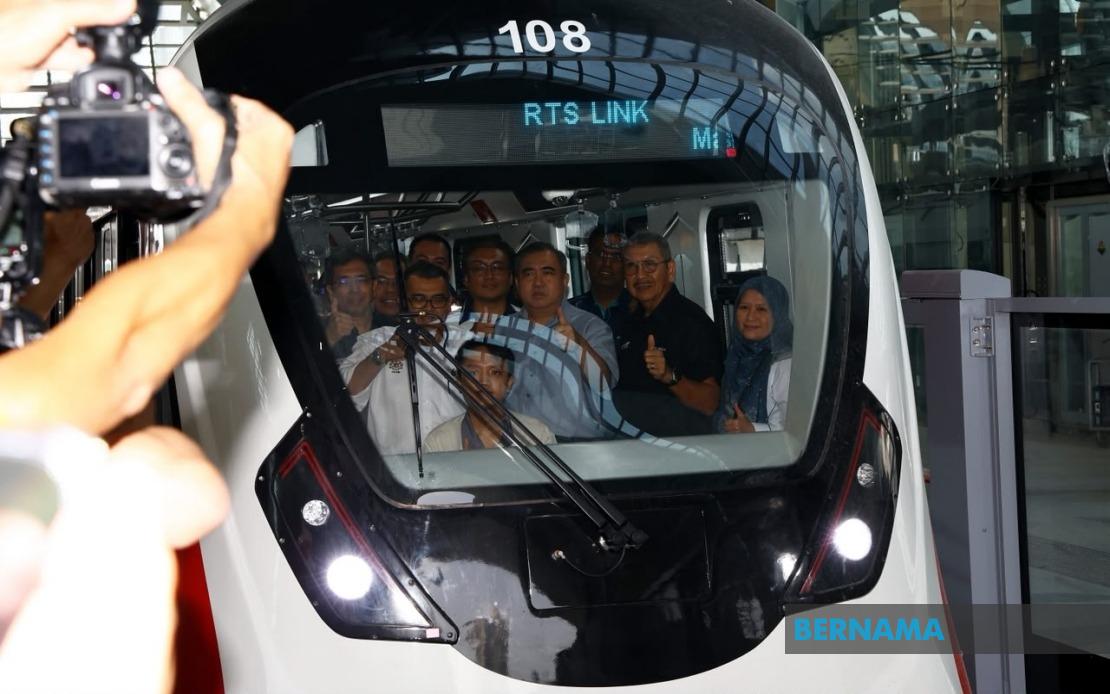
Malaysia's transport infrastructure expansion continues to accelerate with an ambitious new connectivity initiative at Johor Bahru's emerging transit hub. The government has greenlit a RM60 million bridge project designed to directly link the Bukit Chagar RTS Link Station with the KTMB Komuter railway service, representing a significant step toward creating a seamlessly integrated public transport ecosystem in the region. Transport Minister Anthony Loke announced the undertaking following an inspection of the RTS Link development site, emphasizing that the additional infrastructure will fundamentally reshape how commuters access and navigate the border crossing area.
The bridge responds to a practical transportation challenge that had long concerned planners and commuters alike. Without this direct connection, passengers currently relying on the Komuter service would be forced to navigate a circuitous route via JB Sentral to reach the new RTS Link facility. By establishing a direct pedestrian link, the government aims to eliminate unnecessary detours and reduce travel time for thousands of daily users. The initiative reflects a broader policy shift toward reducing friction in public transport networks, recognizing that convenience directly influences ridership and overall system effectiveness. This philosophy increasingly guides Malaysia's approach to major transport investments, where seamless integration between different modes takes priority.
According to Minister Loke, construction of the bridge is anticipated to require approximately twelve months from commencement. This timeline aligns strategically with the broader RTS Link project schedule, ensuring that the connecting infrastructure becomes operational around the same period as the main transit facility. The Ministry of Transport will oversee execution of the project, having secured budgetary approval from the Ministry of Economy. The construction period reflects the complexity of integrating new infrastructure into an existing transport corridor while maintaining operational continuity at adjacent facilities.
The bridge project forms part of a comprehensive overhaul of Johor Bahru's transport landscape designed to maximize the potential of the RTS Link investment. Complementing the bridge initiative, the government is advancing Stage Bus Service Transformation (SBST) 2.0, which will introduce at least 200 additional buses providing dedicated services from residential neighborhoods throughout Johor Bahru to the Bukit Chagar terminus. This expansion recognizes that last-mile connectivity and first-mile access are critical determinants of transit usage patterns. By coordinating bus service expansion with bridge completion and the RTS Link opening, authorities aim to create a cohesive multimodal network that encourages ridership across all transport tiers.
The SBST 2.0 initiative remains in the agreement finalization stage with the bus operator, with the Ministry of Finance expected to formally approve the final award. This administrative process, while standard, underscores the scale of coordination required across multiple government entities to deliver integrated transport solutions. The decision to synchronize bus service launches with RTS Link operations reflects lessons learned from previous transport infrastructure projects, where inadequate feeder services diminished utilization of anchor facilities. By ensuring bus networks are operational from day one, planners hope to capture maximum ridership from the outset.
Bukit Chagar itself is being developed as a comprehensive multimodal transport hub, with planned integration extending beyond the Komuter connection. The station will incorporate direct links to JB Sentral, e-hailing services, and other public transport operators, creating a unified transport gateway. This integrated approach positions the facility not merely as a border crossing point but as a major transport interchange serving both cross-border and domestic travelers. For Malaysian commuters heading to Singapore, the facility will offer multiple options for reaching Bukit Chagar itself, reducing dependence on private vehicles and supporting broader goals of sustainable urban mobility.
Construction progress on the primary RTS Link infrastructure has reached an advanced stage, with the physical building, Customs, Immigration and Quarantine (CIQ) complex, and station structures all substantially completed. The project has transitioned into the critical testing and commissioning phase, during which engineers conduct comprehensive system integration assessments. This phase involves rigorous validation of all electronic and mechanical systems, followed by extended trial operations to identify and resolve any faults before public service begins. Such meticulous testing protocols are standard for high-capacity transit facilities, ensuring reliability from launch.
The RTS Link itself remains on schedule for commencement on January 1, 2025, representing a landmark achievement in regional connectivity. The system has been engineered to handle passenger flows of up to 10,000 people per hour in each direction, a capacity designed to accommodate both leisure travelers and the growing cohort of cross-border workers and students. The connection between Bukit Chagar and Woodlands North in Singapore addresses a critical regional need, as road congestion at the causeway has intensified markedly in recent years. By offering a dedicated rail alternative, the RTS Link promises to alleviate pressure on traditional border crossing routes while strengthening economic linkages between Johor Bahru and Singapore's northern districts.
For Malaysian stakeholders, the RTS Link represents more than merely improved travel convenience. The project catalyzes broader economic development in Johor Bahru's northern corridor, attracting commercial investment and residential growth in proximity to the Bukit Chagar station. The establishment of efficient public transport corridors historically correlates with property value appreciation and increased commercial activity in adjacent areas. The bridge project and bus service expansion amplify these effects by ensuring the station remains accessible to diverse population segments regardless of transport mode preference.
The coordination required to deliver these interconnected projects illustrates the complexity of modern transport planning. Beyond the bridge itself, officials must synchronize construction timelines, secure multi-agency approvals, negotiate with private operators, and ensure that systems function seamlessly together. The RM60 million bridge investment, while substantial, represents only one component of a larger transport transformation. This integrated approach contrasts with earlier infrastructure strategies that often treated transport modes as separate systems requiring independent optimization, an approach that frequently resulted in suboptimal user experiences and underutilization of facilities.
Regional implications extend beyond Johor Bahru's borders. Enhanced public transport connectivity between Malaysia and Singapore supports the broader Iskandar Malaysia development agenda and reinforces integration within the Greater Kuala Lumpur metropolitan framework. As ASEAN nations increasingly recognize sustainable transport as essential to managing urban growth, the RTS Link and its supporting infrastructure offer a model for cross-border transit cooperation. The project demonstrates how coordinated planning across different jurisdictions and transport modes can yield outcomes benefiting residents across political boundaries.
As January 2025 approaches, the success of the RTS Link will substantially depend on complementary infrastructure like the Komuter bridge and expanded bus services functioning effectively. The RM60 million investment, while significant, pales in comparison to the overall RTS Link expenditure yet carries disproportionate importance for ridership and public perception. First impressions matter profoundly for transit systems; efficient, convenient access to the Bukit Chagar station will shape user attitudes and travel behavior patterns for years ahead. The government's attention to these connecting details suggests recognition that transport infrastructure success ultimately depends on getting thousands of granular details right, not merely on construction of flagship facilities.

