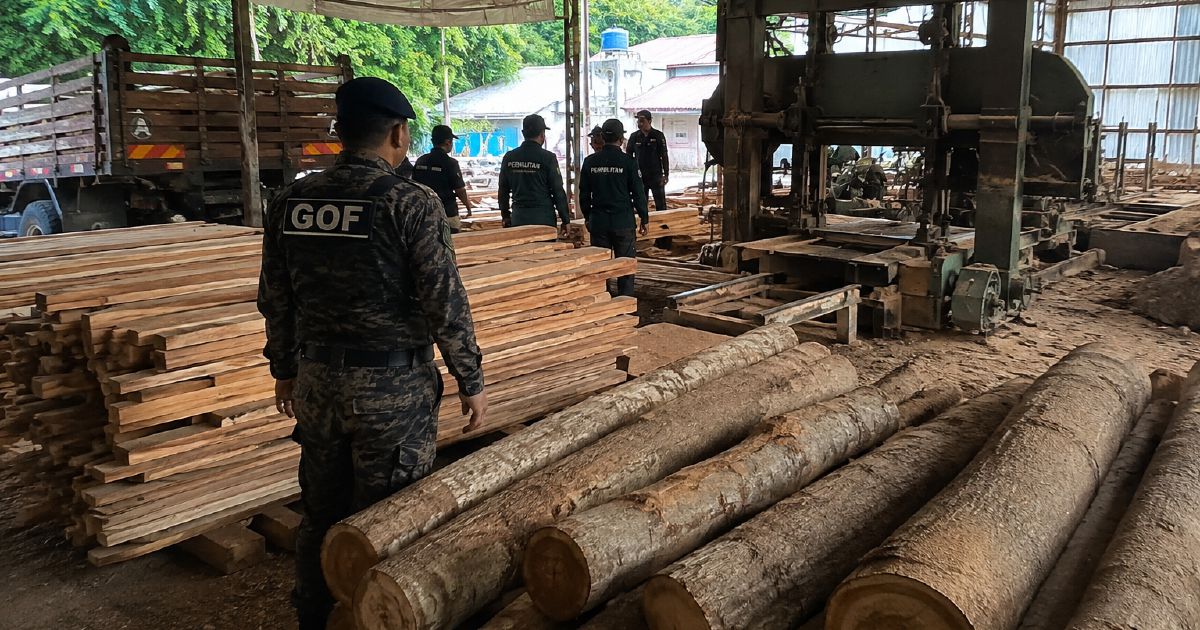
Enforcement agencies have moved decisively against an illegal timber operation in Terengganu's Kuala Berang district, seizing a substantial haul of valuable materials and equipment during a raid that underscores the government's determination to clamp down on unregulated forestry activities. The General Operations Force secured timber stocks and machinery valued at RM640,510 from the sawmill facility, with a 20-year-old operator taken into custody for questioning during the operation.
The seizure represents one of the more significant enforcement actions against timber-related violations in the state's eastern region. The scope of the asset haul—encompassing both raw material and processing equipment—suggests an operation with considerable financial investment and production capacity. Such seizures are typically preceded by intelligence gathering that identifies facilities suspected of processing illegally harvested timber or operating without proper environmental and business permits.
Kuala Berang, situated in the heart of Terengganu's administrative district, has emerged as a critical zone for forestry regulation due to its proximity to timber-producing areas and its role as a processing hub. The locality's position makes it a focal point for regulatory oversight, as authorities work to ensure that only legitimately sourced timber moves through commercial channels. Illegal logging and uncontrolled milling operations create cascading problems: they deplete protected forests, undermine legitimate timber traders who operate within regulatory frameworks, and generate tax leakage for state revenues.
The arrest of the facility operator, though occurring at a young age, reflects the reality that sawmill operations often involve workers and managers across various experience levels. The circumstances of his detention and any subsequent investigations will likely provide authorities with insights into the operational structure of the facility, including potential supply chains for the seized timber and the intended market for milled products.
Malaysia's timber sector has faced mounting pressure to demonstrate sustainability and compliance with both domestic forestry laws and international environmental commitments. Terengganu, as a state with significant remaining forest cover, carries particular responsibility in this regard. The GOF operation serves as a reminder that the authorities possess the operational capacity to conduct surprise raids on suspect facilities, a deterrent factor that shapes industry behaviour across the region.
The seizure also reflects broader Southeast Asian challenges in combating illegal timber trade, which continues to generate hundreds of millions of dollars annually across the region despite strengthened enforcement mechanisms. When timber is illegally harvested and then processed at unregistered facilities, tracing its origin becomes nearly impossible, allowing illicit material to enter mainstream supply chains. Malaysian buyers and exporters who procure timber through legitimate channels face unfair competition from those willing to source questionable material at lower costs.
From an enforcement perspective, the Kuala Berang operation demonstrates inter-agency coordination and intelligence-driven policing. The GOF's specialization in operations enforcement gave it the tactical capability to execute the raid effectively, securing physical evidence and the individual for interrogation. Whether this particular case leads to formal charges will depend on investigative findings regarding the sourcing of the timber, permit status, and regulatory compliance across operational parameters.
For legitimate timber millers and traders operating in Terengganu and elsewhere, enforcement actions carry mixed implications. On one hand, they remove illegal competitors from the market, creating space for compliant operators to function profitably. On the other hand, they underline the regulatory burden that legitimate players must navigate, from environmental impact assessments to labour compliance to timber source verification.
The economic value attached to the seized materials—RM640,510—illustrates why illicit timber operations prove tempting despite enforcement risks. A single successful raid removes from circulation materials and equipment that represented significant capital investment by the operation. For the state, however, documenting and disposing of seized materials presents logistical challenges, and whether items can be released to legitimate purchasers depends on establishing clear title and legal propriety.
Going forward, the incident may prompt authorities to intensify patrols and inspections within Kuala Berang and similar processing zones. It may also trigger awareness campaigns among legitimate timber sector participants, reminding them of compliance requirements and the consequences of regulatory violations. For buyers and downstream users of timber products, such seizures reinforce the need for supply chain transparency and verified sourcing protocols.
The investigation outcome will likely influence how similar cases are handled moving forward, potentially establishing precedent on penalties, asset recovery, and operational standards that authorities seek to enforce. As Malaysia continues calibrating its approach to sustainable resource management, enforcement actions like the Kuala Berang raid function as both practical deterrents and symbolic demonstrations of state capacity to police the timber sector.

