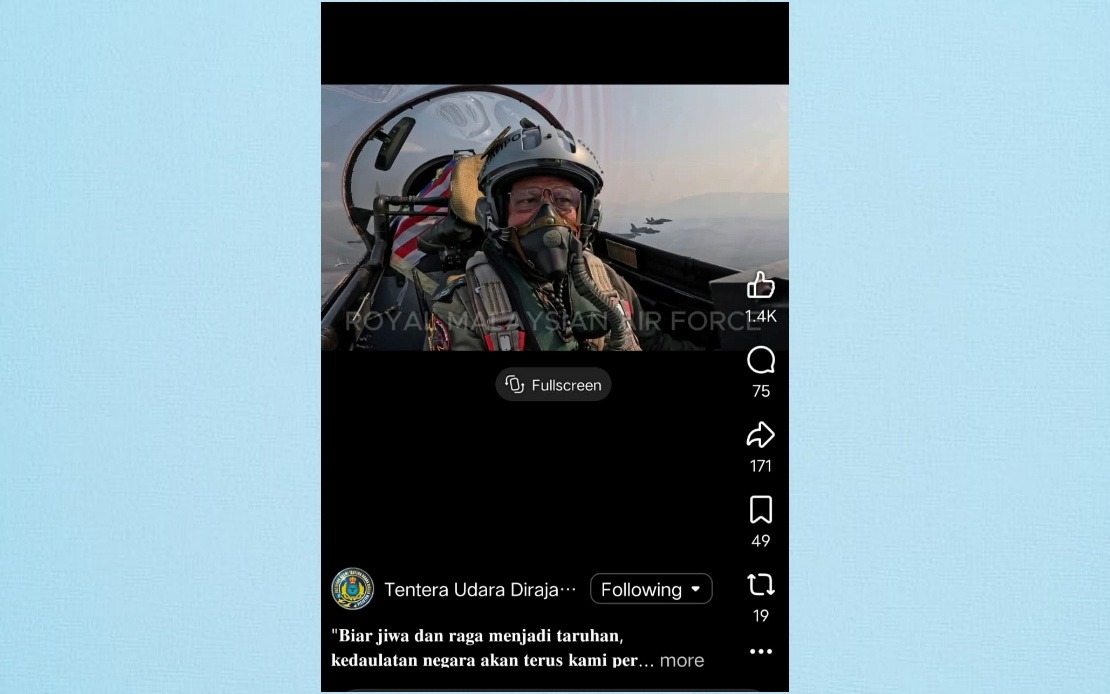
The skies above Putrajaya thundered with military precision as the Royal Malaysian Air Force orchestrated an ambitious air display during Malaysia's 69th National Day celebration, with General Tan Sri Muhamad Norazlan Aris commanding the demonstration from the cockpit of a Sukhoi Su-30MKM. The senior commander's direct participation in leading the aerial formations underscored the significance of the showcase, marking the second consecutive year the RMAF chief has personally piloted the National Day air show, a tradition that embodies the force's operational readiness and institutional pride.
The 10-minute spectacle that commenced at 9:30 am proved to be one of the day's most anticipated moments for the thousands of spectators assembled at Dataran Putrajaya. Eleven combat and transport aircraft participated in carefully choreographed routines, with four Su-30MKMs forming the primary attacking wing, supported by four F/A-18D Hornets and three BAE Hawk 208s. The composition reflected Malaysia's modern fighter inventory and demonstrated the nation's capacity to conduct sustained aerial operations across multiple aircraft types simultaneously, a capability that underscores regional defence considerations in Southeast Asia.
The formation sequences themselves became a calculated language of military capability. Pilots executed the Kite, Diamond, Delta and Victory Combine formations, each manoeuvre selected not merely for visual effect but to illustrate tactical proficiency and crew coordination. These precision formations require months of training and represent the technical mastery expected of modern air forces operating in contested environments. For Malaysian audiences, the display conveyed a straightforward message: the air force maintains high operational standards and can execute complex missions with reliability.
Commentary from Major Patrick Dinnesh, Major Neny Suhaida Ab Suki and Captain Muhammad Iqbal Nasrudin provided running analysis of the aircraft movements and capabilities, transforming the display from spectacle into education. This educational dimension reflects evolving approaches to civil-military engagement in Malaysia, where transparency about defence capabilities increasingly serves both public communication and recruitment objectives. The narrators explained technical aspects that civilians might not otherwise grasp, demystifying military aviation and building institutional legitimacy through knowledge sharing.
Following the combat aircraft demonstration, the RMAF rotated its cargo and transport assets into prominence, including the C-130H Hercules workhorse, the newer A400M Atlas, and the CN235 tactical transport. This transition proved strategically significant, highlighting logistics and humanitarian capabilities alongside strike potential. For a nation that regularly conducts disaster relief and humanitarian operations across the region, projecting airlift capacity carries particular relevance. The visible rotation of such diverse aircraft types also demonstrates the breadth of RMAF operations beyond air defence, addressing multiple security challenges from regional disasters to border surveillance.
Helicopter formations then weaved through the airspace, with EC725 and AW139 rotorcraft showcasing the air force's vertical lift capabilities. What distinguished this portion of the display was the deliberate integration of interservice assets—helicopters flew in coordinated formation with Malaysian Army, Royal Malaysian Navy, Fire and Rescue Department of Malaysia, and Royal Malaysia Police units, physically embodying the concept of whole-of-government security operations. This visual emphasis on interagency cooperation carries particular weight given Malaysia's complex security environment, where coordination between military and civilian agencies proves essential for effective response to maritime threats, border incursions, and humanitarian crises.
The roar of jet engines reverberated across the federal administrative centre, creating an auditory dimension that extended the display's impact beyond visual observation. Military aviation displays operate through multiple sensory channels—the precision formations capture attention visually, the sound conveys raw power and technological sophistication, and the coordinated presence of diverse assets communicates organisational competence. For defence planners and security analysts observing from within the crowds, the display functioned as a transparent demonstration of RMAF capability and readiness. For the general public, it offered entertainment infused with national pride and the reassurance that professional military institutions defend Malaysian interests.
The thousands of spectators gathered at Dataran Putrajaya reacted with sustained enthusiasm throughout the ten-minute sequence, their attention riveted skyward as formations passed overhead. This public engagement reflects the evolving relationship between Malaysia's military and civilian society, where transparency and public visibility of defence capabilities increasingly serve national security objectives. The display required no security barriers preventing civilian observation, instead inviting mass participation in witnessing defence force capabilities, an approach that strengthens public confidence in military institutions while building broader understanding of defence requirements.
The National Day air display carries particular significance within Malaysia's security discourse at a moment when regional tensions and transnational challenges demand sustained defence investment. By showcasing modern fighter jets operating alongside transport and helicopter assets, the RMAF demonstrated the integrated approach necessary for contemporary security challenges. The visible participation of the RMAF chief in operational flying—the personal piloting of a lead aircraft—reinforced the message that Malaysia's military leadership maintains operational credibility, a factor that carries weight in both national confidence and regional security calculations.
Planning and executing such elaborate aerial displays demands coordination across multiple organisations, rigorous safety protocols, and extended training periods for participating pilots. The successful execution reflected institutional competence and the accumulated professionalism within the RMAF structure. From a regional perspective, such displays serve as indirect communication to neighbouring countries regarding Malaysian defence capabilities and resolve, conveying messages of stability and competence without explicit military posturing. The integration of interservice and civilian agency assets further demonstrates that Malaysian security thinking increasingly embraces comprehensive approaches that extend beyond traditional military functions into disaster response and whole-of-government operations.

