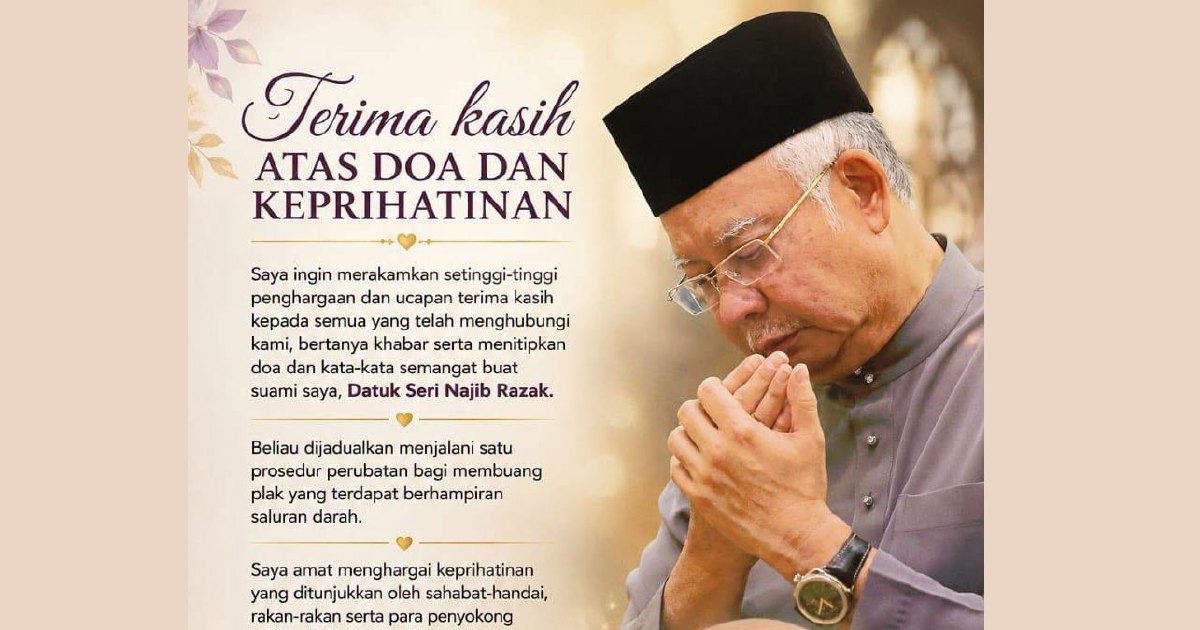
Datin Seri Rosmah Mansor has made a public appeal for prayers and well-wishes as her husband, former Prime Minister Datuk Seri Najib Razak, prepares to undergo a medical procedure aimed at removing plaque deposits from near a blood vessel. The request reflects the personal nature of the situation for the former premier's family, with Rosmah expressing gratitude to those who have already shown their support during this period.
The procedure Najib is scheduled to undergo addresses a vascular health concern, with medical professionals planning an intervention to clear arterial obstruction. Such treatments, commonly performed in modern healthcare settings, are designed to restore proper blood flow and reduce the risk of serious cardiovascular complications. The former premier's family has chosen to make the matter public, likely recognising the widespread public interest in the health and wellbeing of prominent political figures in Malaysia.
Rosmah's public statement serves multiple purposes within the Malaysian context. As a former First Lady, her words carry significant weight among supporters and the general public, many of whom have maintained connections to the couple following the conclusion of Najib's tenure as Prime Minister. Her appeal to the public reflects traditional values emphasising community support during times of health challenges, a sentiment that resonates across Malaysian society regardless of political affiliation.
The announcement comes at a time when Malaysia continues to grapple with various political and social developments. The health situation of senior political figures often captures public attention, not merely as a matter of personal concern but as a reminder of the human dimensions underlying Malaysia's political landscape. Najib's medical challenge presents a moment of reflection for many Malaysians who have observed his political journey over recent decades.
From a practical healthcare perspective, the intervention Najib is undergoing represents a common medical response to cardiovascular risk factors. Plaque accumulation within blood vessels is a concern that affects many individuals across age groups and socioeconomic backgrounds, though it is particularly associated with age-related changes. The procedure to remove such blockages has become increasingly sophisticated, with modern interventional techniques offering improved outcomes and faster recovery periods compared to earlier surgical methods.
Rosmah's expression of gratitude toward supporters acknowledges the role that public sentiment and encouragement can play during medical treatment. In Malaysian culture, the concept of communal support during health crises is deeply embedded, with religious prayers and well-wishes considered important aspects of the healing process. Her explicit request for prayers taps into these cultural values while also requesting practical spiritual support from the diverse Malaysian public.
The timing and manner of this announcement also reflect evolving communication practices among Malaysian political figures. By making the information public through media channels rather than keeping it private, Rosmah has demonstrated a strategy of transparency that may serve to manage speculation and misinformation. This approach allows the family to frame the narrative and provide accurate information directly to the public and media.
For observers of Malaysian politics, the situation underscores the inevitability of health challenges that come with age, affecting individuals across all sectors of society. Najib, who served as Prime Minister from 2009 to 2018, remains a significant figure in Malaysia's political discourse. His health status therefore constitutes matter of public interest, particularly among those who continue to follow his activities and legal proceedings.
The appeal for prayers also highlights the continued role of religious and spiritual elements in Malaysian public life. Regardless of one's political views toward the former premier, the request for communal spiritual support represents a broadly inclusive gesture that invites Malaysians of various faiths to participate in wishing for a successful medical outcome. This cross-cutting appeal demonstrates how health challenges can temporarily transcend political divisions.
From a broader health awareness perspective, the public nature of Najib's vascular procedure may also serve an educational function, bringing attention to cardiovascular health concerns among the Malaysian population. Such visibility of medical conditions affecting prominent individuals can sometimes prompt conversations about preventive healthcare, regular medical screening, and the importance of addressing vascular health before complications develop.
Looking ahead, the family's focus will understandably remain on ensuring the procedure goes smoothly and that recovery proceeds without complications. Rosmah's statement indicates that the procedure is planned rather than emergency-based, suggesting that medical professionals have had adequate time for preparation and that the family has had opportunity to plan accordingly.
The situation also illustrates how personal and family matters continue to intersect with public life for prominent Malaysian figures. Even after leaving formal political office, the activities and circumstances of individuals who held high positions remain subjects of public attention and concern. This intersection of personal health and public interest is a reality that political leaders and their families must navigate, often by choosing to share information rather than allowing rumors to circulate.

