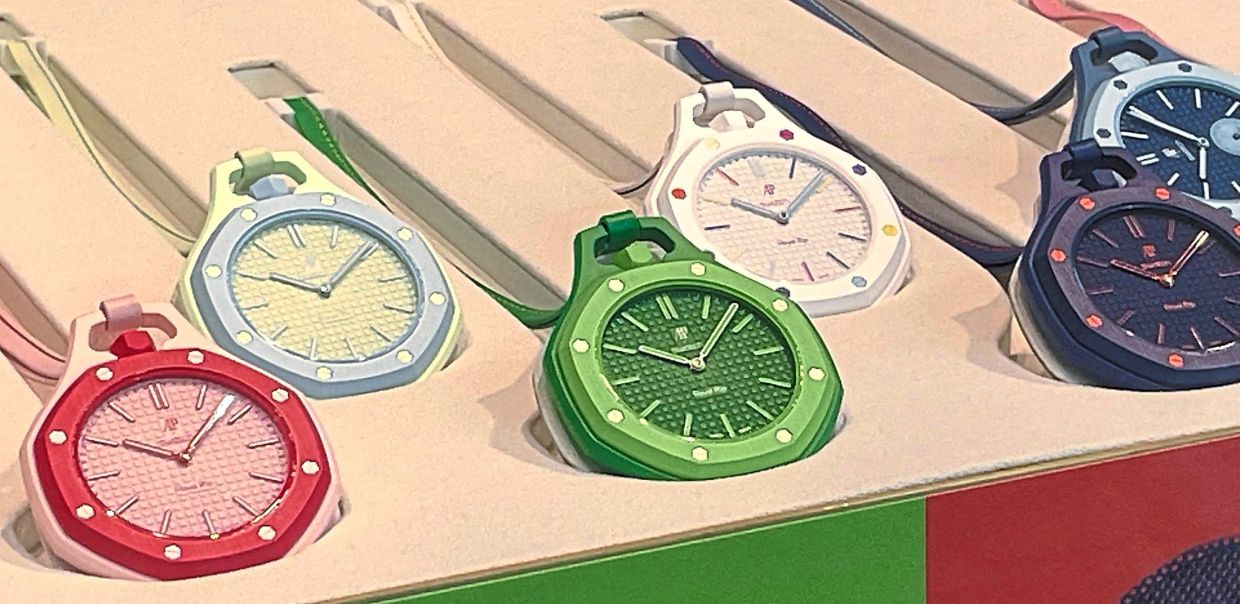
The horological world witnessed a carefully orchestrated eruption of excitement on May 16 when Swatch and Audemars Piguet unveiled Royal Pop, a collaboration that distilled one of haute horlogerie's most storied designs into eight bioceramic pocket watches retailing for less than S$600, equivalent to roughly RM1,800. The collection's rapid depletion across global markets underscored a fundamental shift in how contemporary luxury functions—where perceived scarcity, strategic partnerships and design cleverness matter as much as material cost or traditional craftsmanship credentials.
The pre-launch marketing apparatus proved deliberately enigmatic. Starting in early May, cryptic newspaper advertisements and social media posts teased something mysteriously "iconic" and "unexpected", creating a vacuum that consumers eagerly filled with speculation. Watch enthusiasts flooded forums and Reddit threads with theories, whilst artificial intelligence-generated mock-ups circulated widely across Instagram. This speculative phase proved crucial to building anticipation, yet strict non-disclosure agreements and controlled information channels ensured that authentic imagery and technical specifications remained under wraps until the official May 12 announcement. The secrecy created a paradoxical effect: the less consumers knew with certainty, the more intensely they imagined possibilities.
When Royal Pop finally materialised, the execution surprised even seasoned observers. Rather than conventional wristwatches—which might have cannibalized Audemars Piguet's core market—the collaboration manifested as eight colourful pocket watches that thoughtfully borrowed signature elements from Gerald Genta's legendary Royal Oak: the distinctive octagonal bezel, the "Petite Tapisserie" dial pattern and eight prominent hexagonal screws. The collection split into two functional configurations: Lepine models with crown positioning at twelve o'clock and Savonnette pieces with the crown relocated to three o'clock and incorporating a small seconds subdial. Internally, both variants employed Swatch's hand-wound SISTEM51 movements, mechanically intriguing for their minimalist engineering philosophy yet decidedly removed from the haute horlogerie conventions typically associated with Audemars Piguet.
The deployment of bioceramic cases—a Swatch signature material—proved strategically significant. Rather than positioning Royal Pop as a budget alternative to genuine Royal Oak wristwatches, which command prices near S$30,000, this material choice established the collection as something fundamentally different: a playful reinterpretation of design language expressed through an entirely separate product category. The pocket watch format itself occupies a nostalgic, niche space markedly distant from Audemars Piguet's contemporary business focus, permitting the brand to experiment with iconic visual codes without directly threatening its principal revenue stream. This structural separation granted Audemars Piguet conceptual freedom that a conventional wristwatch collaboration would have foreclosed.
For Swatch, Royal Pop extends a trajectory established through its massively successful 2022 partnership with Omega on the MoonSwatch collection. That earlier collaboration demonstrated the commercial potency of marrying an accessible mass-market timepiece manufacturer with an institution carrying genuine luxury prestige. The MoonSwatch launch generated unprecedented queueing behaviour across major cities, necessitated police crowd management in several locations and triggered substantial secondary market resale activity, with watches commanding multiples of their retail price. These outcomes vindicated a counterintuitive thesis: manufactured scarcity, even at sub-S$400 price points, generates cultural momentum, media visibility and genuine commercial returns that transcend the watches' intrinsic material value.
Royal Pop amplifies this successful formula whilst introducing a crucial variable. Unlike Omega, which functions as a subsidiary within the larger Swatch Group corporate structure, Audemars Piguet operates as an independent manufacture. This distinction transforms Royal Pop from a conventional co-branded offering into something more architecturally ambitious: evidence that Swatch increasingly positions itself as a strategic platform through which independent luxury institutions can broaden consumer engagement without directly compromising their core product offerings or brand positioning. The independence factor carries symbolic weight within horological circles, suggesting mutual respect and genuine creative partnership rather than corporate consolidation.
Local marketing specialists have articulated how this collaboration reshapes fundamental luxury psychology. Pat Law, founder of regional social marketing agency Goodstuph, observes that contemporary luxury transcends mere ownership to encompass proximity—the ability to access a brand's visual and cultural identity even before financial capacity permits engagement with flagship products. Swatch extracts cultural elevation through association with Audemars Piguet's venerable heritage, instantaneously imbuing playful plastic watches with decades of accumulated craftsmanship credibility and horological sophistication. Simultaneously, Audemars Piguet achieves relevance at an unprecedented scale, penetrating consumer consciousness among younger demographics who would otherwise never contemplate visiting boutiques or engaging with S$30,000 entry-level pieces. By existing in cultural conversation through Royal Pop, Audemars Piguet establishes psychological foundations for brand affinity that may eventually convert to mainstream wristwatch purchases as these consumers age and accumulate wealth.
Yet luxury brand research introduces important cautionary considerations. Whilst democratisation strategies generate substantial short-term commercial excitement and sales momentum, excessive accessibility to visual brand codes risks eroding the exclusivity perception that sustains luxury positioning. The more widely Royal Pop's octagonal bezels and tapisserie patterns circulate, the less distinctly associated those elements become with Audemars Piguet's premium positioning. This tension between broadening appeal and preserving scarcity represents an ongoing challenge for luxury houses navigating contemporary market dynamics. Successful navigation requires delicate calibration: the pocket watch format and sub-S$1,000 price point provide natural firewalls, yet future collaborations might lack similar protective distinctions.
The Malaysian and Southeast Asian context adds particular relevance to this broader trend. The region encompasses rapidly expanding middle-class consumer segments increasingly attuned to global luxury culture yet economically constrained from accessing traditional luxury price points. Collaborations like Royal Pop function as cultural gateway drugs, generating regional buzz through social media circulation and creating psychological associations that extend brand reach into aspirational demographics. Watch retailers across Kuala Lumpur, Singapore and Bangkok reported queues comparable to international markets, suggesting that manufactured scarcity and strategic brand partnerships generate cross-cultural appeal independent of local economic development levels.
Royal Pop ultimately crystallises a transformed luxury landscape where strategic positioning, conceptual innovation and carefully engineered scarcity matter as profoundly as material heritage or production expense. By repositioning Audemars Piguet's iconic design language into an entirely separate product category and price architecture, both brands achieved something rare: expanded cultural influence without diluting core brand exclusivity. The pocket watch format proved crucial to this equilibrium, permitting design reinterpretation whilst maintaining psychological distance from mainstream wristwatch commerce. As consumer appetite for experiential luxury and brand proximity intensifies globally, expect similar collaborations to proliferate, particularly partnerships between accessible brands and independent luxury houses seeking fresh market penetration without compromising heritage positioning. The question facing luxury institutions becomes increasingly nuanced: how to expand relevance and engagement without surrendering the exclusivity that justifies premium positioning.