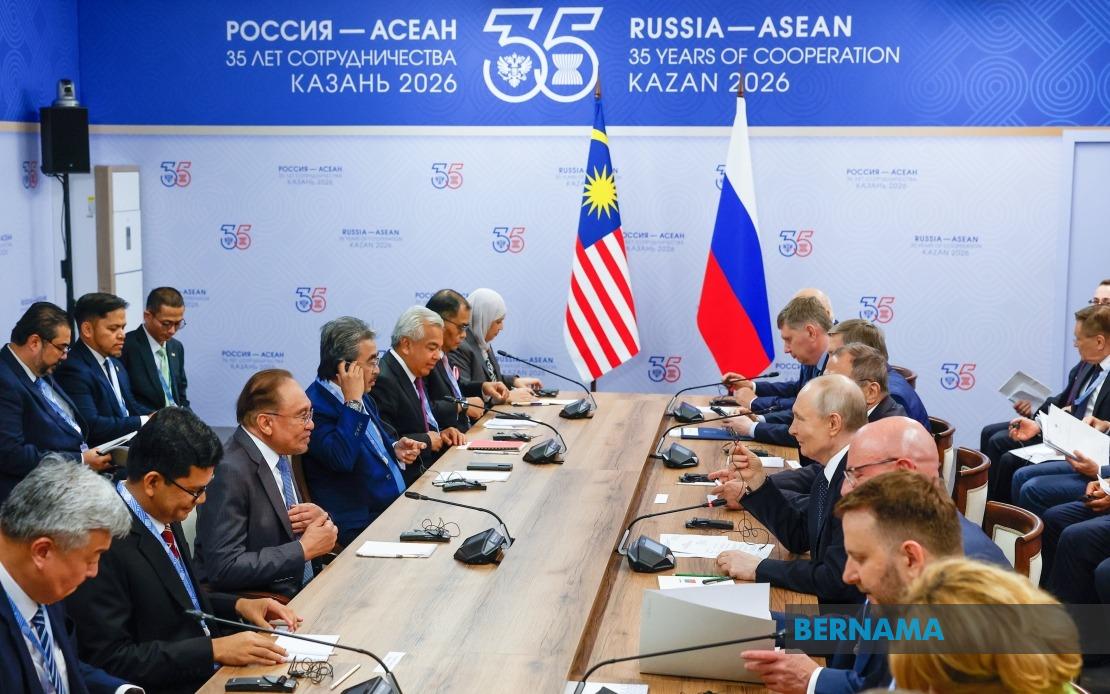
Russian President Vladimir Putin has signalled Russia's commitment to deepening ties with Malaysia, describing the two nations as well-positioned for expanded bilateral engagement as they prepare to commemorate six decades of diplomatic relations next year. The remarks came during bilateral talks between Putin and Malaysian Prime Minister Datuk Seri Anwar Ibrahim held in Kazan on the sidelines of the ASEAN-Russia Commemorative Summit, underscoring the strategic significance both capitals place on their partnership amid broader geopolitical shifts in the Asia-Pacific region.
Putin characterised the approach to the 60th anniversary milestone as an opportunity built on solid ground, noting that Russia and Malaysia have accumulated what he described as "substantive positive experience" in their official dealings. The Russian leader highlighted the depth of institutional engagement between the two countries, pointing to regular high-level contacts maintained through various government ministries, specialised agencies, and parliamentary channels. This network of communication reflects a structured approach to managing bilateral affairs that extends beyond ceremonial exchanges to encompass practical coordination on matters of shared interest.
A key mechanism for translating political commitment into concrete outcomes, Putin explained, is the intergovernmental commission dedicated to economic, scientific, technical, and cultural cooperation. This body serves as the primary vehicle for developing and implementing joint projects across multiple sectors, providing a framework within which both nations can pool resources and expertise. The existence of such formal structures suggests that Russia-Malaysia relations have matured beyond episodic engagement into a system capable of sustaining momentum across different administrations and political cycles.
Trade performance featured prominently in Putin's assessment of bilateral relations, with the Russian president highlighting that commerce between Moscow and Kuala Lumpur expanded by 12.9 per cent during 2025. This growth trajectory, which Putin characterised as a "good result," indicates that economic ties remain robust despite international sanctions pressures and global trade volatility. For Malaysia, continued trade expansion with Russia reflects the country's broader strategy of maintaining diverse economic partnerships and avoiding over-reliance on any single trading partner or regional bloc, a positioning particularly relevant given Kuala Lumpur's balancing act between major powers.
Beyond trade figures, Putin articulated Russian interest in expanding cooperation across education, science, technology, tourism, and humanitarian domains. These sectors represent areas where Malaysia and Russia can leverage complementary strengths: Russia's traditional excellence in mathematics, physics, and engineering education paired with Malaysia's growing innovation ecosystem and tourism appeal. Investment in people-to-people exchange through educational partnerships and cultural initiatives can build foundations for sustained cooperation that transcends fluctuations in political relationships or trade cycles.
Putin specifically welcomed Malaysia's advocacy for strengthening the strategic partnership between Russia and ASEAN as a regional bloc, a point that carries significance beyond bilateral relations. Malaysia's position as an ASEAN member grants it influence in shaping how the 10-nation association approaches its engagement with Russia. The Russian president recalled that the first summit-level meeting between Russia and ASEAN occurred in Malaysia in 2005, establishing a precedent for Malaysian leadership in facilitating dialogue between Moscow and Southeast Asia. By acknowledging Malaysia's continued support for the Russia-ASEAN strategic partnership, Putin recognised Kuala Lumpur's pivotal role as a bridge between Russia and the broader Southeast Asian region.
The timing of Putin's remarks merits attention in the context of regional geopolitics. ASEAN has traditionally sought to maintain balanced relations with major powers rather than align exclusively with any single bloc. Malaysia, as a previous ASEAN chair and key stakeholder, has historically championed this non-aligned principle. Russia's strategic interest in deepening ties with Malaysia reflects Moscow's broader effort to maintain relevance in Southeast Asia amid competition from Western powers and China, making Malaysia's receptiveness to engagement strategically valuable for Russian interests in the region.
Putin described Malaysia as a "long-standing global partner," framing the relationship within a historical narrative of consistency and reliability. He underscored that cooperation between the nations has consistently been anchored in mutual respect and regard for each other's interests—language that sidesteps contentious geopolitical issues and emphasises foundational principles. This diplomatic framing allows both countries to develop pragmatic partnerships on specific issues without requiring alignment on broader strategic questions, a flexibility that appeals to Malaysian policymakers navigating competing international pressures.
Personal diplomatic touches reinforced the warmth of the bilateral relationship. Putin referenced earlier meetings with Anwar in Malaysia and extended formal greetings to His Majesty Sultan Ibrahim, King of Malaysia, a gesture of respect toward Malaysia's constitutional monarchy that carries significance in a nation where the monarchy commands deep reverence. Such courtesies, while ceremonial, serve to embed bilateral relations within frameworks of mutual dignity and acknowledgement of each nation's institutional importance.
For Malaysia, the Putin-Anwar dialogue represents validation of Kuala Lumpur's strategy of engaging Russia despite Western pressure and sanctions. As Malaysia pursues economic diversification and seeks multiple sources of investment, technology, and trade, maintaining functional relations with Russia serves national interests without requiring abandonment of ties with Western democracies or other regional powers. The emphasis on practical cooperation through institutional mechanisms suggests both sides are building relationships capable of weathering international scrutiny and political turbulence.
Looking toward the 60th anniversary in 2026, both nations appear inclined to mark the occasion with substantive achievements rather than symbolic celebration alone. The trajectory outlined by Putin—with growing trade, expanded educational exchange, and deepened cultural ties—suggests that the period leading up to this milestone may see concrete initiatives launched to demonstrate the relationship's vitality. For Southeast Asia broadly, a strengthened Russia-Malaysia partnership represents another data point in the region's efforts to maintain strategic autonomy by cultivating partnerships across traditional geopolitical divides, a balancing act that defines contemporary Southeast Asian statecraft.