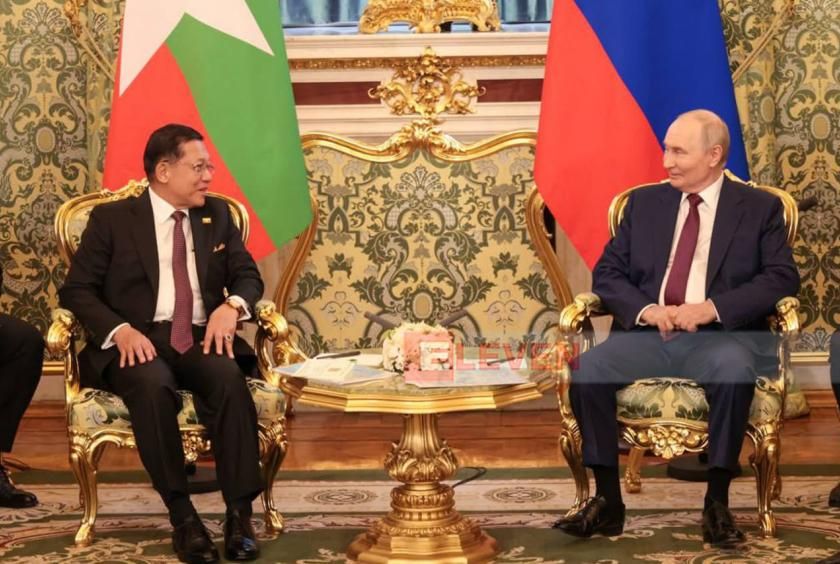
Russian President Vladimir Putin has committed his country to expanded partnerships with Myanmar across energy exploration, infrastructure development, and strategic cooperation, marking a significant deepening of ties between the two nations. Speaking during a joint media appearance with Myanmar President U Min Aung Hlaing on August 18, Putin outlined Russia's willingness to participate in Myanmar's offshore oil and gas ventures as part of a broader economic and strategic engagement spanning multiple sectors. The announcement, backed by 12 memorandums of understanding signed during the visit, underscores Moscow's long-term interest in positioning itself as a key development partner for Naypyidaw, particularly as Western sanctions constrain Russia's access to global markets.
The energy dimension of the Russia-Myanmar relationship carries particular significance given Myanmar's vast untapped hydrocarbon reserves and Russia's expertise in energy infrastructure. Putin specifically highlighted the potential for liquefied natural gas exports from Russian suppliers to Myanmar, envisioning a model where the Southeast Asian nation could consume LNG domestically while potentially exporting surplus supplies to neighbouring countries. This proposal taps into Myanmar's geographical position as a potential regional energy hub, a role that has attracted interest from multiple powers competing for influence in Southeast Asia. The arrangement would provide Russia with a stable market outlet during a period of economic isolation, while offering Myanmar alternatives to energy partnerships with China, which currently dominates regional energy trade flows.
Beyond hydrocarbons, the bilateral cooperation framework encompasses major industrial and infrastructure projects that could reshape Myanmar's economic landscape. Putin cited ongoing coal-fired power plant and oil refinery development, alongside planned construction of a steel manufacturing facility and fertiliser production plant. These projects represent substantial capital commitments and technological transfers that would modernise Myanmar's industrial base. The deep-sea port development initiative in southern Myanmar warrants particular attention for regional observers, as it could position Myanmar as a critical transit point for Indian Ocean trade and provide Russia with strategic access points in a region where Beijing's Belt and Road infrastructure dominance has faced growing scrutiny from other powers.
The nuclear power plant agreement signed in the previous year stands as perhaps the most consequential long-term commitment, with Putin describing it as a cornerstone project for bilateral relations. Russia's civil nuclear programme has become an important tool for deepening strategic relationships, particularly with nations seeking to diversify their energy sources and reduce dependence on fossil fuels. For Myanmar, nuclear capacity would address growing electricity demands from industrialisation while potentially opening pathways to civilian nuclear technology cooperation. However, this dimension of the partnership also reflects Myanmar's strategic calculus to maintain relationships with multiple major powers, particularly as China already plays a dominant role in Myanmar's energy infrastructure.
Cultural and educational exchanges form another pillar of the revitalised partnership, with Putin emphasising people-to-people connections as foundational to long-term bilateral stability. The existence of 400 Myanmar students currently enrolled at Russian universities, alongside 17,000 alumni, suggests an established educational pipeline that predates recent geopolitical shifts. Opening a Myanmar consulate in Vladivostok and establishing cultural centres in Russian regions signals Moscow's commitment to institutionalising these connections beyond government-to-government relations. The approval for constructing a Russian Orthodox church in Yangon, despite Myanmar's Buddhist majority, reflects diplomatic gestures aimed at demonstrating respect for religious freedom and cultural diversity.
Language acquisition initiatives reveal thinking beyond immediate economic returns. Growing enrolment in Russian language programmes at Yangon and Mandalay universities, as well as military academies, indicates preparation for deeper professional and technical exchanges. Such investments in linguistic capacity typically precede expanded technical cooperation, suggesting Russia anticipates increased numbers of Myanmar personnel requiring Russian language skills for defence collaboration, industrial projects, or energy sector work. This mirrors historical patterns from the Soviet era, when language education served as a pathway to deeper institutional integration.
Military-technical cooperation has become increasingly visible, with Putin noting frequent joint exercises in Myanmar's territorial waters and regular naval visits. This dimension warrants careful monitoring from regional security analysts, as it could contribute to shifting naval balances in the Andaman Sea and Bay of Bengal. Russian military presence in Myanmar's waters, even in exercise contexts, provides Moscow with operational familiarity with Southeast Asian maritime environments and opportunities to demonstrate capability to regional audiences. For Myanmar, such cooperation offers access to advanced weapons systems and training that diversify its defence partnerships beyond traditional suppliers.
Historical memory shapes the contemporary partnership framework in ways that extend beyond purely transactional calculations. Putin's invocation of Soviet-era assistance during the 1950s and 1960s, including hospitals and universities that remain functional, grounds the modern relationship in a narrative of proven commitment to Myanmar's development. This historical framing carries particular resonance given Myanmar's experience of Western sanctions and isolation following the military coup, making Moscow's consistent engagement appear as continuity rather than opportunism. The messaging suggests Russia views Myanmar as part of its traditional sphere of influence—a perspective that contrasts sharply with Western efforts to isolate Myanmar's military leadership.
The timing and sequencing of these announcements require contextualisation within broader geopolitical currents. Myanmar's strategic position along major shipping routes, its shared border with China, and its potential as a gateway to South Asia make it a focal point for great power competition. Russia's intensified engagement represents an attempt to maintain relevance in Southeast Asia amid Western-led efforts to isolate Moscow. For Myanmar, balancing Chinese economic dominance with Russian strategic partnership and maintaining tenuous relationships with Western powers presents a complex diplomatic exercise, one that the current military administration appears willing to navigate through security-centric partnerships.
The emphasis on mutual benefit and non-interference in internal affairs, repeated throughout Putin's remarks, addresses implicit recognition of Myanmar's international isolation. These rhetorical commitments carry particular weight given ongoing concerns about Myanmar's military governance and human rights record. By framing the partnership in terms of sovereignty respect and mutual interest rather than conditional reform, Russia signals that its engagement will not include pressure on governance matters, a positioning that distinguishes it from Western approaches and likely contributes to its appeal for Myanmar's leadership.
Looking forward, the trajectory of this partnership will likely depend on several factors: the pace of sanctions relief for Russia, the evolution of Myanmar's domestic political situation, and broader shifts in Southeast Asian geopolitical alignments. Infrastructure projects, particularly the deep-sea port, require sustained investment and technical expertise that will test both countries' capacity for long-term commitment. Educational and cultural initiatives may generate constituencies within Myanmar favouring continued Russian engagement, creating institutional inertia that transcends individual government decisions. The nuclear partnership, while requiring decades to mature, represents a commitment that extends beyond current political configurations.

