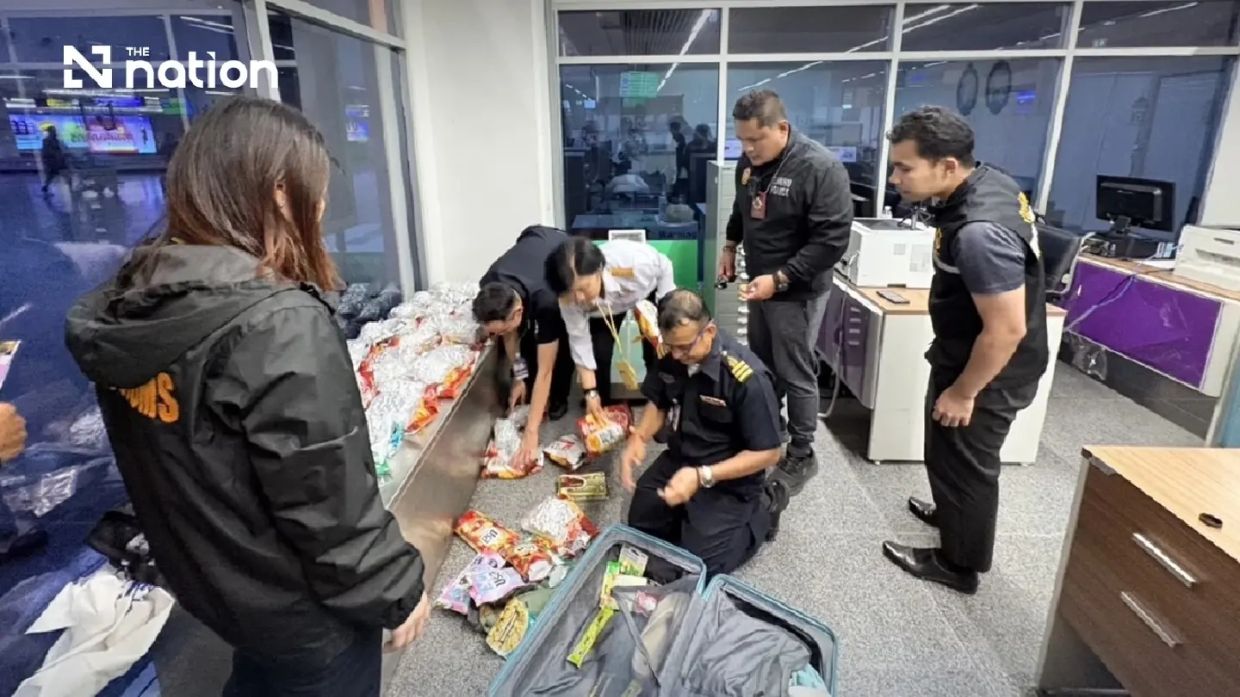
A 30-year-old Russian national faces drug trafficking charges after Thai customs officials discovered a substantial cache of cannabis concealed in his luggage at Phuket International Airport. Sergei Chalabari was apprehended on Wednesday, July 8, in the international departure terminal as he prepared to leave the country, marking another significant narcotics seizure at one of Southeast Asia's busiest travel hubs. The discovery underscores Thailand's ongoing challenges with drug smuggling attempts through its airports, despite increased security measures and heightened vigilance among border enforcement agencies.
The contraband was uncovered during a routine baggage inspection conducted by customs officer Rawin Kanokakorn and his team at the Mai Khao airport facility in Phuket's Thalang district. Two blue BP WORLD wheeled suitcases, together weighing approximately 8 kilograms, belonged to Chalabari and triggered the search that would lead to his arrest. The joint operation between customs and local police represents the coordinated enforcement approach that Thai authorities have increasingly emphasised to intercept drug smuggling operations before they can leave national territory.
The scale of the seizure demonstrates the organised nature of the alleged smuggling attempt. Officers recovered 35 vacuum-sealed packages of cannabis flowers totalling 11.4 kilograms, complemented by 12 separate packages of cannabis resin weighing 6.2 kilograms combined. The meticulous packaging and vacuum-sealing method suggests a sophisticated operation designed to avoid detection, employing techniques commonly used by international drug trafficking networks operating across Asia-Pacific borders. The total haul of 17.6 kilograms represents a significant quantity that would have substantially fuelled local and regional drug markets had it successfully transited through customs.
Initial questioning revealed that Chalabari readily admitted ownership of both the suitcases and their illicit contents, potentially streamlining the legal proceedings against him. He now faces charges related to attempting to smuggle prohibited goods out of Thailand without adherence to customs procedures—a serious offence under Thai narcotics and customs legislation. The straightforward admission, while reducing investigative complexity, does not diminish the gravity of the charges he confronts, particularly given Thailand's stringent drug laws and the substantial quantities involved in this case.
The operational response mobilised by Thai authorities highlights the institutional framework designed to combat drug trafficking at international departure points. Sakhu Police Station superintendent Pol Col Salan Sankhisasanakun and deputy superintendent for investigation Pol Lt Col Rattanawut Nukaew supervised the overall operation, while the customs team was led by Nucha Jeeradit, chief of the Phuket Airport Customs House, alongside Thanomjit Burirak from the customs control division and Charoenporn Jaengwansuk from the investigation and suppression section. This multi-agency coordination reflects Thailand's recognition that combating transnational drug smuggling requires seamless cooperation between customs and police enforcement bodies.
Chalabari's case arrives amid Thailand's intensifying battle against drug trafficking networks that exploit international travel corridors. Phuket's status as a major tourism destination means the airport processes hundreds of thousands of passengers annually, creating both opportunities and vulnerabilities for smuggling operations. The arrest demonstrates that enforcement agencies maintain active surveillance and inspection protocols at departure gates, though the sophisticated concealment techniques employed suggest smugglers continuously evolve their methods to evade detection systems.
For Malaysian readers and the broader Southeast Asian region, this incident carries important implications regarding cross-border drug trafficking patterns and the vulnerability of major regional airports. While Thailand remains the primary enforcement location in this case, the drugs were likely destined for distribution networks extending beyond Thailand's borders, potentially including Malaysia and other ASEAN nations. The interception thus represents a disruption to international trafficking chains that would have ultimately supplied regional markets, underscoring the interconnected nature of Southeast Asia's drug problem.
The case also illuminates the persistent challenge of drug smuggling through human couriers—individuals recruited to transport narcotics through conventional travel channels. Despite advanced scanning technology and security protocols at major airports, determined smugglers continue attempting to move substantial quantities of controlled substances by exploiting luggage compartments and applying concealment techniques. The Russian national's apparent confidence in successfully transporting over 17 kilograms suggests either miscalculation of detection risks or possible coercion by trafficking organisers.
Moving forward, Chalabari faces legal proceedings that will be conducted at Sakhu Police Station, where investigators including Pol Capt Chaphinya Surithamkul, deputy investigation inspector, will manage case development. Thai courts have historically imposed severe penalties for drug trafficking convictions, with sentences frequently exceeding a decade imprisonment, particularly for cases involving substantial quantities of controlled substances. Foreign nationals convicted of drug offences in Thailand have experienced notably punitive legal outcomes, serving as a cautionary precedent for would-be smugglers considering the use of Thailand's transportation networks for illicit narcotics trafficking.

