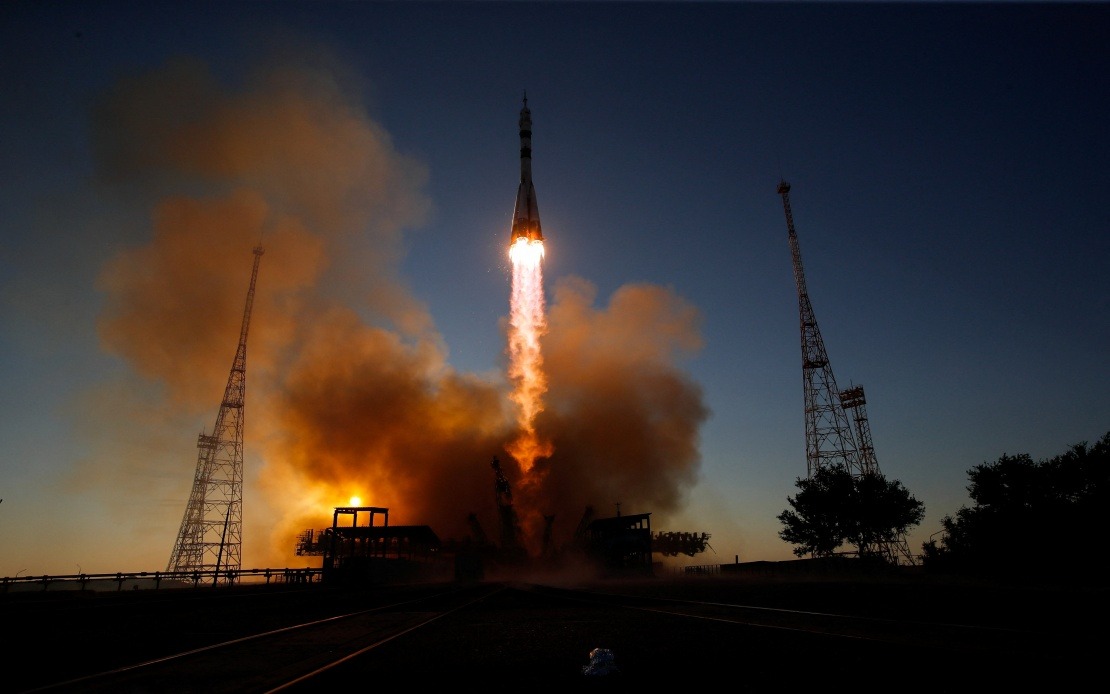
The Soyuz MS-28 spacecraft disengaged from the International Space Station on July 26, concluding an extended research mission that began in late November of the previous year. Aboard the vehicle were Russian cosmonauts Sergey Kud-Sverchkov and Sergey Mikayev alongside United States astronaut Christopher Williams. Russia's state space agency Roscosmos confirmed the successful undocking through live telemetry feeds monitored from mission control.
Following standard orbital mechanics protocols established over decades of spaceflight operations, the three-person crew will now undertake a carefully sequenced descent procedure. Once the Soyuz achieves sufficient separation from the orbiting research facility—a critical safety measure to prevent accidental collision—the spacecraft will execute a deorbit burn. This precisely calculated engine firing will reduce the vehicle's orbital velocity, allowing gravity to recapture and guide it toward the atmosphere.
The descent sequence involves the spacecraft shedding its functional modules in a controlled manner. The pressurised orbital module and service module will detach and burn up during atmospheric re-entry, a natural consequence of their design parameters. Only the descent capsule—a compact, heat-shielded sphere containing the three crew members—will survive the intense thermal environment of re-entry, guided by parachutes to a soft landing.
Navigators and recovery teams have targeted a landing zone near Zhezkazgan in the Kazakh steppe, one of the traditional touchdown areas for Soyuz missions returning from the ISS. Mission control anticipated the capsule would touch down at approximately 12:50 pm Moscow Standard Time, equivalent to 09:50 in Greenwich Mean Time. The arid landscape of Kazakhstan has served as a reliable recovery site for Russia's human spaceflight programme for many years, with experienced ground teams positioned to locate and assist the crew immediately after landing.
The three crew members represent a continuing example of international cooperation in space exploration, despite geopolitical tensions on Earth. Kud-Sverchkov, Mikayev, and Williams have spent the past eight months conducting scientific experiments and maintaining the ISS, one of humanity's most ambitious collaborative projects. This mission continuation underscores how space research transcends national boundaries and remains a domain where nations choose to work together toward common scientific objectives.
Their residency aboard the ISS since November 27 of the previous year encompassed the station's critical operational period during the northern hemisphere winter. During their tenure, the crew participated in experiments ranging from materials science to biological research, contributing to the scientific understanding that benefits researchers and institutions worldwide. The data they collected and the maintenance work they performed will support ongoing investigations long after their return.
The Soyuz programme, operated by Russia and utilised by international partners including the United States through formal agreements, remains the primary means of transporting crew to and from the ISS. For over two decades, these spacecraft have maintained a consistent safety record in returning astronauts and cosmonauts from the orbital station. The MS-28 mission represents another chapter in this long history of reliable human spaceflight operations.
For Malaysia and Southeast Asia, the success of such international space missions carries significance beyond the immediate scientific returns. The collaborative infrastructure demonstrated by ISS operations provides a model for regional cooperation in advancing scientific capability. As nations throughout the region consider expanding their space programmes and research capabilities, the demonstrated commitment of established spacefaring nations to international partnership offers important lessons about how technological advancement and peaceful cooperation can advance together.
The return of experienced crew members like those aboard Soyuz MS-28 also allows for the transfer of knowledge and expertise to the next generation of space explorers. Williams, alongside his Russian counterparts, will contribute insights from their extended orbital residence to training programmes and mission planning for future expeditions. This cyclical process of experienced astronauts mentoring newcomers strengthens the overall capability and safety of human spaceflight operations across all participating nations.
As commercial spaceflight companies develop their own capabilities for crew transport, the established track record of government-operated systems like Soyuz remains the standard against which new ventures are measured. The consistency and reliability demonstrated by Roscosmos across hundreds of missions provides confidence to the international space community and to the public regarding the safety of human space exploration. The successful undocking and anticipated safe return of Soyuz MS-28 represents one more confirmation of this proven operational methodology.

