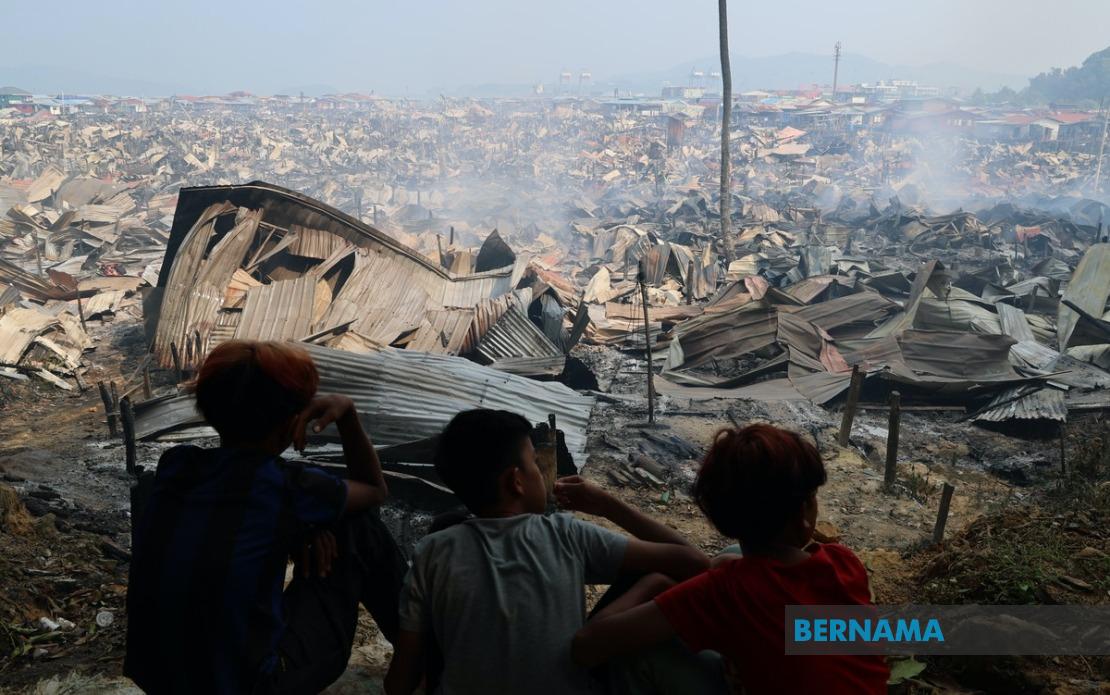
The Sabah government has committed RM3,000 in emergency financial assistance to each Malaysian head of household impacted by a catastrophic fire that swept through Kampung Lok Buta in Numbak, Kota Kinabalu, destroying over 200 residential structures in the early hours of August 31. Chief Minister Datuk Seri Hajiji Noor made the announcement after personally visiting displaced residents at the Likas Multipurpose Hall temporary relief centre, underscoring the state government's rapid response to one of the region's most significant residential disasters in recent years.
The relief package reflects a collaborative funding approach, with each household receiving equal contributions of RM1,000 from three separate sources: the Sabah state government, the federal government, and the Yayasan Kebajikan Sabah. This tripartite structure demonstrates coordination between different levels of administration and the private charitable sector, a mechanism increasingly important for disaster response in Malaysia. The Chief Minister framed the announcement within a humanitarian context, emphasizing that swift financial support would help families navigate the immediate aftermath of losing their homes and possessions.
Beyond direct cash transfers, the state government has pledged to facilitate comprehensive reconstruction efforts through coordination involving the State Secretary's Office and Majlis Amanah Rakyat (MARA). This institutional involvement signals that the relief programme extends beyond emergency payments to encompass longer-term rehabilitation. Authorities will determine whether residents should rebuild at their original Kampung Lok Buta location or relocate to alternative sites deemed more suitable, a decision that will require careful evaluation of safety standards, infrastructure capacity, and community preference.
A noteworthy humanitarian provision extends RM1,000 in state government assistance to non-Malaysian household heads affected by the fire. This inclusive approach recognizes that informal settlements in Malaysian urban areas often include undocumented or foreign residents who, despite their legal status, deserve emergency protection and support. The decision reflects evolving standards of disaster response that prioritize human welfare over rigid immigration categories during humanitarian crises.
The government committed to supplying essential commodities to displaced families, including food and household goods necessary for survival in the immediate post-disaster period. Such provisions address the reality that cash assistance, while crucial, cannot fully meet the urgent needs of families who have lost everything. Access to clean water, cooking facilities, bedding, and basic hygiene products remains critical during the transition period before permanent housing can be arranged.
The fire, originating around 1.40 am, claimed three young lives: four-year-old Nana Abdullah, her six-year-old brother Mohd Asrul, and their eight-year-old cousin Nurfarahdilah Mohd Tajihah. The loss of children in disaster situations carries particular weight within Malaysian society and underscores the vulnerability of families living in densely populated informal settlements where fire safety infrastructure may be inadequate. These deaths will likely prompt reviews of fire prevention measures and emergency response protocols in comparable communities.
For Malaysian policymakers and disaster management specialists, the Kampung Lok Buta incident provides critical lessons about fire risk in rapidly developing urban areas where housing density often outpaces safety infrastructure. Informal settlements throughout Malaysia and Southeast Asia face similar vulnerabilities, with wooden or semi-permanent structures creating conditions where fires spread rapidly and escape routes remain limited. The tragedy highlights the need for proactive fire safety audits and community education programmes in vulnerable neighbourhoods.
The scale of displacement—affecting over 200 households—places significant logistical and financial strain on state resources. The coordination required to house, feed, and eventually rebuild for such a large population demonstrates the complexity of disaster management even in relatively developed Malaysian states. Insurance gaps represent another concern: many residents of informal settlements lack comprehensive property insurance, making government relief their sole recourse for recovery.
The involvement of Yayasan Kebajikan Sabah in the relief effort illustrates how charitable organizations complement government action during major disasters. Private foundations often possess greater flexibility in fund deployment and can respond quickly to emerging needs that formal bureaucratic channels might address more slowly. This partnership model, replicated across multiple Malaysian disasters, has become increasingly institutionalized and effective.
Rebuild location selection will carry long-term implications for community cohesion and livelihoods. If residents cannot return to Kampung Lok Buta, displacement may separate families from employment sources, markets, and social networks. Authorities must balance fire safety imperatives with the practical reality that relocated populations require accessible employment opportunities and maintained community ties to rebuild their lives successfully.
The RM3,000 allocation, while substantial in immediate terms, may prove insufficient for full housing reconstruction given Sabah's property values. This gap between emergency relief and actual rebuilding costs often necessitates additional support mechanisms, including soft loans, government housing schemes, or employer assistance. Monitor how authorities address this shortfall in coming months as displaced residents assess their capacity to secure permanent housing.
Sabah's response contrasts with historical Malaysian disasters where coordination between state and federal authorities sometimes lagged. The explicit mention of federal government participation suggests improved intergovernmental cooperation in disaster response. Similar fires in other Malaysian states may now benefit from this demonstrated model of rapid joint action and transparent funding commitments.

