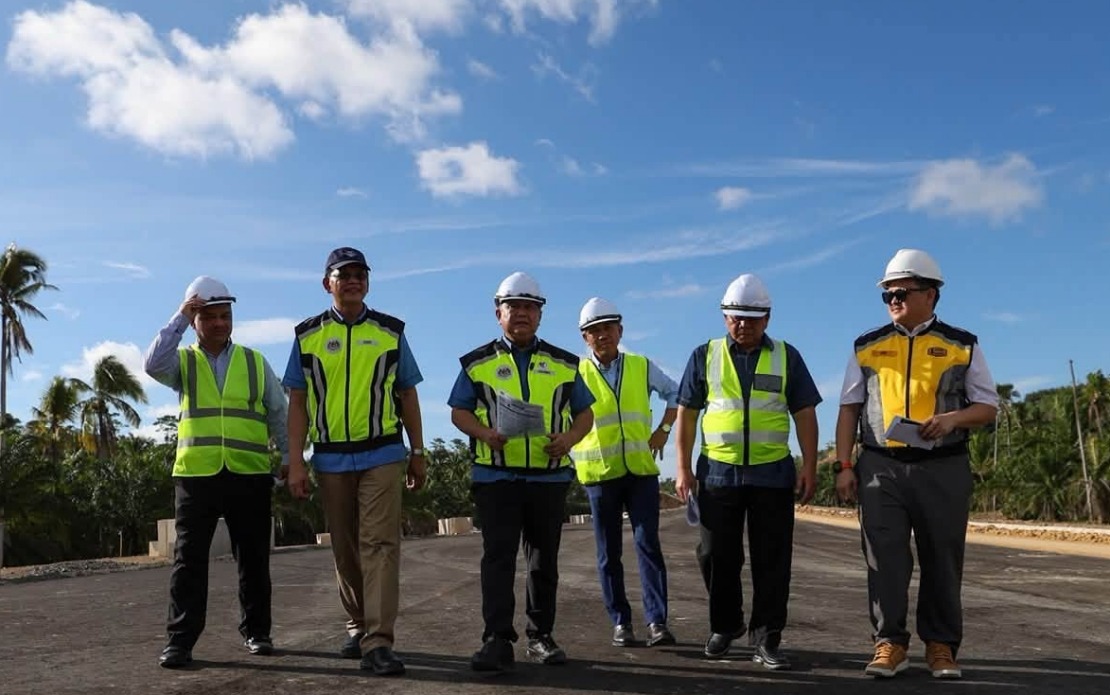
The contractor for Sabah Pan Borneo Highway Work Package 11 has formulated a recovery plan to address mounting delays on the 7.3-kilometre Rampayan Laut-Sarang alignment segment, Works Minister Datuk Seri Alexander Nanta Linggi announced. As of late June, the RM167.48 million project had slipped 32 days behind schedule, with physical progress standing at 61.76 per cent—a shortfall of 4.35 per cent against the original timeline. The initiative aims to bring the project back on track for its contractually mandated completion by September 29, 2026.
The recovery effort reflects intensified coordination among multiple stakeholders in the government and private sector. The Works Ministry, working alongside the Sabah Public Works Department, project consultants, and the main contractor, intends to progressively narrow the delay to just 14 days by August 2026 through stricter oversight of implementation activities. This phased reduction in schedule variance demonstrates confidence that the trajectory can be corrected, though the initial 32-day gap underscores the complexity of executing major infrastructure projects in Sabah's unique geographical and administrative context.
Utility relocations have emerged as a principal bottleneck threatening project momentum. Coordination with Sabah Electricity Sdn Bhd for power infrastructure, the Sabah State Water Department for water supply networks, and Celcom Timur Sabah Sdn Bhd for telecommunications services has created cascading delays that prevented smooth progression of on-site construction works. Such utility coordination challenges are commonplace in Malaysian highway projects but demand particular sensitivity in Sabah, where service providers operate across dispersed populations and challenging terrain. The recovery plan must therefore address not merely the contractor's own productivity but also the synchronisation of third-party stakeholders whose cooperation remains essential.
Land acquisition issues compound these infrastructure challenges. The alignment traverses areas requiring property negotiations and legal clearances that have not proceeded as anticipated. In Malaysian development projects, especially in Sabah where land tenure arrangements can be complex and involve state government, federal interests, and indigenous considerations, acquisition delays often prove intractable without high-level intervention. The recovery plan's success may hinge on expedited administrative handling of outstanding land matters, which ultimately lie beyond the contractor's direct control but directly impact construction sequencing.
The 7.3-kilometre segment represents a critical piece of the broader Pan Borneo Highway initiative, which aims to ring the island of Borneo with improved connectivity. For Sabah specifically, this particular alignment offers tangible economic and social benefits by creating a safer, more direct route to Simpang Mengayau and Kudat in the state's north. The improved corridor is expected to trim travel distances by as much as 30 kilometres and reduce journey times between 30 and 60 minutes, making it particularly valuable for commercial and tourism traffic currently enduring circuitous routes.
The strategic importance of this corridor extends to Sabah's tourism positioning and northern regional development. By shortening access times to the Tourism Belt and supporting implementation of the Northern Sabah Coastal Tourism Master Plan, the upgraded highway becomes an economic multiplier rather than merely a transportation asset. Cleaner routes and faster travel times encourage both domestic and international tourists to explore these regions, while improved logistics enable local businesses to reach broader markets more competitively. The infrastructure thus catalyses the kind of economic activation that development planners in Sabah have long pursued.
Beyond tourism, the alignment's completion carries implications for employment and investment throughout northern Sabah. Works Minister Nanta explicitly framed the project as a vehicle for generating economic opportunities and attracting investment to communities currently constrained by geographical isolation and poor connectivity. Malaysian infrastructure policy increasingly emphasises this multiplier effect—that well-executed transport projects don't merely move vehicles but unlock human and commercial potential in underserved regions. The cost of delay therefore extends beyond contract penalties to encompassing foregone economic activity across the local economy.
The minister's emphasis on quality, safety, and integrity standards reflects heightened scrutiny of Malaysian infrastructure delivery following high-profile project failures and cost overruns in recent years. By explicitly committing to completion that meets exacting standards rather than simply rushing to finish dates, the Works Ministry signals recognition that shoddy construction creates long-term maintenance costs and safety hazards that multiply the original expense. For Sabah residents who depend on this highway's performance across challenging terrain and climate conditions, such assurances matter considerably.
The recovery plan's submission itself represents a milestone in accountability. Rather than quietly extending timelines or absorbing delays, the formal recovery plan commits all parties to measurable milestones and transparent monitoring. Monthly reviews and progressive reduction targets create visibility into whether momentum is genuinely improving or whether obstacles are being understated. This mechanism allows government overseers and the public to distinguish between legitimate project complexities and mere slippage, enhancing confidence in the eventual delivery date.
The 14-day residual delay targeted for August 2026 acknowledges realism about what recovery can achieve without fundamental redesign or massive resource injection. Completing a 7.3-kilometre highway segment in Sabah's terrain, coordinating utility relocations across multiple service providers, and managing land acquisitions remains inherently time-pressured work. The modest remaining gap of 14 days before the September contractual deadline provides minimal but possibly adequate margin for unforeseen complications on a complex project.
Looking forward, the recovery plan's success will offer important lessons for future Pan Borneo segments in Sabah and comparable infrastructure initiatives across the region. Malaysian planners can study which coordination mechanisms proved most effective, how utility relocation can be better anticipated and expedited, and whether land acquisition procedures require legislative streamlining. Infrastructure development in Southeast Asia's more remote regions faces these recurring challenges, making Sabah's experience instructive for governments throughout the region aiming to improve connectivity and economic opportunity.
For Malaysian stakeholders monitoring this project—from the Works Ministry to Sabah's state government to the construction industry—the recovery plan symbolises commitment to delivery despite formidable operational hurdles. Whether the roadway opens fully by September 2026 remains contingent on execution, but the formal recovery mechanism demonstrates that project difficulties need not mean indefinite delay. The coming months will clarify whether the coordinated effort produces tangible acceleration or whether additional remedial measures become necessary.

