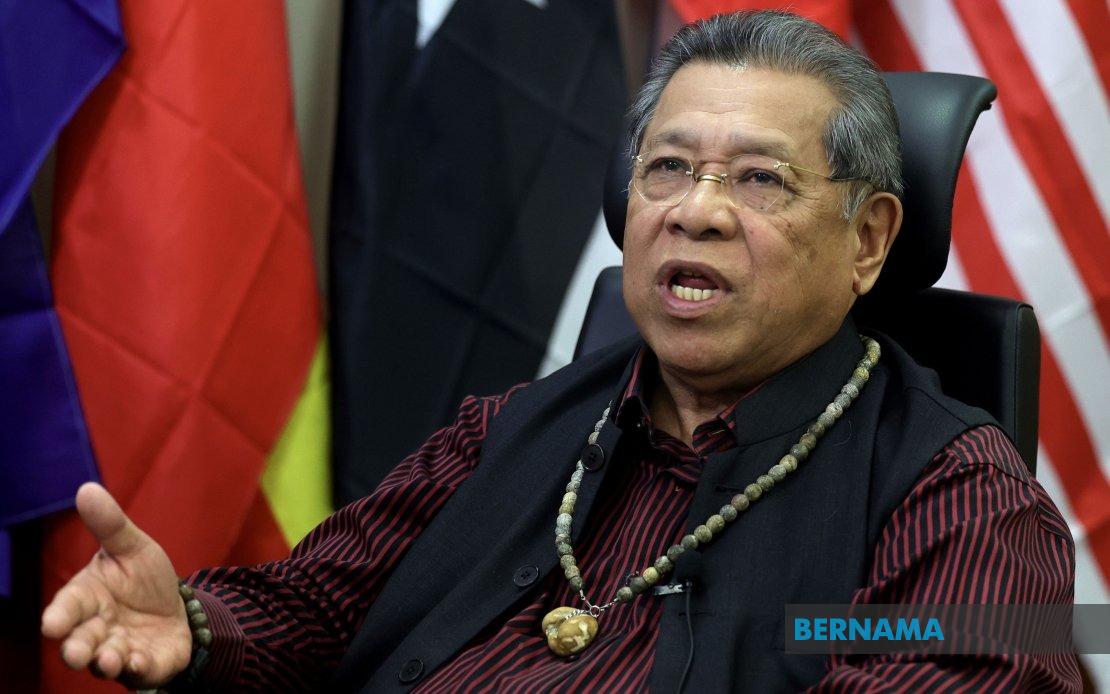
The Malaysian federal government's commitment to Sabah is set to translate into tangible infrastructure and development gains, with funding to the state climbing significantly under Prime Minister Datuk Seri Anwar Ibrahim's administration. Tan Sri Pandikar Amin Mulia, president of the United Sabah National Organisation (USNO), has thrown his weight behind the investment trajectory, underscoring the political and economic implications of sustained federal backing for the East Malaysian state.
The funding increase represents a substantial injection into Sabah's development pipeline. Federal allocations to the state have risen by 35 per cent, climbing from RM13 billion in 2022 to RM17.6 billion in 2026. This uplift was announced by Anwar during his presidential policy address at the 2026 PKR National Congress, held at the Melaka International Trade Centre (MITC) in Ayer Keroh, providing clarity on the government's fiscal priorities for the peninsula's largest opposition-governed state.
For Sabah, the monetary increase carries both immediate and strategic relevance. The enhanced budget allocation enables state authorities to move forward with long-delayed infrastructure initiatives, from healthcare and education facilities to transportation networks and economic development zones. Pandikar Amin characterised the funding boost as a catalyst for rapid development, emphasising that investments in Sabah would generate spillover benefits for the nation's broader economic performance. His framing positions East Malaysian development not as a regional silo but as integral to Malaysia's competitive positioning globally.
The political dimension underlying the funding commitment deserves examination. Pandikar Amin's public endorsement of Anwar Ibrahim's government reflects calculated alignment within Malaysia's coalition politics. By voicing confidence in the Prime Minister's stewardship on both international and domestic fronts, the USNO leader signals continuity and partnership at a time when federal-state relations require cohesion. His remarks were made during a governing party congress, suggesting coordinated messaging around fiscal management and regional equity.
The Prime Minister's own comments at the congress addressed a persistent criticism levelled at his administration: that certain states, potentially including Sabah, have been sidelined in allocation decisions. Anwar rejected such characterisations outright, clarifying that state-level funding is calibrated according to developmental priorities and demonstrated financial need rather than applied uniformly across all territories. This distinction matters in Malaysian federalism, where states have unequal infrastructure bases and economic capacities.
Sabah's historical experience with federal allocations has been marked by periods of marginalisation relative to Peninsular states, a grievance that periodically surfaces in political discourse. The current 35 per cent real increase over a four-year span—from 2022 to 2026—suggests a deliberate recalibration toward the state, possibly reflecting broader political calculations around coalition stability and East Malaysian representation within Pakatan Harapan and the wider ruling coalition.
The magnitude of the increase warrants contextualisation within Malaysia's broader fiscal landscape. A RM4.6 billion absolute increase for Sabah represents meaningful capital deployment in a state with an estimated population of 3.9 million. Such funds are typically allocated across recurrent expenditure, capital projects, and statutory obligations. The distribution methodology and absorptive capacity of state-level institutions will ultimately determine whether the budgetary increase translates into visible development outcomes or remains locked in planning stages and bureaucratic processes.
For Southeast Asian observers, Sabah's funding trajectory underscores Malaysia's ongoing efforts to balance regional development priorities. The state's strategic position in the Sulu-Celebes maritime corridor, its natural resource endowments, and its historical susceptibility to regional security pressures have long justified priority investment. Enhanced federal funding can support border security infrastructure, port facilities, and economic initiatives that strengthen Malaysian sovereignty and integration across the region.
Pandikar Amin's backing of the MADANI Government—the administration's self-described development brand—reflects pragmatic statecraft within Malaysia's federal system. USNO, despite its origins in Sabah state politics, has aligned with the broader ruling coalition framework, and the party president's endorsement of Anwar signals consolidation rather than friction. This political alignment creates space for improved federal-state coordination, potentially accelerating project implementation timelines that might otherwise face inter-governmental delays.
The sustainability of increased allocations beyond 2026 remains an open question. Budget cycles are subject to economic conditions, fiscal performance, and shifting political priorities. Sabah's political leaders, including Pandikar Amin, will likely seek written commitments or statutory arrangements to protect against future retrenchment. Medium-term fiscal planning transparency would strengthen investor confidence in Sabah's development trajectory and signal genuine commitment to long-term growth rather than cyclical political favours.
Looking forward, the efficacy of the RM17.6 billion allocation will depend on institutional capacity, project selection rigour, and corruption controls. Malaysian states have historically faced challenges in project implementation, with cost overruns and delays common across infrastructure portfolios. Sabah's bureaucratic machinery will require strengthening to absorb and deploy the increased funding efficiently, a consideration that may warrant capacity-building investments alongside project capital.
The announcement also carries implications for Malaysia's internal cohesion at a time when regional inequality remains a persistent policy concern. Demonstrable progress in Sabah's development indicators—poverty reduction, employment growth, infrastructure coverage—will validate the government's investment thesis. Conversely, underperformance could reignite debates about federal allocation fairness and regional marginalisation, complicating coalition management in a nation where East Malaysian votes carry strategic weight in parliamentary arithmetic.

