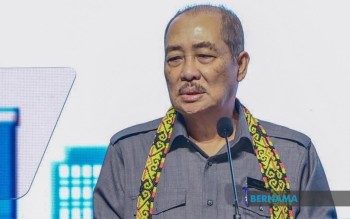
Sabah Chief Minister Datuk Seri Hajiji Noor has announced that the state government expects to clinch a 40 per cent ownership stake in a floating liquefied natural gas project operating within Sabah's territorial waters, with a formal agreement with national oil corporation Petronas anticipated within the coming months. The development represents a significant shift in the state's relationship with the federal petroleum authority, granting Sabah considerably greater leverage and financial participation in energy ventures that were previously dominated by federal-level control.
The arrangement stems from an earlier understanding between Sabah and Petronas that fundamentally restructured how the state engages with its hydrocarbon resources. This framework has opened pathways for greater autonomy in decision-making around major energy infrastructure projects. The floating liquefied natural gas installation, sometimes termed a floating production storage and offloading vessel or FPSO equivalent, would represent cutting-edge technology for offshore extraction and processing, allowing the state to benefit substantially from future production revenues and operational opportunities.
Beyond the headline FLNG project, Hajiji disclosed that Sabah will also receive a 20 per cent equity position in an oil and gas field that Petronas has successfully developed in Sandakan. This dual arrangement demonstrates a comprehensive recalibration of benefit-sharing across multiple hydrocarbon ventures, ensuring the state captures value across different asset classes and geographic zones. The Sandakan field addition underscores that the FLNG partnership is not an isolated transaction but rather part of a broader portfolio realignment favouring greater Sabah participation.
The Chief Minister attributed these gains to harmonious collaboration between Sabah's state apparatus and Malaysia's federal government, emphasising that improved coordination has yielded tangible economic dividends for residents. This framing highlights a political narrative of unity and shared prosperity, particularly relevant in a federal structure where resource-rich states have historically felt marginalised in wealth distribution. For Malaysian observers, the development signals that Sabah's negotiating position within the federation has strengthened, potentially creating precedent for similar discussions with other resource-dependent states.
Hajiji also seized the opportunity to tout Sabah's attractiveness as an investment destination, noting that approximately 40 foreign diplomats and high commissioners have sought meetings with him over the preceding five years, drawn by the state's investor-friendly regulatory environment. This statistic underscores Sabah's emergence as a serious contender for major foreign direct investment in Southeast Asia, particularly in sectors aligned with blue economy development and industrial manufacturing. The diplomatic interest reflects growing recognition of Sabah's geographic positioning, demographic potential, and resource endowments.
The state's industrial infrastructure is reaching saturation point, according to Hajiji, with both the Kota Kinabalu Industrial Park and the Sipitang Oil and Gas Industrial Park approaching full occupancy driven by sustained investor demand. This capacity constraint, whilst a positive indicator of business confidence, necessitates strategic expansion into virgin industrial zones. The state government is consequently diversifying its manufacturing footprint eastward along Sabah's eastern coastline and developing a blue economy-focused industrial park in the northern region, positioning the state to capture emerging opportunities in maritime industries, aquaculture, renewable energy, and sustainable resource extraction.
In Kalabakan specifically, Hajiji revealed plans for a substantial new township development spanning approximately 1,000 acres, aimed at catalysing economic activity in this border region with Indonesia. Such township development typically encompasses residential, commercial, and light industrial components designed to create self-sustaining communities with employment generation capacity. Kalabakan's location along the Sabah-Indonesia frontier makes it a strategic locus for cross-border economic integration, particularly relevant given Malaysia's intensified focus on regional connectivity and the Association of Southeast Asian Nations economic architecture.
Complementing the township initiative, the state intends to establish a customs, immigration, and quarantine complex at the border crossing, a critical infrastructure element that would streamline trade flows and reduce transaction costs for businesses engaged in cross-border commerce. Such facilities are foundational for effective regional trade, facilitating smoother movement of goods and services whilst maintaining necessary regulatory oversight. The planned road connection linking Kalabakan to the border will further reduce logistical friction and enhance the township's viability as a commercial hub.
These interconnected infrastructure and equity initiatives reflect a coherent development strategy positioning Sabah as a dynamic regional economy. The FLNG partnership addresses immediate resource wealth extraction, whilst industrial park expansion and border township development provide medium-term employment and revenue diversification. For Malaysian readers and investors, these announcements suggest Sabah is transitioning from a resource-extraction economy overly dependent on hydrocarbon revenues toward a more balanced structure encompassing manufacturing, blue economy ventures, and cross-border trade facilitation.
The timing of these announcements, made during a community engagement programme in Kalabakan, demonstrates political acumen in connecting macro-level policy achievements to constituent-level benefits. Hajiji's emphasis on federal-state cooperation and investor confidence signals continuity and stability, reassuring both external investors and domestic stakeholders of the government's commitment to sustained economic expansion. For Southeast Asia's investment community, Sabah's trajectory warrants close monitoring as it positions itself as a credible alternative to established manufacturing hubs and energy investment destinations across the region.

