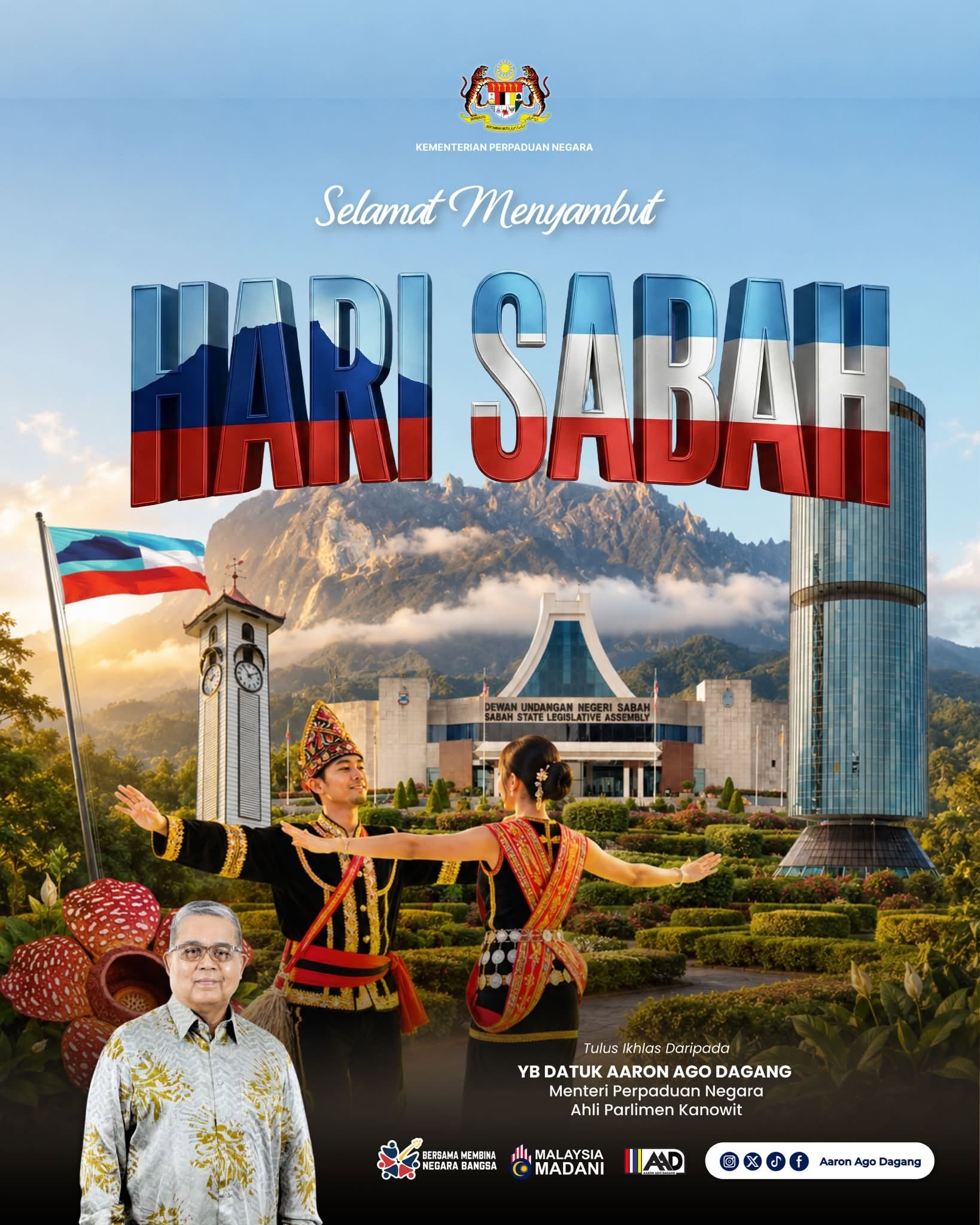
The intricate cultural landscape of Sabah represents far more than administrative convenience; it forms the bedrock upon which the state's identity and stability are constructed, according to National Unity Minister Datuk Aaron Ago Dagang in remarks marking Sabah Day on August 31. The minister's emphasis on the state's pluralistic character arrives at a moment when Malaysia continues to grapple with questions of social cohesion and the mechanics of multiracial coexistence across its regions.
Within Sabah's borders exist 35 distinct ethnic communities, each subdivided into 217 separate sub-groups, according to the minister's accounting. This fragmentation by numbers alone might suggest complexity or potential fracture; instead, Dagang reframed it as accumulated richness. The Kadazan, Dusun, Bajau, Murut, Rungus, Bisaya, Lotud, Lundayeh and numerous smaller communities have each contributed distinctive linguistic systems, sartorial traditions, musical forms, choreographic practices and historical narratives that collectively compose the contemporary Sabah known to residents and observers alike.
The architecture of Sabah's harmony, as presented by the minister, rests on a deceptively simple foundation: mutual comprehension, respect and acceptance among communities that might otherwise remain isolated from one another. Dagang's framing challenges a persistent narrative that diversity inherently generates tension or requires top-down management to prevent conflict. Instead, he proposed that the Sabah example demonstrates how divergent populations naturally achieve peaceful coexistence when the prerequisites of understanding and reciprocal regard are met. This interpretation carries implications for other Malaysian states and regions where ethnic composition proves more polarised or where historical grievances have calcified into institutional practice.
The chronological depth of Sabah's historical experience lends particular weight to the minister's arguments about resilience through diversity. The territory transitioned through multiple sovereign arrangements—the North Borneo administration, the British North Borneo Company's commercial dominion, Japanese wartime occupation and post-war British governance—before attaining self-determination in 1963. Rather than these successive upheavals fragmenting the population along ethnic lines or creating centrifugal tendencies, the various communities maintained sufficient cohesion to present a unified polity. This historical continuity suggests that the ethnic groups inhabiting Sabah have developed institutional and social mechanisms for managing difference that predate modern nation-state frameworks.
Sabah's accession to the Federation of Malaysia on September 16, 1963—a fortnight after its initial independence declaration—represented a deliberate choice by its ethnically diverse population to embed themselves within a larger multiracial structure. The timing and voluntary nature of this merger distinguish Sabah's relationship to Malaysia from that of other constituent territories. The population collectively determined that their interests aligned with participation in a federal system encompassing Peninsular Malaysia, Singapore, Sarawak and their own territory. This historical agency complicates simplistic narratives about federal imposition and highlights instead the agency of Sabah's communities in selecting their political future.
The minister's invocation of historical figures and past generations carries particular significance within the Malaysian context, where questions of national memory and historical recognition frequently intersect with contemporary political disputes. Dagang explicitly called upon the current generation to acknowledge the intellectual, physical and sacrificial contributions of their predecessors—leaders, activists, ordinary citizens and community organisers whose labours constructed the institutional scaffolding within which Sabah operates today. This genealogical consciousness serves not merely as nostalgic commemoration but as a challenge to present-day inhabitants to recognise their inheritance as a trust requiring active stewardship.
The responsibility framework articulated by the minister distributes obligations across multiple domains simultaneously. Educational advancement, economic dynamism, technological adoption and infrastructural development constitute the forward-looking agenda upon which Sabah's present generation must concentrate their energies. Yet these developmental imperatives do not exist in isolation from cultural and historical preservation; rather, they form a dual mandate requiring simultaneous progression and conservation. Sabah's communities must simultaneously construct contemporary infrastructure and institutions while maintaining the historical and cultural inheritance that distinguishes their state within Malaysia's federalism.
The formal declaration of August 31 as Sabah Day by the state government in 2024 formalises what had previously existed as commemorative practice without official institutional recognition. This elevation of the date to official status represents an assertion of Sabah's distinct national identity within the Malaysian federation, analogous to how other states and the federal territories maintain distinct founding dates and commemorative frameworks. The gesture simultaneously acknowledges Sabah's particularity and its integration within the broader Malaysian calendar of national observances. For Malaysian audiences, particularly those unfamiliar with the depth of Sabah's historical experience and ethnic composition, the minister's remarks and the formal recognition of Sabah Day combine to foreground a regional narrative often marginalised in national discourse dominated by Peninsular preoccupations.
The minister's construction of diversity as strength rather than challenge carries implications that extend beyond Sabah's territorial boundaries into broader Southeast Asian contexts where ethnic pluralism, migration patterns and the legacies of colonial administration have similarly created multicommunal societies grappling with questions of coexistence and common citizenship. Sabah's demonstrated capacity to maintain stability across 35 ethnic communities offers empirical evidence that such arrangements remain viable when underpinned by institutional competence, historical consciousness and mutual regard. The articulation of this model from Malaysia's national government carries particular weight, signalling official recognition that diversity can constitute a national asset rather than a liability requiring containment or management through assimilationist pressures.

