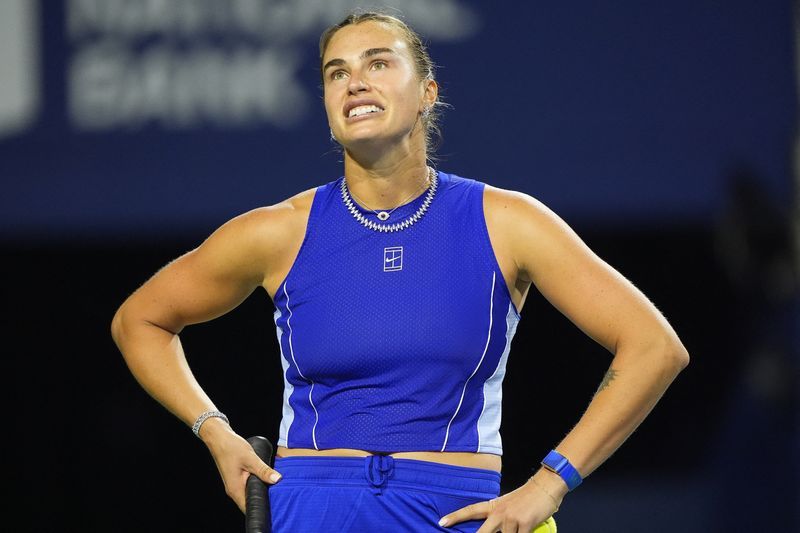
The pathway to defending her U.S. Open title encountered an unexpected detour for Aryna Sabalenka when the world number one suffered a defeat to Russia's Ekaterina Alexandrova in the fourth round of the Canadian Open in Toronto on Saturday. The 16th-seeded Alexandrova prevailed 7-6(3) 4-6 6-4 in a gruelling encounter that stretched beyond two and a half hours, securing a quarter-final berth while leaving questions about Sabalenka's form heading into the year's final Grand Slam tournament.
The match represented a significant juncture in Sabalenka's preparation schedule, coming at a critical juncture in the North American hard court swing. The Belarusian, a four-time Grand Slam winner and defending champion at Flushing Meadows, had arrived in Canada with considerable confidence but was unable to withstand Alexandrova's tactical adjustments and sustained aggression throughout the three-set battle.
Sabalenka's troubles began immediately, as Alexandrova seized the initiative with an early break in the opening set. However, Sabalenka demonstrated the resilience that has defined her career, regrouping to force the set into a decisive tiebreak. Yet the momentum did not swing decisively in her favour, as Alexandrova claimed the tiebreak 7-3 to claim the first set and establish psychological advantage in the encounter.
The second set witnessed a complete reversal of fortune. Sabalenka asserted control with a crucial break that afforded her a 4-3 advantage, subsequently holding serve to bring the match level at one set apiece. This recovery suggested that the top seed might yet find her rhythm and reclaim dominance over the Russian challenger. The ability to force a decisive third set indicated that Sabalenka retained the competitive steel necessary to overcome adversity.
Yet the decider proved decisive in an unfavourable direction. As the match progressed into its final stages, Sabalenka's error tally mounted alarmingly, a concerning sign for a player whose aggressive baseline game normally compensates for occasional waywardness. Alexandrova held firm under pressure, maintaining her composure as her opponent's concentration wavered. At 5-4, Sabalenka faced match point and managed to save two opportunities through determined play, but a double fault on the third match point proved her undoing, handing Alexandrova the victory and a place in the semi-finals.
Alexandrova's composed demeanour following the victory underscored the significance of her achievement against a player ranked substantially above her in the world standings. In her courtside interview, the Russian emphasised her tactical approach of treating each point as if it carried ultimate importance, refusing to allow Sabalenka's reputation or ranking to influence her decision-making. Alexandrova acknowledged that after Sabalenka levelled the match by winning the second set, she had begun to doubt her chances, yet she persevered through the critical moments when they arrived.
The psychological dimension of this result cannot be underestimated for Malaysian and Southeast Asian tennis enthusiasts observing the sport's elite level. Sabalenka's loss demonstrates that even players at the pinnacle of professional tennis require momentum and consistency heading into major tournaments. Her mounting unforced errors in the deciding set point to possible fatigue or loss of focus, factors that frequently determine outcomes in closely contested matches between top competitors.
Alexandrova's progression to the semi-finals sends her toward a clash with Ukraine's Elina Svitolina, who advanced by overwhelming eighth-seeded American Amanda Anisimova with a 6-2 6-4 victory. This matchup between two European players offers intrigue for the Toronto tournament, with both competitors now just two matches away from claiming the title. Svitolina's dominant performance against a seeded opponent suggests that the American hard court season remains genuinely unpredictable, with several potential champions capable of triumphing depending on the day and conditions.
For Sabalenka, the loss serves as a timely reminder that no lead is insurmountable and no opponent can be overlooked, regardless of rankings or recent success. The reigning U.S. Open champion now faces the prospect of entering Flushing Meadows without recent tournament momentum, a position that presents both challenges and opportunities. Historically, players have won Grand Slam titles without necessarily arriving at peak form, instead finding their stride as tournament competition intensifies. Nevertheless, most observers would have preferred to see Sabalenka flourish in Toronto rather than stumble.
The Canadian Open result injects considerable uncertainty into U.S. Open predictions, potentially reshuffling favourite status heading into a tournament where Sabalenka has previously demonstrated mastery. Her path to a repeat championship now becomes fractionally more complicated, not because the loss itself determines outcomes, but because it suggests a window exists for challengers to exploit. The depth of women's tennis currently on display, with players ranked outside the top ten capable of defeating the world number one, reinforces how competitive the sport has become at its highest echelon.

