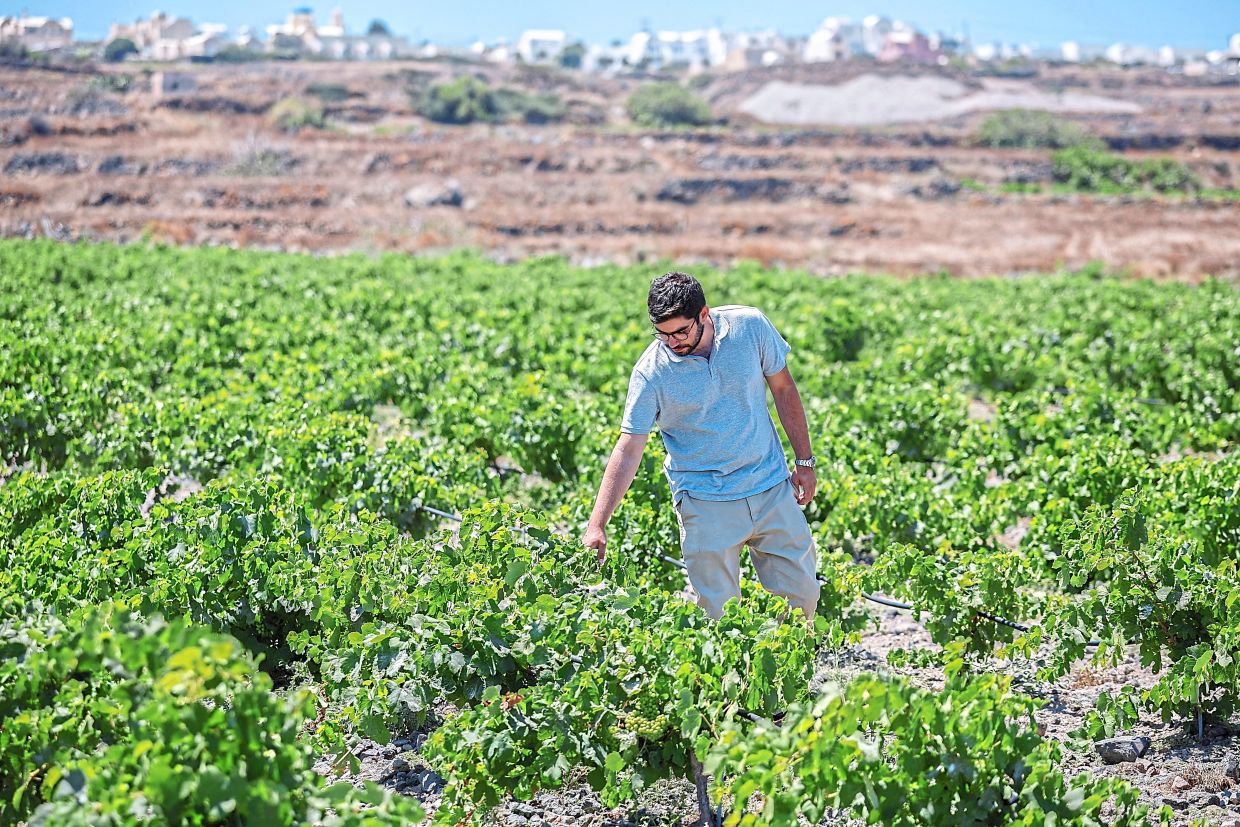
The ancient terraced vineyards of Santorini, which have produced distinctive wines for centuries, face an unprecedented challenge as consecutive years of extreme heat and dwindling rainfall threaten the viability of the island's most celebrated agricultural heritage. Winemaker Yiannis Boutaris, representing the sixth generation of his family's winemaking tradition at Domaine Sigalas, now confronts a stark reality: a 90-year-old vine trained in the traditional basket shape—a technique designed to shield grapes from the Mediterranean sun—has succumbed entirely to the combined stress of heat and moisture depletion. This loss encapsulates a broader crisis unfolding across the island as climate patterns shift dramatically, with temperatures soaring to 60-year highs between 2023 and 2025 and precipitation reaching dangerously low levels.
The environmental pressure on Santorini's wine sector extends beyond mere crop stress. Rising temperatures and erratic rainfall have triggered a cascade of economic disruptions: grape prices have climbed sharply, overall wine production has contracted significantly, and the island's already strained freshwater supplies face mounting competition from tourism infrastructure and household consumption. For a region where viticulture has been central to identity and livelihoods for millennia, these changes represent an existential threat requiring fundamental rethinking of farming practices. The crisis is not isolated to Greece—it signals a broader vulnerability across Mediterranean wine regions as climate change progressively narrows the climatic envelope within which premium wine production remains feasible.
Instead of abandoning their ancestral craft, however, Santorini's leading producers are engaging in a deliberate process of adaptation, combining traditional knowledge with cutting-edge environmental technology. Boutaris and his peers have launched several experimental initiatives in collaboration with local government authorities and academic scientists. The most ambitious of these involves capturing and treating wastewater from residential buildings and hospitality establishments—a resource that would otherwise strain municipal infrastructure—and redirecting it for vineyard irrigation. This approach, already proven viable in California's wine regions, offers dual benefits: it reduces pressure on the island's freshwater aquifers while eliminating the prohibitive energy and financial costs associated with desalination facilities, which currently represent the primary alternative source for supplemental irrigation.
Beyond wastewater recycling, Santorini's winemakers are experimenting with spatial reorganisation of their vineyards. The traditional scattered planting pattern, while aesthetically distinctive and culturally embedded, proves inefficient when water must be conserved and carefully distributed. By transitioning to row-based cultivation systems, growers can implement targeted irrigation that minimises waste through evaporation and runoff. This structural shift challenges centuries of accumulated practice, yet represents a pragmatic concession to new environmental constraints. Such modifications require significant capital investment and carry uncertain outcomes, reflecting the genuine risk that accompanies agricultural innovation under climate stress.
Among the more innovative adaptations being piloted on the island is atmospheric water harvesting—a technology that captures moisture present in the air using hydrogel compounds, then releases that water through heat supplied by solar photovoltaic panels. While still in experimental phases, this approach holds particular promise for Mediterranean climates where, despite low rainfall, ambient humidity remains substantial. The technology exemplifies how renewable energy and advanced materials science can address water scarcity without depleting finite groundwater reserves. For Santorini specifically, solar resources are abundant, making the energy component of this system especially feasible and cost-effective compared to island communities dependent on imported fuel.
Winemaker Yiannis Papaeconomou represents another cohort of producers adapting through subsurface irrigation techniques. By delivering water directly to root zones through buried drip systems rather than overhead spraying, this method dramatically reduces evaporative losses—a critical advantage in an arid climate experiencing increasingly intense solar radiation. Papaeconomou is simultaneously integrating improved trellising systems that optimise canopy structure for water efficiency. These complementary measures reflect a holistic approach to vineyard management where multiple small interventions compound to achieve meaningful resource conservation.
The challenge facing Santorini's wine industry cannot be divorced from the broader competition for scarce water resources across the island. During peak tourism seasons, when hundreds of thousands of visitors arrive to experience the island's famous sunsets and white-washed villages, demand for freshwater escalates dramatically. Hotels, swimming pools, restaurants, and residential properties all vie with agricultural producers for limited supplies. This competition intensifies as water tables drop and traditional sources prove insufficient. The seasonal nature of this demand—with summer tourism coinciding precisely with the growing season's greatest water requirements—creates acute resource management dilemmas for island authorities.
The broader Mediterranean region, particularly southern Europe, faces similar pressures as climate patterns shift poleward and summer drought seasons extend. Stefanos Koundouras, a viticulture professor at Aristotle University of Thessaloniki, has documented how recent conditions represent the most extreme in living memory. His research indicates that without significant adaptation, the European wine sector—especially producers in iconic regions surrounding the Mediterranean—risks sustained deterioration in both yield and quality. The distinctive character that defines terroir—the complex interaction of climate, soil, and geography that gives wines their regional signature—becomes increasingly difficult to maintain when temperature and precipitation regimes shift beyond historical norms.
The economic implications extend throughout Greece's wine industry hierarchy. Northern regions, where temperatures remain relatively moderate and rainfall more consistent, currently produce grapes at approximately €0.80 per kilogram. Santorini's prices, meanwhile, have risen sharply due to scarcity and the added costs of innovative water sourcing. This price differential incentivises producers to seek alternative irrigation solutions rather than abandon production entirely, creating market dynamics that favour innovation. However, the sustainability of premium pricing depends on maintaining quality standards; if climate stress degrades grape characteristics sufficiently, even higher prices cannot sustain demand from discerning consumers and international markets.
The initiatives underway on Santorini should be understood not merely as technical solutions but as expressions of cultural persistence. Winemaking families operating across multiple generations view their craft as inseparable from their identity and their island's heritage. The adaptive measures being implemented—wastewater recycling, atmospheric harvesting, reorganised planting patterns—represent deliberate choices to preserve continuity rather than surrender to environmental change. Yet these adaptations also acknowledge that preservation of tradition in its original form is no longer feasible; instead, tradition must evolve to accommodate new circumstances while maintaining essential character.
For Malaysia and Southeast Asia, Santorini's experience offers instructive lessons about climate vulnerability in agricultural sectors seemingly remote from tropical concerns. Many Southeast Asian specialty crops—particularly spice cultivation, premium tea production, and emerging wine industries in highland regions—face comparable pressures from erratic precipitation and shifting temperature patterns. The technological and institutional approaches being piloted in Greece—particularly wastewater treatment systems, solar-powered water harvesting, and collaborative arrangements between farmers, government, and research institutions—provide practical models adaptable to regional contexts. As climate change progresses, agricultural societies throughout Asia will increasingly confront analogous choices between abandoning traditional production or fundamentally reimagining practices while preserving cultural and economic continuity.

