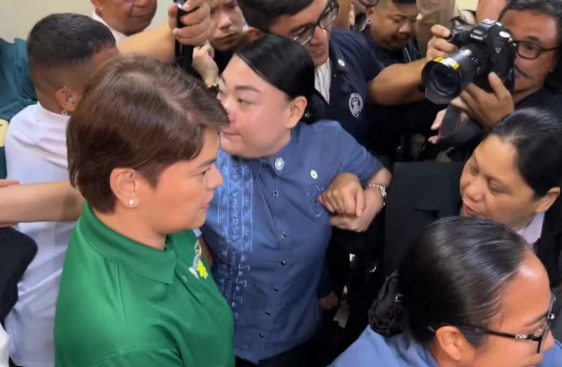
Vice President Sara Duterte arrived at the Philippine Senate on Tuesday to meet with her legal team, using the occasion to reaffirm her commitment to weathering an impeachment process she has repeatedly characterised as a "bloodbath." In remarks delivered to reporters, Duterte declared that "in this bloodbath and bludgeoning, I will be bloodied but unbowed," a formulation that echoes the resolute tone of William Ernest Henley's celebrated poem "Invictus," which explores themes of perseverance and steadfastness against overwhelming odds. The Vice President's invocation of this literary reference appears designed to position herself as a figure of principled resistance, defiant in the face of institutional pressure.
Duterte's most recent comments mark a continuation of rhetorical positioning she initiated in May 2025, when she first expressed a desire to proceed with impeachment proceedings, framing them explicitly as a "bloodbath." At that time, her language seemed to suggest appetite for confrontation, yet this characterisation has drawn considerable scrutiny from political opponents and commentators who have questioned the sincerity of her embrace of the trial process. This scepticism has been fuelled by her noticeably absent presence during House impeachment hearings conducted across 2025 and 2026, a pattern of non-engagement that stands in stark contrast to her current assertions of willingness to fight.
The Vice President confronts a formidable array of criminal and administrative allegations encapsulated within four separate Articles of Impeachment. The first charge concerns the alleged misappropriation of significant public funds—specifically P612.5 million that was drawn from confidential expenditure accounts maintained by the Office of the Vice President and the Department of Education, with the latter accounting for P112.5 million of the total sum. These funds are at the heart of broader questions about the transparency and proper accounting of executive discretionary spending in the Philippines.
Article II targets Duterte's financial disclosures and personal wealth accumulation, alleging that she failed to accurately report assets across multiple Statements of Assets, Liabilities and Net Worth spanning the years 2022 to 2024. Accompanying this charge is an assertion that she maintained undivested business interests despite regulatory obligations to do so, raising questions about potential conflicts of interest and the governance standards expected of high-ranking officials. The unexplained wealth component of this article reflects broader concerns about asset accumulation among Philippine public servants.
The third article addresses alleged connections between the Vice President and irregularities in procurement processes at the Department of Education, with accusations involving bribery and improper conduct by education officials. This dimension of the impeachment inquiry extends beyond Duterte herself to examine the network of administrative relationships and decision-making processes within her sphere of influence during her tenure as Education Secretary, a position she held before ascending to the vice presidency.
Most gravely, Article IV contains allegations of assassination threats directed toward President Ferdinand Marcos Jr., First Lady Liza Araneta-Marcos, and former House Speaker Martin Romualdez. Such charges, if substantiated, would represent not merely administrative malfeasance but conduct potentially threatening to national security and political stability. These accusations emerged following a period of public tension between Duterte and the administration, marked by escalating rhetoric from both sides.
The impeachment trial structure under the Philippine constitutional framework demands a conviction threshold of at least two-thirds of all senator-judges, a standard reflecting the gravity with which the 1987 Constitution treats the removal of a sitting vice president. The proceeding is anticipated to consume approximately 92 days of Senate time, a duration that would extend the trial well into early 2027 and consume a substantial portion of the legislative calendar. This extended timeline will test the endurance of both the prosecution and defence teams, whilst maintaining public attention on the proceedings.
For Malaysian observers and Southeast Asian analysts, the Duterte impeachment presents instructive lessons regarding institutional resilience and checks on executive power in the region. The Philippine Senate's willingness to proceed with formal impeachment of a sitting vice president, despite the political costs and potential for destabilisation, demonstrates the persistence of constitutional mechanisms in democracies facing internal strain. The trial's progression will likely influence perceptions of institutional integrity across Southeast Asia, where questions about the robustness of formal oversight mechanisms remain contested.
The extended duration of the trial also raises practical governance questions about the functioning of the Office of the Vice President during proceedings, and the broader political climate during an extended period of executive uncertainty. In a region where institutional stability and predictable governance frameworks significantly influence investor confidence and regional cooperation, the outcome and conduct of this trial may reverberate beyond the Philippines' borders. Malaysia and other ASEAN nations will be watching how the system manages what amounts to a fundamental constitutional stress test, particularly given the Philippines' historical importance as a democratic anchor in Southeast Asia.

