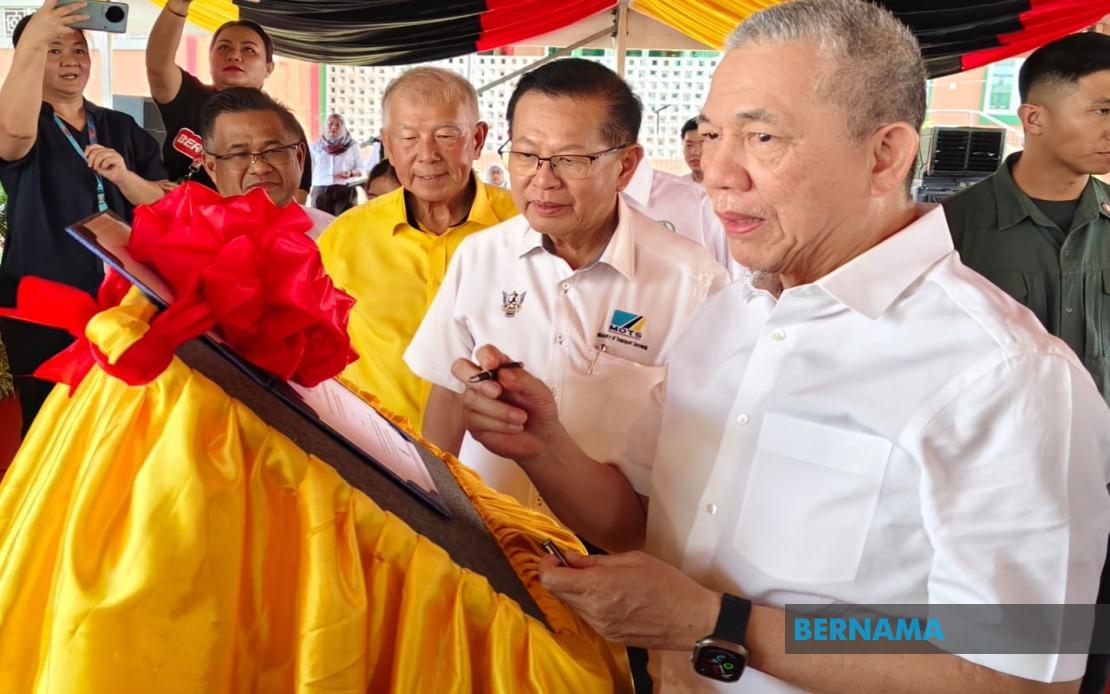
Deputy Prime Minister Datuk Seri Fadillah Yusof has unveiled an ambitious programme to strengthen Sarawak's defences against natural disasters, approving 52 projects under the Cakna MADANI initiative worth RM9.46 million this year alone. The announcement underscores the federal government's commitment to protecting one of Malaysia's most vulnerable states from the twin threats of coastal and riverbank erosion alongside recurring flood events that threaten lives and livelihoods across the region.
The scale of implementation reveals a phased approach to infrastructure delivery. Among the 52 approved projects, completion figures already show tangible progress: 12 have reached finality, 13 are actively under construction, and 27 remain in preparatory stages. This distribution indicates a realistic timeline for deployment rather than concentrated activity, allowing for quality assurance and community integration at each site. The staggered approach also distributes budgetary demands across fiscal periods and permits accumulated learning from early phases to inform subsequent projects.
Fadillah, who also holds the portfolio of Energy Transition and Water Transformation Minister, inspected the Riverbank Stabilisation Project at the Tab Cinaq Cemetery in Miri District during his visit to the state. This particular initiative, budgeted at RM134,682, represents the granular focus of the programme on protecting specific community assets and infrastructure. The project involves constructing a 50-metre retaining wall designed to arrest riverbank deterioration, a critical intervention given the cemetery's cultural significance and the proximity of nearby residential and public facilities that face mounting risk from seasonal water movement.
The timeline for the Tab Cinaq project, running from May through November, illustrates the seasonal considerations that shape implementation schedules in Sarawak. The completion window aligns with the transition period before monsoon patterns intensify, a strategic choice reflecting local hydrological knowledge. Miri, located in the northern coast of Sarawak, experiences significant tidal and rainfall variations that demand precise scheduling to maximise construction efficiency whilst minimising exposure to adverse weather conditions.
Looking beyond immediate interventions, the government has approved 29 comprehensive flood mitigation schemes encompassing a spectrum of approaches: the Flood Mitigation Plan (RTB), High Priority Flood Mitigation (TBBT) initiatives, coastal erosion management systems, and river conservation infrastructure. The combined budget of RM3.834 billion positions these investments as strategic long-term commitments rather than emergency responses, reflecting a transition towards proactive disaster prevention rather than reactive crisis management.
The composition of the 29-project portfolio reveals the distinction between continuation and new initiatives. Eighteen continuation projects, requiring RM3.567 billion cumulatively, represent sustained engagement with previously identified problem areas where earlier assessments have validated ongoing need. The 11 new projects, valued at RM267 million, suggest either emerging vulnerability zones identified through recent monitoring or previously unaddressed areas now elevated in priority due to changing environmental conditions or population shifts.
The Sungai Miri flood mitigation initiative exemplifies the scale and timeline of major undertakings within this framework. As a continuation project carrying a RM31 million tag, it began construction in October 2023 and has achieved 58.11 percent physical completion. The projected November 2026 finish date indicates a three-year development cycle for flagship interventions, reflecting the engineering complexity and procurement processes inherent in major infrastructure works across the Malaysian construction sector.
Sarawak's exposure to erosion and flooding stems from its geographical positioning as a coastal and riverine state with significant precipitation and tidal influences. The Rejang River, Malaysia's longest, carries enormous seasonal water volumes, whilst coastal zones face saltwater intrusion and storm surge pressures. Urban expansion in vulnerable areas has increased population density in flood-prone localities, elevating the economic and human stakes of mitigation failures. These structural vulnerabilities explain why Sarawak consistently features prominently in national disaster management discussions and why proportionally substantial budgetary allocations flow toward the state.
The Cakna MADANI programme itself represents a broader political commitment to participatory development, with the word MADANI referencing Malaysia's civilisational aspirations enshrined in government messaging. By anchoring erosion and flood projects within this framing, authorities link infrastructure investment to foundational concepts of societal advancement and inclusive prosperity. Communities benefit materially from stabilised riverbanks and protected settlements whilst also receiving symbolic validation that their welfare constitutes a matter of national developmental importance.
For Malaysian policymakers and regional observers, the Sarawak initiative carries implications extending beyond state boundaries. As Southeast Asia confronts climate volatility and intensifying weather patterns, the systematic approach demonstrated here—combining immediate localised interventions with decade-long strategic programmes, integrating continuation and innovation, and coordinating multiple mitigation modalities—offers a replicable template. Other Malaysian states facing analogous challenges, alongside neighbouring jurisdictions managing similar hydrological pressures, can observe and potentially adapt methodologies developed through Sarawak's experience.
The investment magnitude also reflects confidence in Sarawak's role within Malaysia's developmental trajectory. By committing billions to protective infrastructure, federal authorities signal faith in the state's economic and social future worth defending. This contrasts sharply with scenarios where disaster risk receives minimal investment, effectively writing off vulnerable populations. The budgetary commitments to Sarawak thus carry messages about state-federal relationships and governmental obligations toward all regions, regardless of political history or electoral configurations.
Moving forward, execution quality will determine whether these projects deliver promised resilience. Construction timelines, material specifications, and maintenance protocols require rigorous oversight to ensure that completed works function as designed across decades of operational life. Community engagement in project identification and implementation can enhance ownership and stewardship, particularly for localised interventions like the Tab Cinaq stabilisation where cemetery users and neighbouring residents possess irreplaceable contextual knowledge about environmental dynamics and infrastructure requirements.

