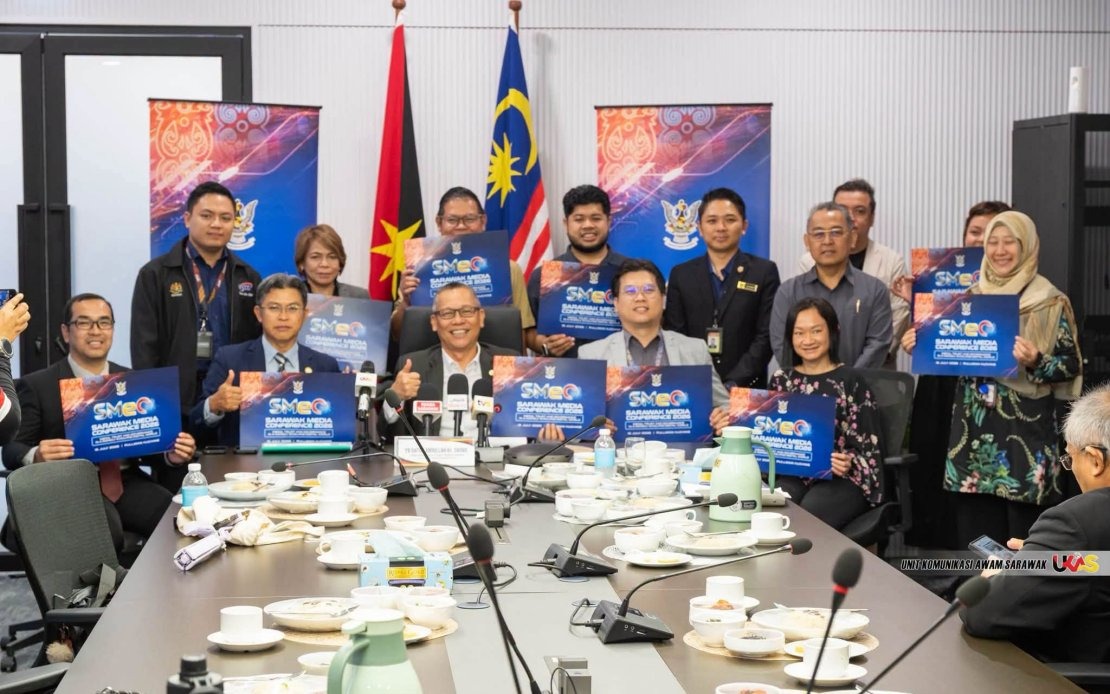
Sarawak's upcoming media conference promises to be a significant gathering of industry stakeholders grappling with fundamental questions about journalism's future in an increasingly digital landscape. The Sarawak Media Conference (SMeC) 2026, scheduled for Thursday in Kuching, is anticipated to attract roughly 800 attendees spanning the full breadth of communications sectors—from practising journalists and media organisations to university researchers, government officials, technology companies and student journalists keen to understand their profession's trajectory.
Organised under the auspices of the Sarawak Government through its Public Communications Unit (UKAS), the conference has been configured around a thematic focus on the interconnected challenges of media credibility, institutional accountability and technological disruption. Sarawak Premier Tan Sri Abang Johari Tun Openg will formally open proceedings, underscoring the political significance attached to addressing these concerns at the highest levels of state governance. The choice of opening speaker reflects recognition that media policy and digital regulation are no longer peripheral matters but central to modern governance frameworks.
The substantive agenda, as outlined by Datuk Abdullah Saidol, Deputy Minister in the Sarawak Premier's Department overseeing corporate affairs and communications, will concentrate on two interconnected pillars. First, participants will examine mechanisms for rebuilding and sustaining public confidence in media institutions at a time when trust metrics are deteriorating across much of Southeast Asia and globally. Second, the conference will probe how regulatory and ethical frameworks should evolve to accommodate artificial intelligence, algorithmic content distribution and other transformative technologies reshaping the information ecosystem.
The timing of this conference carries particular relevance for Malaysia and the broader Southeast Asian region. Trust in traditional media institutions has been eroded by prolonged political turbulence, the proliferation of misinformation on social platforms and shifting consumption patterns among younger audiences who increasingly source news from unvetted online channels. By assembling Malaysia's media community to discuss these challenges systematically, Sarawak is positioning itself as a thought leader in addressing what has become a critical infrastructure question for democratic societies.
The programme will feature prominent voices from Malaysia's media and technology sectors. Lunnie Gan, founder of SOL Digital, and Premesh Chandran, deputy chairman of the Malaysian Media Council (MMC), are among the confirmed speakers. These particular selections suggest the conference organisers view the challenge as requiring both innovative technological perspectives and established frameworks for journalistic standards and self-regulation. The inclusion of academics alongside industry practitioners indicates an intention to ground discussions in research evidence rather than anecdotal claims about media performance and digital transformation.
Beyond the primary conference programming, associated events will extend the conversation into the evening. A dinner coordinated with Sarawak's observance of National Journalists' Day (HAWANA) 2026 will feature Deputy Prime Minister Datuk Seri Fadillah Yusof, further elevating the national profile of these discussions and suggesting federal-level engagement with the agenda being set in the state capital. This parallel event provides opportunity for informal networking and relationship-building among media leaders and government figures.
The conference will also serve as the venue for recognising outstanding media practitioners through the Sarawak Premier's Special Appreciation Awards, distributed across five professional categories reflecting the modern media landscape's diversification. Awards will be presented to editors, journalists and field reporters; photographers; videographers; radio broadcasters; and social media influencers. This multi-category approach acknowledges that journalism and media influence now extend far beyond traditional newsroom hierarchies, encompassing visual storytellers, audio practitioners and digital creators whose work shapes public discourse and information flows.
The presence of influencers among award categories is particularly noteworthy for what it signals about evolving definitions of media responsibility and influence in Malaysia. As social media platforms increasingly function as primary news sources for significant population segments, the question of how ethical standards and accountability mechanisms apply to non-institutional content creators has become unavoidable. By formally recognising social media influencers in a professional awards ceremony, the Sarawak Government is implicitly endorsing the notion that these actors bear some responsibility for information quality and public benefit, not merely commercial engagement metrics.
For Malaysian communications professionals more broadly, the conference represents an opportunity to engage with peers facing genuinely novel regulatory and ethical challenges. The integration of artificial intelligence into content creation, curation and distribution is moving at pace, yet professional norms and legal frameworks have not evolved commensurately. Discussions about how newsrooms should deploy AI tools while maintaining journalistic integrity, how algorithms should be audited for bias, and how media organisations can retain public trust while adapting to digital economics are urgent questions without settled answers.
The Sarawak Media Conference 2026 also reflects growing recognition that media challenges transcend individual states and demand coordinated responses across Malaysia's federal structure. By hosting this gathering, Sarawak contributes to the national conversation about how journalism can remain vital in an age of information abundance and technological transformation. The lessons generated from discussions in Kuching will likely inform media policy discussions at federal level and among regional counterparts facing similar pressures.
Ultimately, the conference embodies an implicit recognition that media systems are not self-regulating or naturally resistant to degradation. Maintaining institutional health requires deliberate effort—investment in professional training, clarity about ethical boundaries, constructive dialogue between media and government, and systematic engagement with technological change. By assembling 800 stakeholders to focus intensely on these questions, Sarawak is demonstrating that states can play meaningful roles in shaping Malaysia's media future, even within a federalised governance structure. The outcomes and conversations emerging from this event will merit close attention from media practitioners, policymakers and citizens concerned about information quality across Malaysia.

