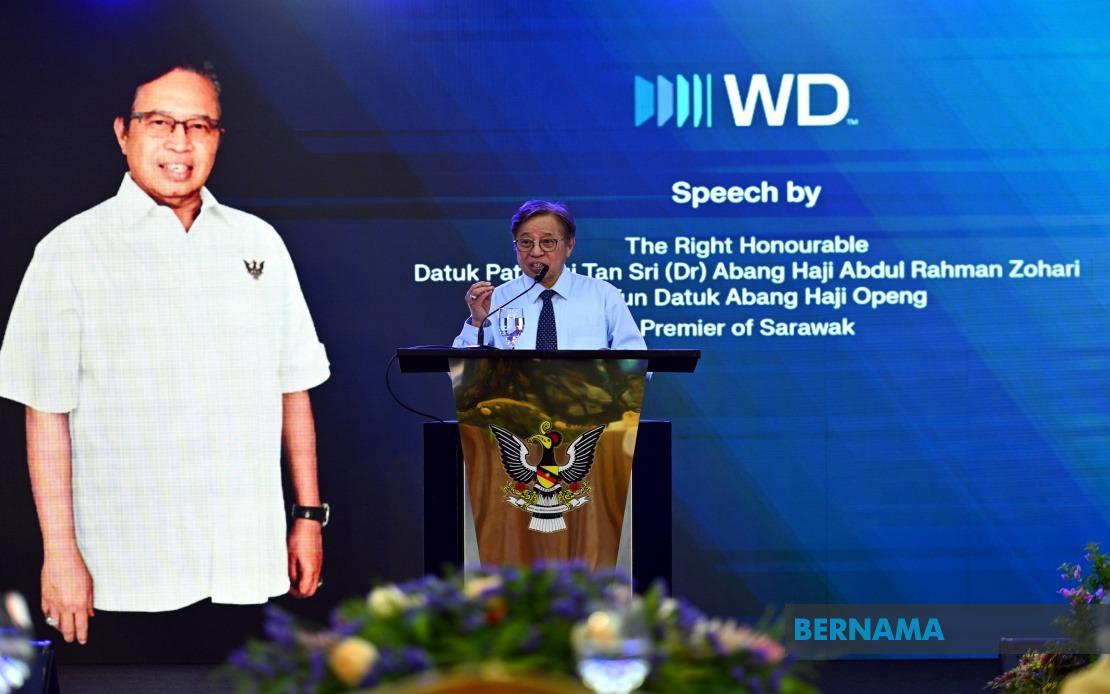
Sarawak's leadership has signalled measured openness to discussions on enhancing the state's special grant allocation under Article 112D of the Federal Constitution, provided such an increase aligns with Putrajaya's budgetary constraints. Speaking in Kuching on July 2, Premier Tan Sri Abang Johari Tun Openg adopted a pragmatic stance, emphasizing that any boost to the grant should proceed only if the Federal Government possesses the fiscal room to accommodate it without compromising national financial stability.
Abang Johari's measured response reflects a delicate political balance. While signalling Sarawak's willingness to engage in conversations about additional funding, he simultaneously acknowledged the realities of federal budgeting pressures, suggesting that the state leadership understands the Centre's constraints. His comment that Sarawak would "welcome" an increase but "understand" if the Federal Government cannot afford it signals neither outright demands nor complete acceptance of the status quo, positioning the state as a reasonable negotiating partner in ongoing fiscal discussions with Kuala Lumpur.
The Premier disclosed that substantive negotiations on the matter have not yet commenced. Although the topic of enhanced special grant allocations was broached during a recent meeting with Prime Minister Datuk Seri Anwar Ibrahim in Bintulu, the conversation remained at a preliminary level without detailed technical discussions or specific proposals. This suggests that both Sarawak and the federal administration are still in the exploratory phase, gathering information and assessing feasibility before committing to formal negotiations.
Prime Minister Anwar had previously informed Parliament on June 30 that talks regarding Sarawak's special grant continue to progress within the framework of the Malaysia Agreement 1963, commonly referred to as MA63. This constitutional instrument remains the foundation for discussions between Kuala Lumpur and Sarawak, underscoring the historical and legal context within which contemporary fiscal arrangements between the federal and state governments operate. The invocation of MA63 carries symbolic weight in Sarawak, representing the state's distinct constitutional standing within Malaysia.
For Malaysian and Southeast Asian observers, the unfolding discussion touches on broader questions of federal-state relations and resource distribution within a diverse federation. Sarawak, as one of Malaysia's largest and most resource-rich states, has historically maintained a particular emphasis on its autonomy and the terms of union established in 1963. Any adjustment to its special grant must be understood against this backdrop of Sarawak's distinct political and constitutional position within the Malaysian federation.
Beyond fiscal matters, Abang Johari used the occasion to underscore Sarawak's strategic positioning in the global technology sector. During the New Horizon for Western Digital programme, he highlighted the three-decade partnership between the state and Western Digital, a relationship that exemplifies how Sarawak's natural endowments translate into competitive advantages in attracting high-technology investment. The state's abundant renewable energy resources and substantial water supplies provide the infrastructural foundation that technology manufacturers require, particularly those engaged in energy-intensive data storage operations.
The Premier articulated a forward-looking vision in which data storage capacity becomes an economic driver comparable to or potentially surpassing oil revenues. This strategic pivot reflects recognition that Sarawak's long-term prosperity depends less on hydrocarbon extraction—a finite resource subject to price volatility—and more on positioning itself as a hub for digital infrastructure within the Asia-Pacific region. The development of glass substrate technology for data storage represents precisely this type of high-value manufacturing capability that Sarawak seeks to cultivate.
Western Digital's investment in glass substrate-based recording technology carries particular significance in an era of accelerating artificial intelligence deployment and exponential data growth. Glass substrate technology enables substantially greater data storage density compared to conventional materials, addressing the infrastructure demands of AI-driven systems and cloud computing platforms. For Sarawak, securing and expanding such investments represents a pathway to economic resilience and technological sophistication beyond traditional resource extraction.
The convergence of fiscal negotiations and technology sector development reveals how contemporary state-level governance in Malaysia operates across multiple domains simultaneously. Sarawak leadership must simultaneously manage federal relations, fiscal arrangements, and economic diversification strategies. The state's openness to technology sector partnerships, combined with its measured approach to special grant discussions, reflects a comprehensive development strategy that encompasses both historical entitlements and forward-looking economic positioning.
From a Southeast Asian perspective, Sarawak's trajectory toward technology-centric economic development mirrors patterns visible across the region, where nations and subnational entities compete for investment in digital infrastructure. The state's natural advantages—energy abundance and geographic positioning—position it competitively within regional supply chains for data center operations and semiconductor-adjacent manufacturing. The Western Digital partnership exemplifies how established foreign investors can serve as anchors for broader technology ecosystems.
The timing of these discussions also matters contextually. As Malaysia navigates broader fiscal challenges and economic restructuring, conversations about special grants and state-level funding necessarily occur within constraints that did not exist during periods of higher federal revenues. Both the state and federal governments face pressure to prioritize spending, making any expansion of special grant allocations a politically sensitive undertaking that requires careful calibration and demonstrated capacity.
Looking forward, the outcome of Article 112D negotiations will likely depend on multiple variables: the trajectory of federal revenues, competing demands from other states and federal programmes, and the strength of Sarawak's negotiating position. Abang Johari's pragmatic framing suggests Sarawak is unlikely to pursue aggressive demands that could strain federal-state relations, preferring instead a collaborative approach grounded in mutual understanding of fiscal realities. This measured approach may ultimately prove more effective in securing incremental improvements than confrontational positioning would achieve.

